

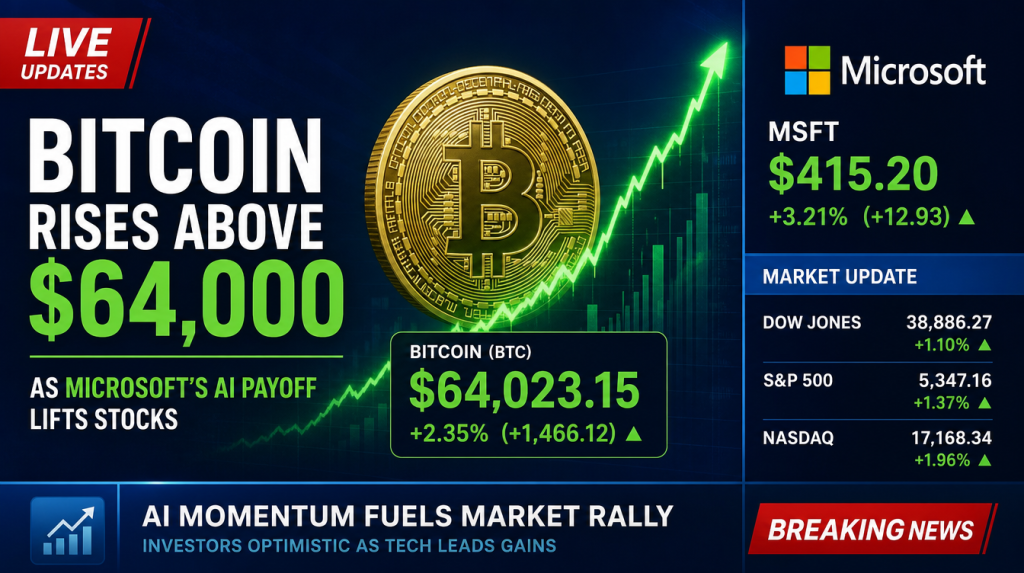
Nasdaq 100 futures climbed 1.5%, led by Microsoft, which jumped 8% in premarket trading after its cloud division posted its strongest growth in four years while maintaining disciplined spending.
Markets received slightly encouraging inflation data. The Core Personal Consumption Expenditures (PCE) Price Index for June increased by just 0.1%, below expectations of 0.2% and down from May’s 0.3% rise.
On an annual basis, core PCE rose 3.3%, matching forecasts and easing from 3.4% the previous month.
Although the PCE index is a key inflation measure for the Federal Reserve, the data reflects June, with the calendar about to move into August.
Elsewhere, the initial estimate for second-quarter GDP growth came in at an annualized 1.5%, missing the 2.1% forecast. Jobless claims remained low but edged up to 197,000 from 188,000 the week prior.
Markets showed little reaction overall. Bitcoin edged up slightly to $64,800, while Nasdaq futures gained 1.7%, supported by Microsoft’s roughly 10% surge following its earnings report.
Bond yields rose modestly as investors continued to process the Fed’s decision to hold rates steady and comments from Chairman Kevin Warsh.
In crypto developments, decentralized lending platform Aave is considering exiting six blockchains—Sonic, Scroll, zkSync, Metis, Soneium, and Aptos—after revenue from these deployments fell below operating costs.
The proposal involves $98.1 million in supplied assets and $15.6 million in outstanding debt, with the affected chains accounting for $12.8 million in deposits and $4.1 million in debt. Deposits have sharply declined, with Sonic dropping 74% to $7.6 million and Scroll down 86% to $2.2 million over six months.
Aave plans to halt new activity, lower borrowing and supply limits, and increase interest rates to encourage users to withdraw funds and repay loans, as each network generates less than $5,000 in revenue.
Meanwhile, the Bank of England held its benchmark interest rate at 3.75%, citing a faster-than-expected drop in inflation to 2.6%. However, it warned inflation could rise again later this year due to elevated energy prices linked to tensions in the Middle East.
The decision passed with a 6–3 vote, with dissenting members favoring a rate hike to 4%, compared to a 7–2 split at the previous meeting.
In bond markets, the inflation-adjusted yield on the U.S. 30-year Treasury approached 3% for the first time since 2008, meaning investors are earning nearly 3% above inflation. This increases the opportunity cost of holding assets like gold, bitcoin, or tech stocks that do not generate yield.
A continued rise in real yields could therefore weigh on risk assets.
The U.S. Dollar Index fell to 100.67 despite the Fed’s “hawkish hold” on interest rates, extending its prior decline. At the same time, longer-term yields continued to rise, with the 30-year yield reaching 5.24%, its highest level since 2007.
A weaker dollar tends to support bitcoin, while higher yields can act as a headwind.
Bitcoin traded around $63,900 on Thursday, slightly lower, as stock futures moved higher on strong Microsoft earnings that reassured investors that heavy spending on AI is beginning to deliver results.
S&P 500 futures rose 0.2% and Nasdaq 100 futures gained 0.4% after a recent correction. Microsoft’s strong performance signaled that AI investments are generating growth without significantly increasing costs—contrasting with Alphabet’s recent spending outlook that unsettled markets.
Bitcoin has closely followed this trend, moving in line with AI and semiconductor stocks rather than crypto-specific factors.
About The Author





More Stories
CFTC Warns Prediction Platforms of Manipulation Risks in ‘Mention Markets’
Lummis Says Trump Opposition Helped Derail Crypto Clarity Act
XRP Ledger Retries Upgrade Designed to Split Payments and Compliance Roles