

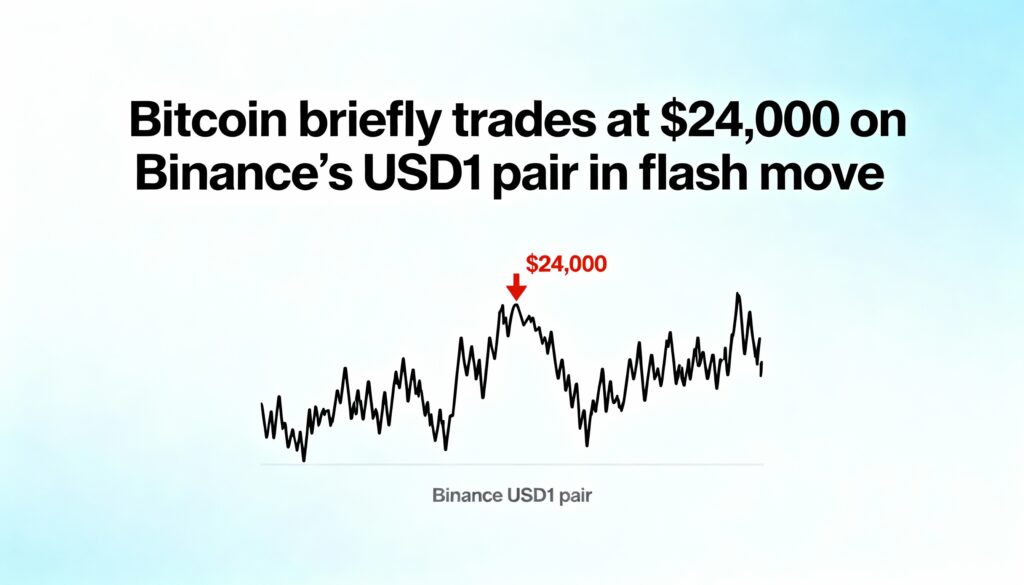
Abrupt price dislocations typically stem from thin liquidity and are more likely to occur during low-activity trading periods.
Bitcoin briefly plunged to $24,111 on Binance late Wednesday, forming a sharp downward wick on the BTC/USD1 pair before rapidly rebounding above $87,000 within seconds, exchange data shows. The move did not appear on other major bitcoin trading pairs and was confined to USD1, a stablecoin issued by Trump family-backed World Liberty Financial.
Prices on the pair later stabilized, with bitcoin returning to levels consistent with the broader market.
These sudden “wick” events are commonly attributed to shallow order books or, in some cases, temporary pricing or display errors, rather than reflecting a broader market breakdown. Newly introduced or lightly traded stablecoin pairs often lack deep liquidity, as fewer market makers are actively quoting tight spreads.
In such environments, a single sizable market order, liquidation, or automated trade routed through the pair can rapidly exhaust available bids, causing prices to momentarily print far below the true market level until buyers step back in.
Additional factors such as spread widening, faulty liquidity-provider quotes, or trading algorithms responding to abnormal price prints can intensify the move. The effect is often amplified during quieter hours, when reduced participation limits the market’s ability to quickly normalize prices.
Despite their dramatic appearance on charts, traders typically interpret these prints as microstructure anomalies rather than signals about bitcoin’s underlying direction. Nonetheless, the incident highlights the execution risks associated with thinly traded pairs, particularly when liquidity in newer stablecoins or trading routes is still developing.
About The Author



More Stories
Crypto heavyweight rolls out oil trading, diverging from Hyperliquid’s perps model.
Bitcoin holds above $71,000 as oil slips under $100 on U.S. 15-point Iran peace proposal.
Robinhood expands share repurchase program to $1.5 billion amid ongoing stock decline