

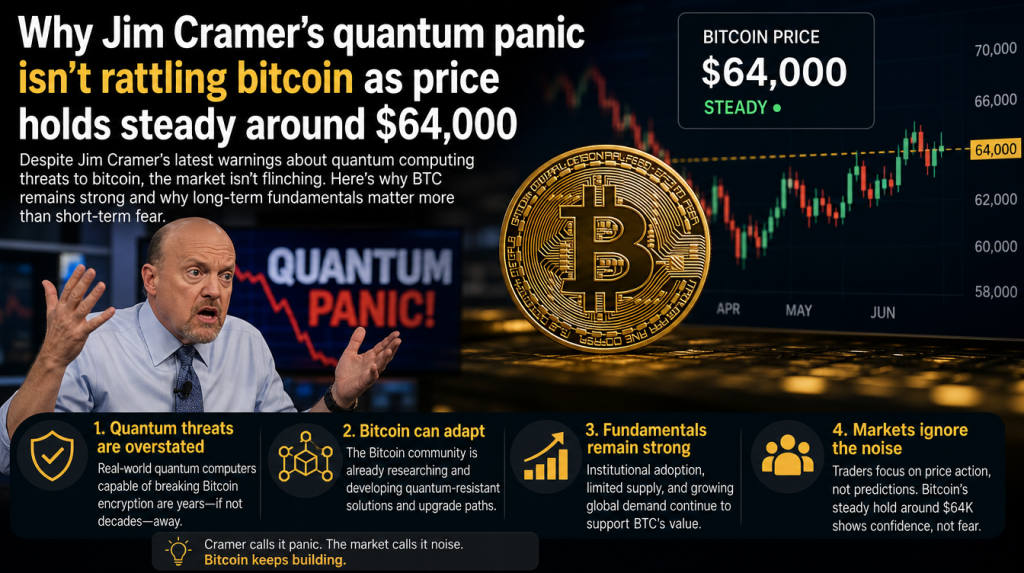
Jim Cramer’s decision to sell his bitcoin holdings over concerns about quantum computing has sparked a positive reaction from parts of the crypto community, largely because of his history of controversial market predictions.
The “Mad Money” host revealed that he intends to exit his bitcoin position after warning that advances in quantum technology could pose a threat to cryptocurrencies within the next three to four years.
His comments came after a July 31 interview with IBM Chairman and CEO Arvind Krishna, who told Cramer that quantum computers could eventually challenge current cryptographic systems within that timeframe. Krishna advised investors to remain cautious about the potential risks.
The actual size of Cramer’s bitcoin holdings remains unknown. No wallet addresses linked to him have been identified or tracked by blockchain analytics firms, making it impossible to independently confirm whether he owns BTC or has begun selling any holdings.
Despite Cramer’s bearish outlook, some crypto investors welcomed the announcement, viewing his exit as a potential bullish signal.
“Jim Cramer did it again. Bitcoin just received the strongest buy signal of 2026,” one self-described bitcoin maximalist wrote on X.
Others echoed similar views, while bitcoin continued to hold steady near $64,000 despite recent market concerns, including the Coldcard wallet exploit and rising bond yields.
The “Inverse Cramer” Effect
The crypto community’s reaction is closely tied to Cramer’s reputation as a market contrarian. The so-called “inverse Cramer” strategy — betting against his public market calls — became a widespread meme and even inspired the launch of the Inverse Cramer Tracker ETF (SJIM) in 2023. The fund was designed to short stocks based on his recommendations but was closed in early 2024 after failing to attract significant investor interest.
Cramer’s reputation has been shaped by several notable reversals and inaccurate market predictions.
In December 2017, as bitcoin approached its first major rally toward $20,000, Cramer dismissed the asset as “monopoly money” and argued that buying it was speculation rather than investing. By September 2020, however, he reportedly purchased bitcoin near $10,000 following a discussion with investor Anthony Pompliano and later increased his exposure.
His stance shifted again in June 2021 when he sold most of his bitcoin holdings, citing China’s crackdown on crypto mining. Bitcoin later surged to an all-time high near $70,000 in November of that year.
In early 2024, Cramer predicted a major bitcoin decline after the launch of U.S. spot bitcoin ETFs. Although BTC briefly fell toward $40,000, the expected deep sell-off failed to materialize, and the asset recovered to around $70,000 by March.
By January 2025, Cramer had changed his position again, describing bitcoin as a valuable portfolio asset and encouraging investors to hold BTC directly rather than gain exposure through companies such as Strategy that hold bitcoin on their balance sheets.
His outlook turned negative once more last month when he described bitcoin and gold as “bad money” being sold in favor of growth-focused assets such as SpaceX, Apple, and Nvidia. Now, in August 2026, he is preparing to leave the market entirely.
Cramer’s most criticized recent call, however, came outside crypto. In February 2023, he told viewers that Silicon Valley Bank was undervalued and said concerns surrounding the bank were misplaced. Just weeks later, SVB collapsed in what was then the second-largest bank failure in U.S. history.
For now, bitcoin’s price action suggests investors are not reacting strongly to Cramer’s quantum computing concerns. BTC has remained resilient near $64,000 despite both the Coldcard security incident and Strategy’s recent bitcoin sales.
About The Author





More Stories
CFTC Warns Prediction Platforms of Manipulation Risks in ‘Mention Markets’
Lummis Says Trump Opposition Helped Derail Crypto Clarity Act
XRP Ledger Retries Upgrade Designed to Split Payments and Compliance Roles