

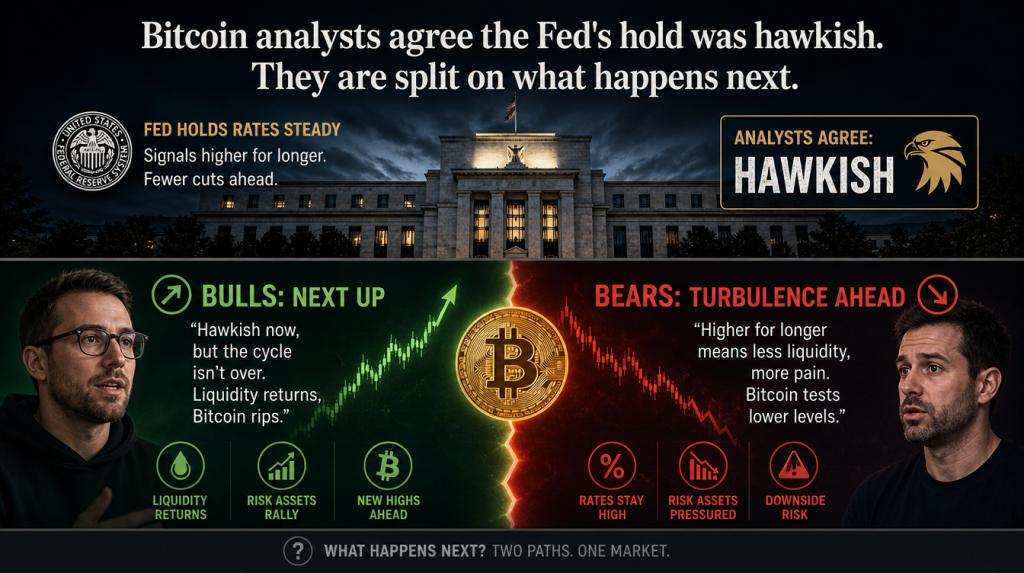
Four analysts agreed that the Federal Reserve’s hawkish decision to keep rates unchanged has altered the outlook for risk assets, but they remain divided on whether bitcoin is facing an immediate challenge or whether the bigger test will come at the September Fed meeting.
The Federal Reserve maintained interest rates on Wednesday, a decision that came amid unusual uncertainty after several influential market participants had argued for a rate increase. Bitcoin showed little reaction, continuing to trade within a narrow range near $64,000 throughout the announcement and Chair Kevin Warsh’s press conference.
Despite the limited market response, analysts offered differing views on what the Fed’s stance means for bitcoin’s next move.
Some described the decision as the most unfavorable scenario for digital assets, while others viewed it as a manageable continuation of restrictive policy rather than a major negative shift. Another group argued that bitcoin’s direction will depend heavily on developments in broader markets, with the key risk potentially arriving at the September Fed meeting.
Andrei Grachev, managing partner at DWF Labs, expressed concern about what the Fed’s hawkish tone suggests about policymakers’ willingness to accept slower growth in order to control inflation.
The Fed’s message was clear. The Federal Open Market Committee kept rates at 3.50%-3.75%, but three officials — Cleveland Fed President Beth Hammack, Minneapolis Fed President Neel Kashkari, and Dallas Fed President Lorie Logan — voted against the decision and supported a 25-basis-point increase. The final vote was 9-3. During his press conference, Chair Kevin Warsh emphasized that there is no tolerance for inflation remaining above the 2% target.
Grachev said the Fed is signaling that it will prioritize inflation control even if that creates economic pressure, calling it the least supportive outcome for digital assets this cycle.
His argument is that tighter monetary conditions reduce liquidity and make leveraged positions more expensive to maintain. In his view, institutional investors are likely to become more defensive immediately, putting additional pressure on risk assets.
While acknowledging bitcoin’s ability to withstand previous periods of hawkish policy, Grachev warned that another unexpected shift toward tighter conditions could weigh on prices.
Can-Luca Köymen, investment strategist at Sygnum Bank, offered a more optimistic perspective, saying the Fed’s decision largely matched expectations.
Köymen said the combination of a rate hold and hawkish messaging was consistent with a central bank seeking flexibility while monitoring uncertainty around energy prices.
For bitcoin, he argued that a restrictive Fed environment does not necessarily mean the macro backdrop is deteriorating. He said Sygnum’s positive outlook on crypto was never dependent on immediate rate cuts, but instead on inflation remaining under control — something Wednesday’s decision did not change.
He added that investors should continue watching oil prices and whether recent improvements in ETF inflows and on-chain accumulation can continue.
Bitget Chief Analyst Ryan Lee focused less on bitcoin itself and more on other markets likely to react first, particularly technology stocks and gold.
Lee said the Fed’s cautious approach was understandable given energy market developments. He argued that recent softer inflation figures were partly helped by lower energy costs, while policymakers are likely aware that future data could reflect renewed energy pressures.
According to Lee, the market discussion has shifted from whether the Fed will cut rates this year to whether the next policy move could actually be a hike.
He also noted that institutional buyers have continued absorbing market volatility, suggesting demand remains present during periods of weakness. However, he expects rate-sensitive technology stocks to face the greatest pressure if yields continue rising.
Lee said the Nasdaq 100 could see further valuation pressure from higher-for-longer interest rates, while gold could also face challenges if rising yields and a stronger dollar outweigh safe-haven demand.
Stephen Coltman, head of macro at 21Shares, focused on the September Fed meeting as the next major risk event.
Coltman described Wednesday’s decision as a temporary relief for investors but warned that the September meeting could become more complicated if inflation remains elevated and policymakers face a difficult decision during a politically sensitive period.
The focus on September reflects market expectations, with fed funds futures now pricing in a 72% chance of a rate hike at that meeting. Additionally, three regional Fed presidents already supported raising rates at Wednesday’s decision.
For bitcoin, the outlook remains uncertain. None of the analysts are predicting a major crash, and none are forecasting an immediate rally.
The main disagreement centers on what factor will determine the next move — tighter liquidity conditions, energy prices, ETF demand, or the outcome of the September Federal Reserve meeting.
About The Author




More Stories
CFTC Warns Prediction Platforms of Manipulation Risks in ‘Mention Markets’
Lummis Says Trump Opposition Helped Derail Crypto Clarity Act
XRP Ledger Retries Upgrade Designed to Split Payments and Compliance Roles