

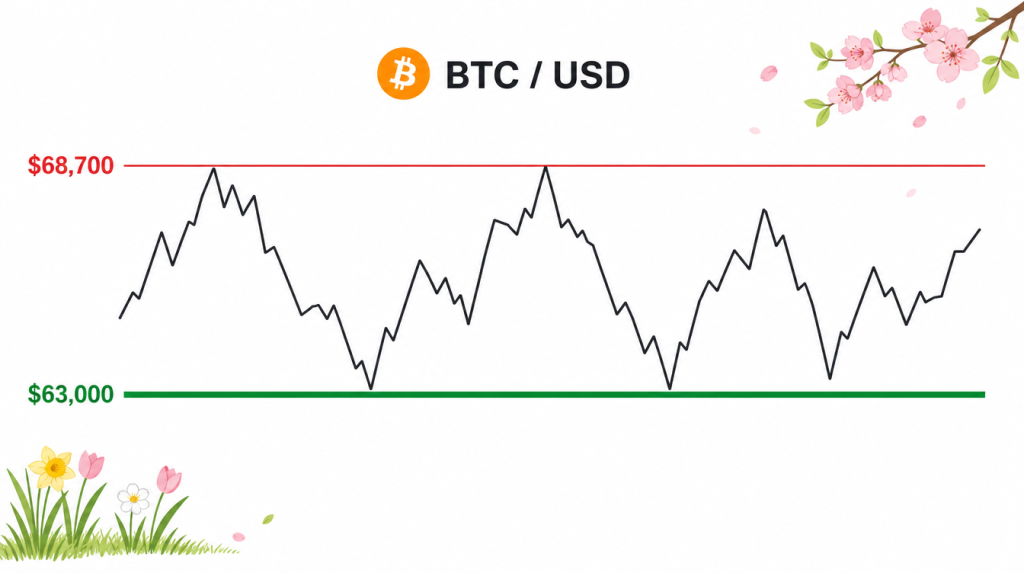
Bitcoin is currently confined between $63,000 and $68,700, with declining spot trading activity, ETF withdrawals and continued whale selling increasing the possibility of a sharp move.
According to CoinGecko data, Bitcoin traded between roughly $63,500 and $64,000 this week, remaining below the $65,000 threshold that has proven difficult to reclaim in recent sessions.
Data shared by Wu Blockchain indicates that Bitcoin spot exchange volume has dropped to its lowest level since Glassnode started tracking the metric in early 2019. Meanwhile, Crypto Rover noted that Bitcoin volatility has contracted to levels not seen since October 2023.
The subdued market reflects more than typical summer inactivity. Both new buying demand and forced selling, the two factors that generally push a range toward a breakout, have weakened. As a result, Bitcoin remains caught between two increasingly narrow cost-basis levels.
Bitcoin Breakout Setup: Realized Price vs. Short-Term Holder Cost Basis
Bitcoin is currently positioned between the $63,000 median realized price and the $68,700 short-term holder cost basis. The median realized price serves as a key support level because it represents the midpoint of the cost basis across Bitcoin holders.
The $68,700 level acts as resistance because it reflects the average purchase price of recent buyers. Glassnode’s Week 32 analysis said Bitcoin has remained within this range for almost three months, while the distance between the two boundaries has continued to shrink alongside falling volatility.
Analyst Ted Pillows highlighted Bitcoin’s inability to sustain levels above $65,000 despite gains across stocks and metals, viewing the divergence as a sign of weakening momentum. His analysis suggests BTC could retreat toward $60,500–$61,000 before attempting a recovery, an area Bitcoin has visited during previous periods of subdued summer trading.
Glassnode has also identified $58,500, the low recorded in June, as an important level if the median realized price fails. The firm warned that shallow order books combined with elevated leverage could cause any downside break to happen more rapidly than usual.
Whale Selling and ETF Outflows Pressure Bitcoin
On-chain data from Lookonchain shows that a wallet associated with Paxos transferred another 800 BTC, worth approximately $50.72 million, for sale through trading firm Wintermute.
The wallet has now sold around 2,500 BTC worth nearly $154 million over the past two months. Rather than being sold in a single transaction, the holdings have been gradually distributed, adding supply to the market at a time when buying interest remains weak.
U.S. spot Bitcoin ETFs also experienced $61.16 million in net outflows on Aug. 12, with Fidelity’s FBTC accounting for $46.82 million of the withdrawals. Combined with historically low spot trading volume, the ETF outflows point to softer institutional demand rather than renewed accumulation.
Bitcoin Bull and Bear Cases
A sustained move above the $68,700 short-term holder cost basis, supported by stronger spot volume and renewed ETF inflows, could restore recent buyers to profit and create room for Bitcoin to challenge new local highs.
Crypto Rover noted that Bitcoin’s previous comparable volatility compression occurred in October 2023, after which BTC eventually gained more than 330%. While the historical pattern does not guarantee a similar rally, it remains a reference point for traders monitoring the current setup.
On the downside, a clear break beneath the $63,000 median realized price would weaken Bitcoin’s primary support and potentially send the asset toward $60,500–$61,000. If selling pressure intensifies, $58,500 could become the next major level to watch.
Glassnode’s seller-exhaustion indicators are approaching levels previously associated with bear-market lows. However, the firm noted that genuine spot demand remains subdued, with Bitcoin continuing to flow onto exchanges despite signs that sellers are becoming increasingly exhausted.
Another factor traders may need to monitor is the possibility of a global interest-rate shock. Such an event could trigger a carry-trade unwind and provide the catalyst needed to push Bitcoin decisively out of its current compressed range.
For now, limited liquidity and exceptionally low trading volume suggest that once either buyers or sellers gain control, Bitcoin could make a much larger move than its recent narrow trading range indicates.
About The Author





More Stories
Bitcoin Starts New Quarter Stuck in Familiar $82K-$85K Range
Citigroup Lifts 12-Month Bitcoin Target to $113K as ETF Inflows Return
Bitcoin’s Inflation-Fueled Jump to $85.5K Fades as Yields Stay High