

SEC-CFTC Crypto Framework Moves Forward as CLARITY Act Faces Delays
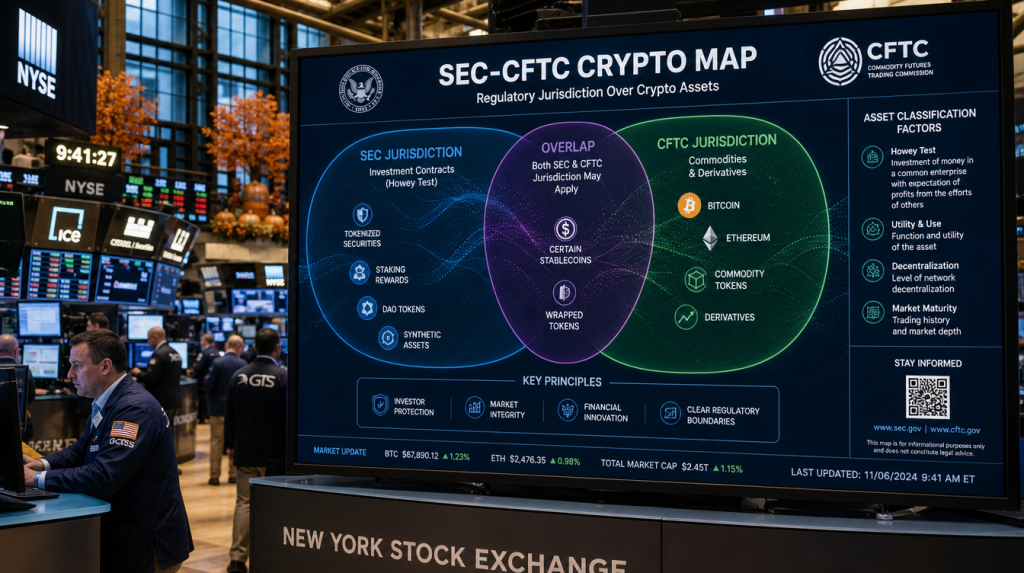
The SEC and CFTC released joint guidance last week that divides digital assets into five groups: digital commodities, digital collectibles, digital tools, stablecoins and digital securities. The move suggests the SEC is prepared to establish its own regulatory framework for crypto instead of waiting indefinitely for the Senate to advance the stalled CLARITY Act.
The guidance gives crypto exchanges, token issuers and traders a practical framework for understanding potential regulatory jurisdiction. However, it remains an agency interpretation rather than legislation, a distinction that could be important for investors assessing regulatory risks.
The latest CLARITY Act development comes as crypto markets await today’s CPI report, which could push Bitcoin out of its current consolidation near $64,000. Whether the data triggers a move higher or lower remains uncertain.
SEC-CFTC Framework Prioritizes Speed Over Legislation
Under the SEC and CFTC’s new classification system, digital commodities, collectibles, tools and stablecoins generally fall outside securities regulation. Digital securities are the category most clearly placed under SEC oversight. However, the SEC noted that it can still claim jurisdiction over certain assets that are otherwise considered nonsecurities under specific circumstances.
That remaining uncertainty is precisely what comprehensive market-structure legislation was intended to resolve. As a result, the joint guidance appears to function more as an interim framework than a permanent regulatory settlement.
Ian Katz, managing partner at Capital Alpha, said regulators appear unwilling to wait for Congress to resolve the issue given the slow pace of formal rulemaking. Speaking to The Hill, he said regulators were not completely stopping their efforts while waiting for legislation.
SEC Chair Paul Atkins echoed that position during the DC Blockchain Summit, describing the guidance as a necessary step that had been overdue.
Atkins also outlined plans for a broader regulatory structure that could include exemptions for startups and fundraising activities, along with a safe harbor for crypto assets that have evolved beyond securities classification. Such measures would typically require legislative authority rather than relying solely on agency interpretation.
Senate Remains Divided Over Crypto Legislation
The House passed the CLARITY Act last July, but the legislation continues to face resistance in the Senate. The Agriculture Committee has advanced its portion without Democratic support, while the Banking Committee has encountered additional obstacles, including the loss of backing from Coinbase.
Stablecoin rewards remain one of the central disputes. Traditional banks are pushing for stricter limits, while crypto companies argue that excessive restrictions could put them at a competitive disadvantage.
President Trump has also criticized banks for what he described as efforts to weaken the GENIUS Act and has called for faster progress on broader crypto market-structure legislation.
Senators Angela Alsobrooks and Thom Tillis have reportedly negotiated a bipartisan compromise involving stablecoin rewards, although the precise terms have not been made public.
David Carlisle of Elliptic said the joint SEC-CFTC interpretation offers the market some additional certainty while lawmakers remain unable to reach agreement.
What Comes Next for the CLARITY Act
Even if the Senate Banking Committee moves forward with its legislation in April, lawmakers would still have several hurdles to clear. The Banking Committee bill would need to be reconciled with the Agriculture Committee’s version, secure at least 60 votes in the Senate and eventually be aligned with the House-approved CLARITY Act.
The process would also need to move quickly before midterm election politics make major legislative action more difficult.
Sen. Bernie Moreno highlighted the urgency, warning that failure to pass the CLARITY Act by May could push digital-asset legislation further into the future.
For crypto traders and investors, the timing of congressional action may ultimately matter more than the details of the SEC-CFTC guidance itself. Agency interpretations can be changed or withdrawn by future commissioners without congressional approval, while rules established through legislation carry considerably greater durability.
That difference between regulatory guidance and statutory law has already influenced institutional market behavior and could remain an important factor in determining how much lasting influence U.S. crypto regulation has on digital-asset prices and capital flows this year.
About The Author





More Stories
Bitcoin Starts New Quarter Stuck in Familiar $82K-$85K Range
Citigroup Lifts 12-Month Bitcoin Target to $113K as ETF Inflows Return
Bitcoin’s Inflation-Fueled Jump to $85.5K Fades as Yields Stay High