

A proposed amendment to the XRP Ledger (XRPL) would enable institutions to conceal token balances and transaction amounts, while still allowing issuers, auditors, and regulators controlled visibility.
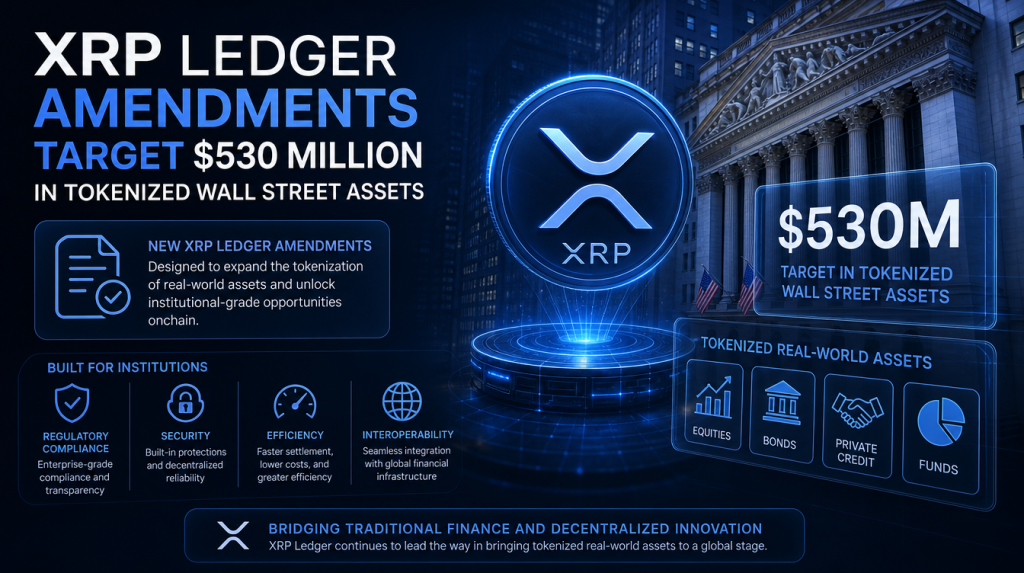
A privacy-focused feature tailored for institutional capital is heading to a vote on XRPL, where over $530 million in tokenized real-world assets are already recorded.
Released this week, XRPL version 3.3.0 introduces six proposed amendments. One of the most notable is “Confidential Transfers,” designed specifically for institutional users. It enables the encryption of balances and payment amounts for Multi-Purpose Tokens (MPTs), which Ripple has positioned for use in funds, bonds, and other financial instruments.
The goal is to allow institutions to transfer tokens without disclosing the size of holdings or transaction values. While wallet addresses and token types remain visible, the specific balances and transferred amounts can be hidden.
Despite this encryption, the ledger can still verify transaction accuracy using cryptographic techniques that confirm validity without exposing the underlying data.
Throughout 2026, Ripple has been advancing XRPL’s role in tokenized finance. Recently, Aviva Investors launched a tokenized share class of its U.S. Dollar Liquidity Fund on XRPL, following an earlier partnership announcement with Ripple in February.
There is already significant capital on the network for such features to support. Data from RWA.xyz shows approximately $1.38 billion in tokenized real-world assets on XRPL, including $845.7 million in RLUSD. Ondo contributes $212.6 million, followed by VERT Capital with $116.1 million and Archax with $55.4 million, while Societe Generale holds about $11.6 million.
Excluding RLUSD, this leaves over $530 million in other tokenized assets on XRPL, though the market is still dominated by a small number of issuers.
The initial rollout of Confidential Transfers is limited in scope. Users must opt in to use encryption, and the feature currently supports only direct MPT transfers between accounts. It does not yet extend to XRPL’s decentralized exchange, escrow functions, or checks.
The remaining five amendments also target institutional use cases. “Batch” allows up to eight transactions to be grouped together, including an option where all actions must succeed or fail as a whole. “Sponsor” enables one account to pay transaction fees and reserves on behalf of another, eliminating the need for new users to hold XRP initially.
“Permission Delegation” allows an account to authorize another party to perform specific transaction types, enabling limited operational control without full access. Meanwhile, “Dynamic MPT” gives issuers the flexibility to modify certain token attributes after issuance.
Version 3.3.0 also includes performance improvements and bug fixes. According to XRPL Operations, it reduces memory usage by 10% to 15% and enhances how quickly nodes synchronize with the network.
None of these amendments are active yet. For implementation, XRPL changes must receive at least 80% approval from trusted validators for a continuous two-week period.
Confidential Transfers must now pass that threshold. Beyond approval, the real test will be whether institutions like Aviva or Ondo decide to adopt the feature and conceal transaction details, or continue operating with full transparency.
About The Author





More Stories
CFTC Warns Prediction Platforms of Manipulation Risks in ‘Mention Markets’
Lummis Says Trump Opposition Helped Derail Crypto Clarity Act
XRP Ledger Retries Upgrade Designed to Split Payments and Compliance Roles