

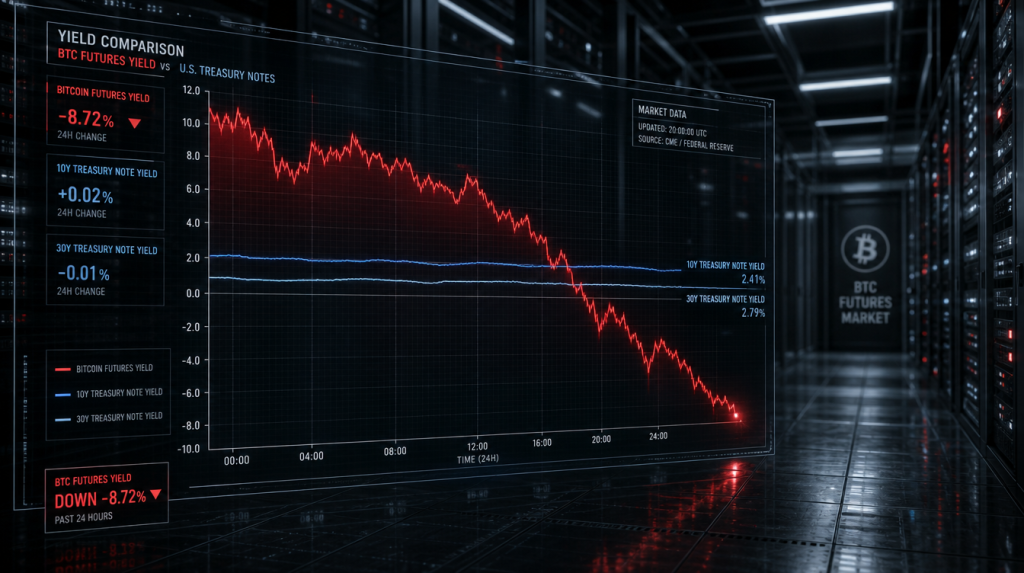
Bitcoin futures’ once-profitable carry trade has largely disappeared, with quarterly basis yields falling below two-year U.S. Treasury returns since February. The decline points to reduced arbitrage opportunities and reflects a more developed and efficient crypto market.
The futures strategy, which was once a major source of returns for traders, has consistently delivered weaker performance than traditional government debt for months.
During the 2021 crypto bull market, bitcoin futures carry trades generated annualized returns above 20% on both regulated and offshore exchanges. The approach typically involved selling bitcoin futures short while maintaining a matching spot bitcoin position, allowing traders to capture the premium between futures and spot prices. Today, the same trade offers only around 3% returns, compared with roughly 3.8% from two-year U.S. Treasury notes.
Futures markets have long allowed traders to profit from the spread between futures contracts and spot asset prices, a difference known as the basis. However, annualized bitcoin futures basis yields have remained below two-year Treasury yields for over five months, according to Glassnode data.
Glassnode reported that three-month bitcoin futures basis yields have stayed below two-year Treasury rates since February. The firm noted that only one other period on record lasted this long, occurring between August 2022 and January 2023 before ending near the market cycle low.
The three-month bitcoin futures basis has remained below Treasury yields for 157 consecutive days, based on Glassnode’s latest data.
When futures-based carry returns fall below short-term government bonds, investors have fewer reasons to commit capital to the strategy. A trader can now achieve better returns by holding Treasury securities rather than taking on the additional risks associated with bitcoin futures arbitrage.
The shrinking carry premium has also contributed to declining bitcoin futures activity. July trading volume dropped to slightly above $880 million, extending the decline from February’s $1.47 trillion peak, according to Coinglass data. The broader crypto market downturn has further pressured derivatives activity.
Despite the decline, the falling basis can be viewed as a sign of improving market efficiency. Since basis trades depend on pricing gaps between related markets, lower yields indicate those inefficiencies are being reduced. Over time, this can result in tighter spreads, more effective hedging, and fewer unusually large arbitrage opportunities as bitcoin markets continue to mature.
About The Author





More Stories
CFTC Warns Prediction Platforms of Manipulation Risks in ‘Mention Markets’
Lummis Says Trump Opposition Helped Derail Crypto Clarity Act
XRP Ledger Retries Upgrade Designed to Split Payments and Compliance Roles