

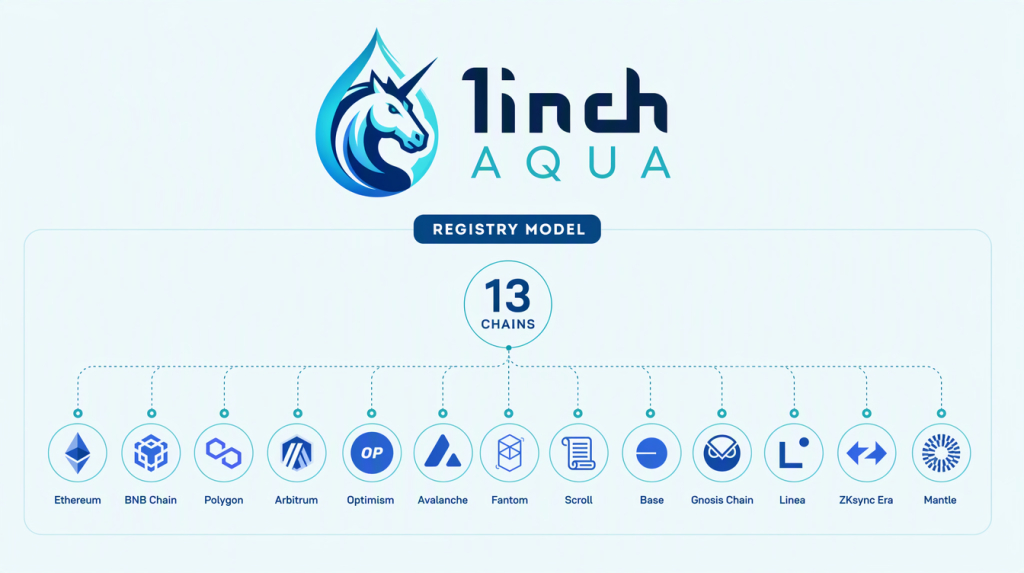
1inch has transitioned its Aqua liquidity protocol from a developer preview into a full public launch, supporting 13 EVM-compatible networks at the same time. The broad rollout places Aqua across many of the chains already used by professional market makers and retail liquidity providers.
The release targets one of DeFi’s biggest ongoing challenges: liquidity fragmented across multiple chains and isolated pools. This scattered capital often sits underutilized, generates weaker returns, and forces liquidity providers to manage positions through different platforms and interfaces.
How Aqua’s Registry Model Differs From Traditional AMMs
Unlike traditional automated market makers (AMMs), Aqua does not rely on standard liquidity pool deposits. Instead, it uses a registry-based allowance system where liquidity providers register their wallet balances as backing, allowing those assets to support multiple active quotes without being transferred into a pool.
A trade is completed only when it matches the conditions set by the liquidity provider. At that point, the protocol pulls the required assets directly from the provider’s wallet to settle the transaction.
The potential capital efficiency improvement is significant, at least in theory. Based on research surrounding the protocol, 1inch has highlighted a scenario where a $100,000 wallet balance could support positions representing $300,000 in quoted liquidity. However, this figure refers to the total value of outstanding quotes rather than the amount of capital actually available for execution.
Real execution capacity remains limited by the assets held in the wallet at the moment a trade is filled. Providers with concentrated positions or insufficient balances may encounter practical constraints that are not immediately visible from quoted liquidity figures.
This custody-focused design differs from traditional AMMs, where users deposit assets into smart contracts and transfer control of those funds while remaining exposed to impermanent loss caused by price fluctuations.
By keeping assets in the provider’s own wallet, Aqua offers a more flexible structure for professional market makers managing their balance sheets. However, successful execution still depends on counterparty availability and real-time verification of wallet balances during settlement.
Multi-Chain Expansion and Liquidity Incentives
The public launch supports Ethereum, Arbitrum, Base, BNB Chain, Optimism, Polygon, Robinhood Chain, and six additional EVM-compatible networks.
This broad chain coverage addresses a major issue in DeFi: liquidity remains heavily divided across ecosystems. While Ethereum and Arbitrum maintain deeper liquidity pools, newer networks often struggle to attract professional liquidity providers without targeted incentive programs.
To encourage adoption and build liquidity across all 13 networks, 1inch is introducing an incentives initiative backed by 10 million 1INCH tokens from the 1inch Foundation and 500,000 USDC from the 1inch DAO.
The rewards program will be distributed through Merkl and managed by Degensoft Ltd (BVI). While the incentive package represents a substantial commitment, the long-term success will depend on whether it attracts durable liquidity providers or short-term participants who leave once rewards decline.
Ultimately, Aqua’s ability to reduce liquidity fragmentation will depend on whether its registry-based approach can deliver better efficiency for market makers while creating sustainable liquidity across multiple chains.
About The Author





More Stories
Binance Expands Into Precious Metals With Gold and Silver Options as Commodity Demand Surges
AI Firm Behind $60M Crypto Liquidation Wave to Fully Reimburse Traders
Citadel Bets Against the Fed Consensus as Bitcoin Waits for the Rate Decision