

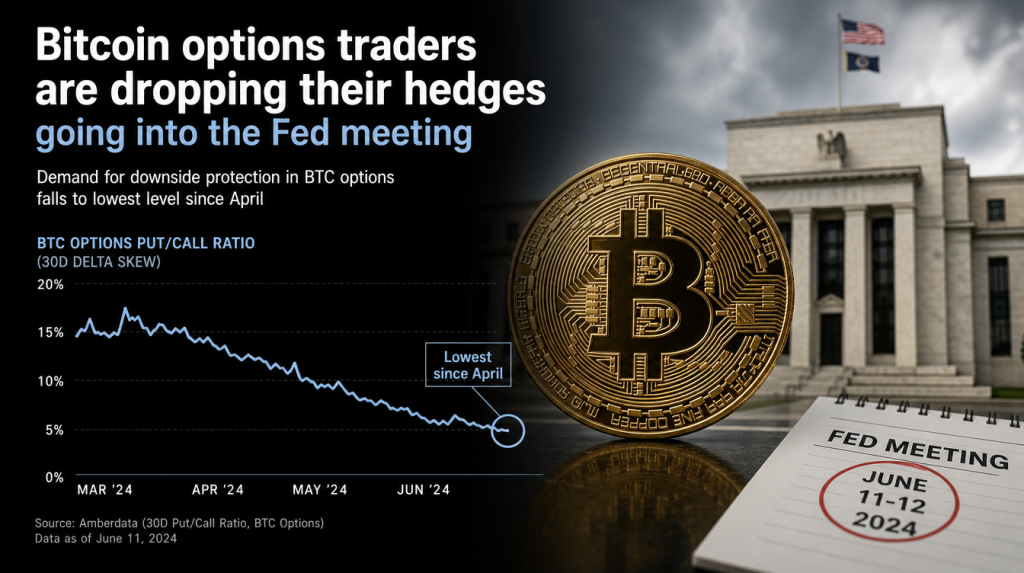
Bitcoin’s options market has become significantly less defensive over the past month, with traders reducing the downside protection they accumulated in June as the Federal Reserve prepares for its upcoming meeting.
The put/call ratio based on open interest, which tracks the amount of capital positioned in put options that benefit from price declines compared with call options that profit from gains, has dropped to around 0.52 from approximately 0.76 in late June, according to Glassnode data.
The decline shows that call options are taking up a larger portion of the market, suggesting traders are reducing hedges instead of increasing downside protection. Recently, larger market participants have been building positions in $70,000 strike calls and bullish call spreads, indicating expectations for bitcoin’s price to move higher.
The options market appears to be pricing in a relatively calm near-term outlook compared with the next several months. Bitcoin options are assigning lower risk to the coming week, despite the upcoming Federal Reserve decision.
The 25-delta skew, which measures the extra cost traders pay for downside protection compared with similar upside exposure, has fallen to about 4% for one-week options, while three- and six-month contracts remain elevated at 11% to 12%.
This suggests traders are still maintaining protection against potential market shocks later in the year but have largely reduced their demand for short-term insurance.
Implied volatility, which reflects the market’s expectations for future price swings, has also declined across maturities, standing at 34.3% for one-week options compared with 40.8% for six-month contracts.
The upward-sloping volatility curve indicates that traders expect near-term conditions to remain calmer than the longer-term outlook, an unusual pattern ahead of a major scheduled macroeconomic event.
The Federal Reserve’s interest-rate decision is scheduled for Wednesday. Markets currently assign only about a 15% probability of a rate increase in July, making the subdued short-term pricing understandable based on current expectations.
However, the lack of hedging leaves markets with limited protection if the Fed’s statement or economic projections surprise investors. When positioning becomes this light, unexpected developments can lead to sharper price swings rather than being absorbed smoothly.
Bitcoin remained near the $65,000 level for most of the past week, holding steady even during Thursday’s sell-off that erased $797 billion from major U.S. technology stocks. The cryptocurrency market also navigated several negative developments, including bankruptcy protection filings from blockchain projects Movement Labs and Storj, along with shutdown announcements from crypto exchanges BitMEX and BitMart.
About The Author





More Stories
Bitcoin Drops to $83,300 as Bond Yields Reach 2007 High
Traders See Four Fed Rate Hikes by June 2027 as Bitcoin Falls Below $83K
Bitcoin Shrugs Off Rising Bond Yields Over the Long Term, Data Shows