

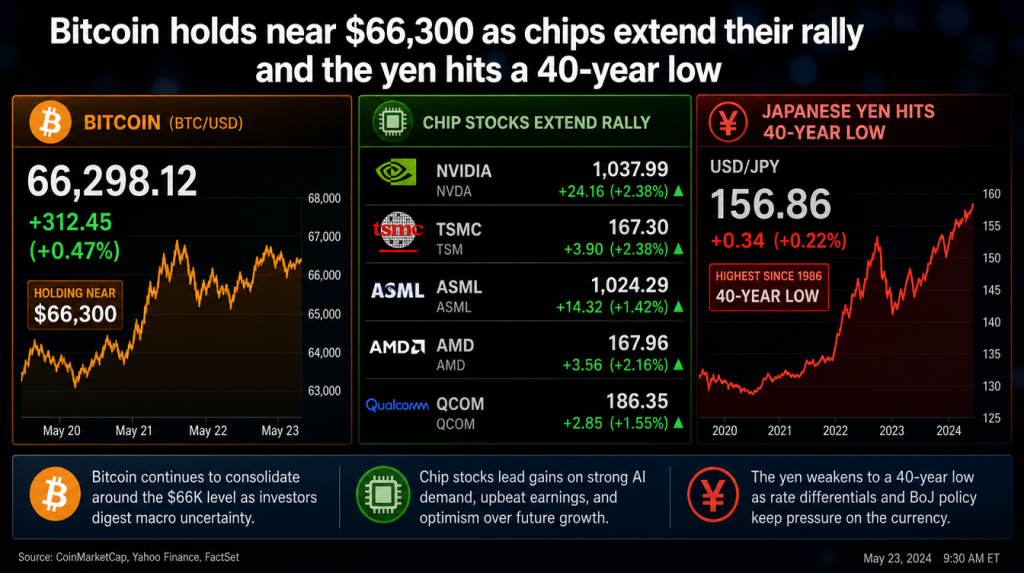
Semiconductor shares extended their gains for a second straight session on renewed optimism around artificial intelligence, while the Japanese yen weakened beyond 163 per dollar for the first time since 1986.
Bitcoin remained close to $66,300 on Wednesday, holding near a two-week high as the chip-driven market rally that has supported crypto prices throughout the month continued for another session. At the same time, the yen dropped to its lowest level in roughly 40 years.
The largest cryptocurrency gained nearly 1% during the day and was up about 3% over the week, with approximately $31 billion in trading volume recorded over 24 hours. BTC traded within a range of around $65,400 to $66,900.
Ether was trading near $1,935, posting a weekly gain of about 3%. XRP climbed 2% to $1.14, while TRON also moved slightly higher. Hyperliquid’s HYPE was among the weakest performers, falling 4% to $60 and extending its seven-day decline to 10%. Bitcoin’s continued dominance and limited movement among major tokens suggest the market is being driven more by broader macro trends than by crypto-specific developments.
The primary catalyst remains the semiconductor sector. MSCI’s Asia Pacific equity index advanced 1%, building on Tuesday’s strongest daily performance in a month. South Korea’s Kospi surged 5% as signs emerged that a leveraged sell-off, which had dragged the index nearly 30% below its peak, was coming to an end.
Samsung and SK Hynix were among the biggest contributors, following a more than 5% jump in a U.S. semiconductor index on Tuesday that helped the sector recover from technical bear-market conditions.
The China-related AI concerns that pressured these same stocks — along with Bitcoin — less than a week earlier have now largely reversed.
A new focus for markets is the currency market, where the yen fell below the 163-per-dollar level for the first time since 1986. The decline has continued despite Japan’s intervention efforts to support the currency. Finance Minister Satsuki Katayama said officials remain prepared to take “bold steps” if necessary, according to Bloomberg, but a stronger dollar, rising U.S. Treasury yields, and higher oil prices linked to the Iran conflict have continued to outweigh those measures.
For Bitcoin supporters, this environment reinforces a long-standing argument for the asset.
A major currency losing significant value against the dollar, while policymakers struggle to stop the decline despite large-scale intervention, reflects the type of currency debasement scenario often cited by Bitcoin advocates.
However, it remains uncertain whether this narrative is currently attracting meaningful Bitcoin demand. In recent months, BTC has moved more closely with semiconductor stocks than with currency markets. Still, ongoing currency weakness adds to the broader macro backdrop that has historically strengthened the case for scarce, fixed-supply assets like Bitcoin.
About The Author





More Stories
CFTC Warns Prediction Platforms of Manipulation Risks in ‘Mention Markets’
Lummis Says Trump Opposition Helped Derail Crypto Clarity Act
XRP Ledger Retries Upgrade Designed to Split Payments and Compliance Roles