

Here’s a clear and refined paraphrased version:
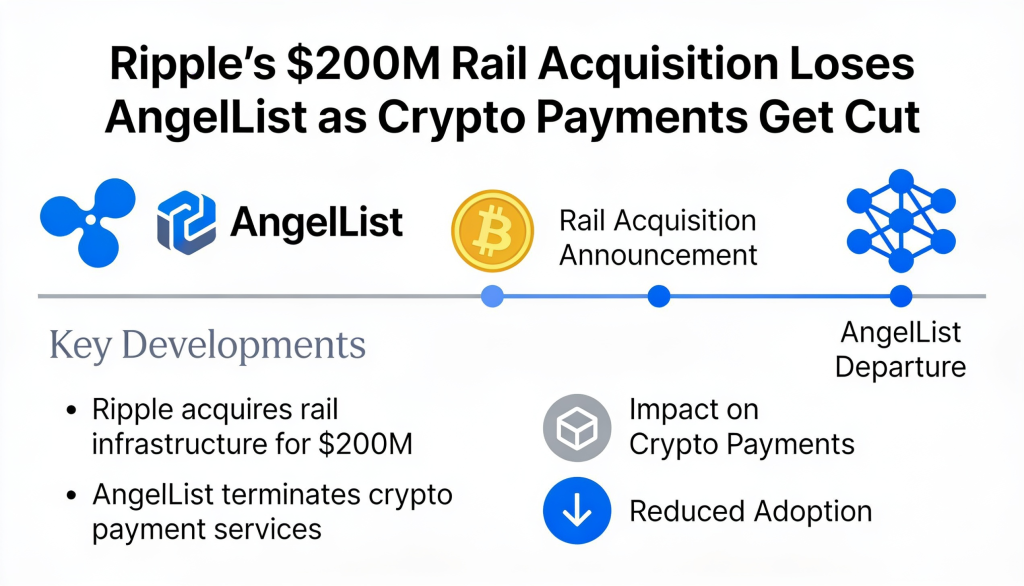
AngelList, a venture capital platform with over 50,000 funds and 800,000 accredited investors, will end its partnership with Rail—the B2B payments platform owned by Ripple—on July 31, 2026. As part of this move, all crypto payment options will be removed, marking a notable setback for Ripple’s enterprise payments strategy less than a year after its $200 million acquisition of Rail.
In an official notice, AngelList confirmed that support for USDC, USDT, DAI, and ETH will be fully discontinued after the deadline. Users have been advised to switch to ACH or wire transfers for future investments to avoid delays, while existing accounts, investments, and portfolio data will remain unaffected.
No specific reason was provided beyond the announcement of the wind-down.
Rail’s Original Purpose
Ripple acquired Toronto-based Rail in August 2025 as part of a broader $2.45 billion M&A strategy. Rail was designed to help businesses process stablecoin payments—such as USDC and USDT—across multiple fiat currencies without requiring crypto wallets or exchange integrations. For platforms like AngelList, it offered a streamlined way for accredited investors to deploy funds using digital assets.
The goal was to simplify crypto adoption within institutional workflows without forcing companies to overhaul their infrastructure. However, AngelList’s decision to exit suggests that this value proposition did not fully align with its operational needs.
Mixed Signals for Ripple’s Expansion
The timing of this development is notable given Ripple’s broader momentum. In early July 2026, the company secured an important regulatory license in Europe, and Clearstream recently added XRP and other digital assets to its custody services.
While Ripple is expanding its institutional presence in some areas, AngelList’s departure highlights that adoption of crypto-based payment systems remains inconsistent across enterprise platforms, despite positive headlines.
Implications for Ripple’s Strategy
Although the move does not directly impact Ripple’s financial position, it weakens the narrative around Rail. Losing a high-profile partner like AngelList raises questions about the platform’s real traction among enterprise clients.
Even as XRP shows positive market performance in 2026, with improving ETF flows and trading activity, enterprise adoption of Ripple’s payment solutions appears to be following a different trajectory.
AngelList’s shift also reinforces a broader reality: traditional payment systems like ACH and wire transfers continue to dominate due to their simplicity and regulatory clarity, even among tech-focused institutions.
Broader Market Context and What’s Next
The stablecoin sector has faced challenges in 2026, and ongoing uncertainty around settlement infrastructure may have influenced AngelList’s decision, even if not explicitly stated.
For now, users relying on crypto payment options—including USDC—must transition before the July 31 deadline. After that, AngelList will rely entirely on traditional financial rails, with no indication of when or if crypto payments might return.
Going forward, attention will be on whether Ripple announces new enterprise partnerships to offset the reputational impact, and whether Rail can maintain its remaining client base as the market reassesses Ripple’s enterprise payment ambitions heading into late 2026.
About The Author





More Stories
Bond Volatility Surges as Bitcoin and Wall Street Remain Calm
Altcoins Surge as Bitcoin Holds Near $84,000
Bitcoin ETF Flows Turn Positive in 2026 After Erasing $5.8B Deficit