

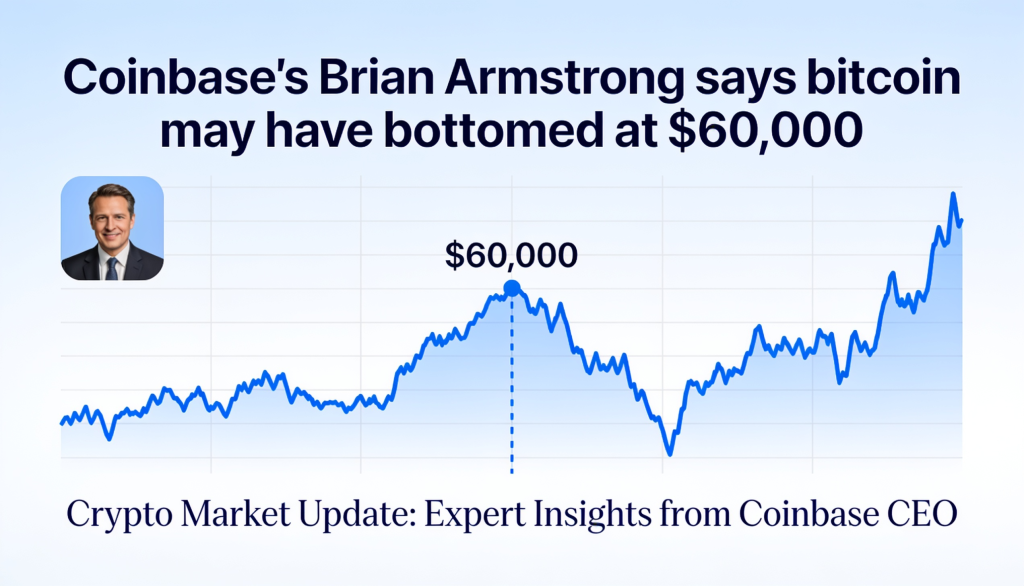
Armstrong said his view is that Bitcoin may already have formed a market floor, referencing the four-year cycle that has historically aligned with major market lows.
Coinbase (COIN) CEO Brian Armstrong suggested that Bitcoin (BTC) may have bottomed out near the $60,000 level.
“I think we’ve probably bottomed at this point, maybe around the sixty K area, but it’s impossible to know for certain,” Armstrong said in a video posted on X on Monday. He added that he remains bullish on Bitcoin and expects significantly higher prices by 2030.
He also reiterated his belief that “Bitcoin is the new digital gold.”
Bitcoin was trading above $66,000 on Monday, up nearly 3% over the past 24 hours, following news that the U.S. and Iran had agreed to reopen the Strait of Hormuz. Earlier this month, the asset had dropped to around $59,743 on June 5, marking its lowest level since October 2024, before rebounding.
Armstrong highlighted Bitcoin’s four-year halving cycle, which has historically coincided with alternating bull and bear phases, as a key framework for interpreting the current correction. The asset remains roughly 50% below its October 2025 peak near $126,000.
Last week, the Coinbase CEO also argued that the recent price decline obscures broader strength in the crypto sector. “Derivatives, stablecoins, prediction markets are all up,” he posted on X on June 5. “It will take some time for that to be reflected.”
His view comes with important caveats, however.
On-chain analytics firm CryptoQuant noted that while Bitcoin has entered a historical value zone near its realized price of around $53,600, demand conditions remain weak and ETF inflows have yet to stabilize. While the market may be approaching a valuation floor, confirmation of a sustained recovery has not yet emerged, leaving traders dependent on macro catalysts for clearer direction.
About The Author





More Stories
Bitcoin Starts New Quarter Stuck in Familiar $82K-$85K Range
Citigroup Lifts 12-Month Bitcoin Target to $113K as ETF Inflows Return
Bitcoin’s Inflation-Fueled Jump to $85.5K Fades as Yields Stay High