

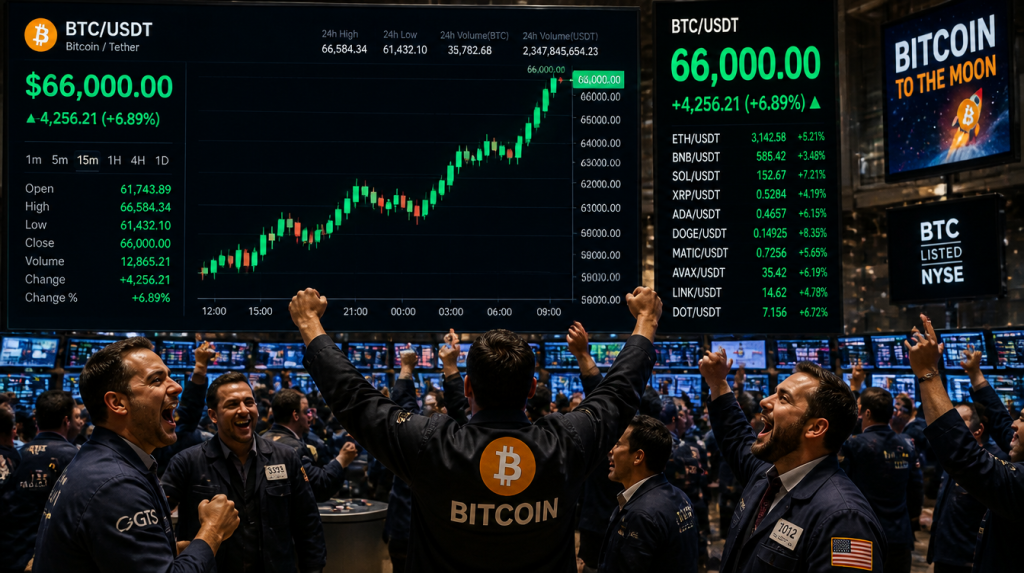
Bitcoin Climbs Near $66K Following US–Iran Peace Agreement
Bitcoin advanced 2% to $65,800 on Monday, June 15, after the United States and Iran announced a memorandum of understanding aimed at ending their conflict. The agreement includes an immediate ceasefire and a pledge to reopen the Strait of Hormuz within 30 days, easing concerns over geopolitical tensions and global energy supplies.
The development sparked a broad risk-on move across financial markets. S&P 500 futures gained 1.2% during Asian trading hours, while Brent crude oil fell 4.5% to $83.39 as traders priced in lower supply risks from the Gulf region. The positive sentiment also lifted major altcoins, with XRP, Solana, and Cardano posting gains of 3% to 4%.
Meanwhile, data from SoSoValue showed that spot Bitcoin ETF outflows slowed significantly to $315.8 million last week, compared with more than $1 billion in weekly withdrawals during each of the previous four weeks. Although the moderation offered some support to Bitcoin prices, institutional flows remained negative overall.
The key question for investors is no longer whether the US–Iran peace deal can influence markets, but whether the resulting improvement in risk sentiment can sustain a longer-term Bitcoin recovery. ETF demand remains weak, and the Crypto Fear & Greed Index stands at just 20 out of 100, indicating persistent extreme fear among market participants.
Hormuz Reopening and Its Impact on Crypto Markets
The relationship between energy prices, inflation expectations, and risk assets is becoming increasingly important. By reducing concerns over supply disruptions, the planned reopening of the Strait of Hormuz removed a significant risk premium from oil markets, contributing to Monday’s sharp decline in crude prices.
Lower energy costs can help ease inflation expectations, potentially reducing pressure on the Federal Reserve to maintain restrictive monetary policy. Such conditions generally support risk-sensitive assets, including Bitcoin, by improving liquidity expectations and lowering discount-rate pressures.
ETF activity, however, presents a more nuanced picture. Although weekly net outflows declined to $315.8 million for the period ending June 13, funds continued to experience withdrawals. The slowdown suggests that aggressive institutional selling may be easing, but persistent outflows indicate that demand remains fragile. As a result, Monday’s rally appears to reflect market relief rather than a decisive return of institutional buying.
Bitcoin at $65,800: Temporary Bounce or Lasting Recovery?
Bitcoin has recovered roughly $6,700 from its June 5 low near $59,100, marking its strongest performance since October 2024. Monday’s close around $65,809 represented the highest finish during this rebound phase.
Despite the recent gains, technical analysts remain cautious. Previous rallies linked to developments involving Iran pushed Bitcoin toward $79,500 in late April before momentum faded sharply. Key resistance levels remain near the 50% Fibonacci retracement at $78,962 and the 200-day exponential moving average around $81,708, both well above current prices.
The cryptocurrency is currently trading within the $62,000–$66,000 zone, an area that previously absorbed significant selling pressure before the market fell to yearly lows. For bullish momentum to strengthen, Bitcoin must establish a sustained daily close above $66,440, which served as an important intraday high during recent trading.
The earlier selloff that drove Bitcoin below $73,000 created several resistance layers overhead, and the current rebound has yet to challenge the more significant barriers above $68,000. As such, the latest 2% advance appears more consistent with short-covering and sentiment-driven buying than with a confirmed technical breakout.
For now, the rally highlights improving risk appetite following the US–Iran agreement, but stronger institutional participation and a break above key resistance levels will be needed to validate a broader bullish trend.
About The Author




More Stories
Bitcoin Starts New Quarter Stuck in Familiar $82K-$85K Range
Citigroup Lifts 12-Month Bitcoin Target to $113K as ETF Inflows Return
Bitcoin’s Inflation-Fueled Jump to $85.5K Fades as Yields Stay High