

Fresh U.S. inflation data released on Thursday showed a mixed picture, while the European Central Bank delivered its first interest rate hike in nearly three years, marking a renewed tightening cycle in Europe.
Markets are now focused on Friday’s session, dominated by the long-awaited public debut of SpaceX, in what is expected to be one of the largest IPOs ever. The company priced shares at $135, raising $75 billion and surpassing Saudi Aramco’s 2019 record listing.
SpaceX sold 555.6 million shares at the offering price, implying a fully diluted valuation of roughly $1.8 trillion. The company generates about $19 billion in annual revenue from launches, government contracts, and Starlink, though the valuation reflects lofty growth expectations. It also holds 18,712 bitcoin, worth close to $1.2 billion at current prices.
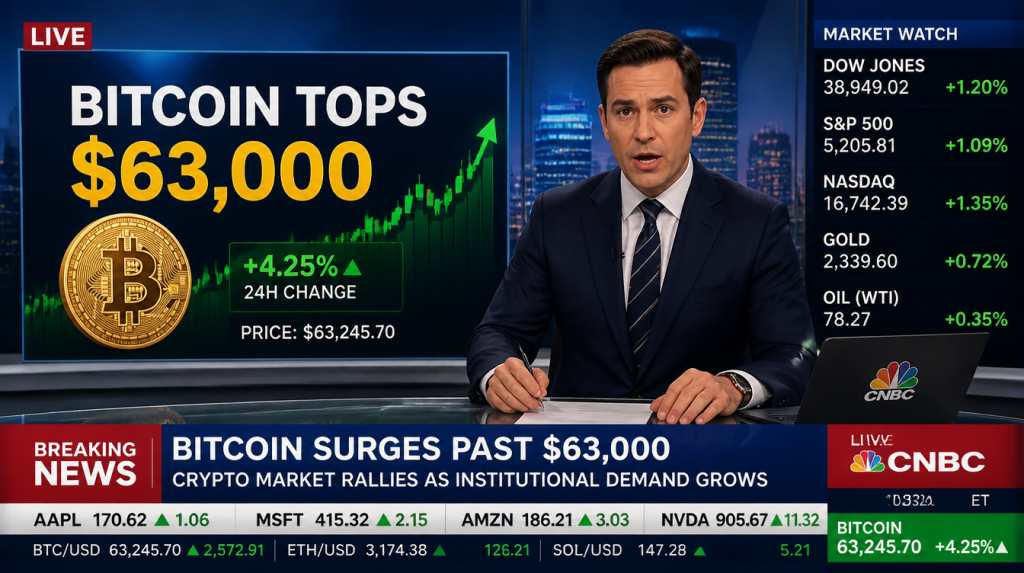
Risk assets strengthened ahead of the listing after geopolitical headlines boosted sentiment. Following reports that President Trump called off planned strikes on Iran amid diplomatic progress, equities rallied, with the Nasdaq up 2.4% and the S&P 500 rising 1.8%. Bitcoin climbed to around $63,500, gaining roughly 2.5% over 24 hours.
Crypto-related stocks also advanced, including Coinbase (+3.6%), Galaxy Digital (+8.8%), and Strategy (+4.3%).
Earlier, Trump’s social media post confirming the cancellation of military action pushed markets to intraday highs, sent oil prices down around 3%, and pulled Treasury yields lower, while Bitcoin held near $63,400.
Investor demand for SpaceX has been exceptionally strong. BlackRock reportedly placed orders of at least $5 billion, while retail demand has exceeded $70 billion, according to Bloomberg. However, allocations are expected to be heavily limited, leaving much of the demand unfilled. Some investors have funded IPO participation by selling technology stocks, particularly in AI and semiconductor names, adding pressure to those sectors.
Bitcoin’s market signals remain mixed. The Coinbase Premium Index briefly turned deeply negative, suggesting stronger selling pressure on U.S. exchanges versus offshore markets, even as Bitcoin dipped below $63,000 following producer price data.
ETF flows continue to weigh on sentiment, with U.S. spot Bitcoin ETFs recording $213.85 million in net outflows in a single day and more than $5.7 billion in cumulative redemptions since mid-May.
Some analysts caution that the correction may not be over, with downside scenarios still pointing toward a possible retest of $50,000 as capital rotates into IPO and AI-driven trades while macro and geopolitical risks remain elevated.
Corporate Bitcoin treasury activity has also weakened, with several listed firms selling portions of holdings to manage debt and liquidity, adding incremental supply to a fragile market.
On the macro front, U.S. producer price data delivered a mixed inflation signal, briefly pressuring Bitcoin before prices stabilized near $62,500. In Europe, the ECB’s rate hike underscored a clear policy shift driven by persistent inflation pressures.
Gold slipped to a six-month low while Bitcoin held above $63,000, with both assets still constrained by higher rate expectations.
Derivatives positioning shows rising leverage, with Bitfinex margin longs climbing above 90,000 BTC for the first time since late 2023—signaling aggressive positioning even as volatility persists.
Overall, markets remain driven by a combination of macro shifts, geopolitical headlines, and a major IPO catalyst, with liquidity flows and positioning dominating short-term direction.
About The Author





More Stories
Bitcoin Starts New Quarter Stuck in Familiar $82K-$85K Range
Citigroup Lifts 12-Month Bitcoin Target to $113K as ETF Inflows Return
Bitcoin’s Inflation-Fueled Jump to $85.5K Fades as Yields Stay High