

Ethereum News: pERC-20 Proposal Introduces Private-by-Default Token Transfers
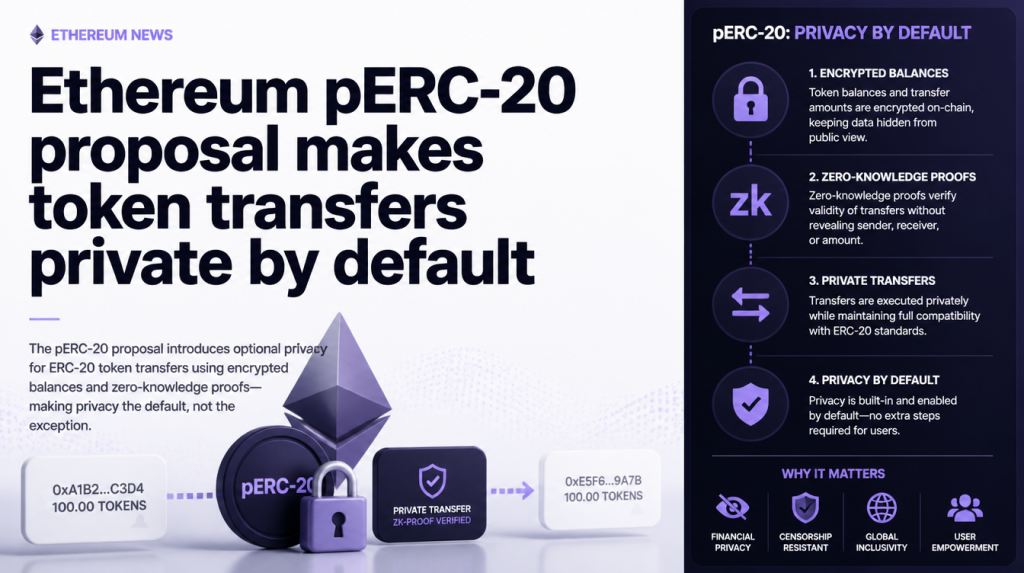
A new Ethereum token standard proposal, pERC-20 (ERC-7605), outlines a major shift toward privacy by default for token transfers. It embeds zero-knowledge proofs directly into token contracts to hide balances, transaction amounts, and counterparties.
Unlike a privacy add-on to ERC-20, pERC-20 is designed as a complete replacement interface. It is privacy-native from minting through transfers, with the goal of ensuring that no token balances are ever exposed in public on-chain state.
The design is inspired by Zcash-style ZK-UTXO systems, including Groth16 proofs and Orchard-based note commitments, adapted for Ethereum’s EVM. It is intended to work with existing wallets like MetaMask and does not require new precompiles or specialized infrastructure.
In this model, tokens are represented as encrypted cryptographic notes rather than visible account balances.
A compliance-focused blacklist mechanism is also included, reflecting an attempt to balance privacy with regulatory requirements rather than pursuing full anonymity.
Ethereum News: Inside pERC-20’s Move From Accounts to Notes
Under ERC-20, token balances are fully transparent and can be checked at any time using functions such as balanceOf, which expose holdings and transaction history for any address.
pERC-20 removes these account-based functions entirely.
Instead of balanceOf, approve, and transferFrom, the proposal introduces a simplified structure based on mint, burn, and transfer operations. Each transaction must be verified through zero-knowledge proofs.
The system uses a UTXO-style, note-based design similar to Zcash’s Orchard model. Tokens do not exist as account balances; instead, they are stored as encrypted notes linked to cryptographic keys, each representing a fixed value and usable only once.
Ownership is proven via standard ECDSA signatures, allowing compatibility with existing Ethereum wallets without requiring new tools or hardware.
Transaction validity is ensured using Groth16 zero-knowledge proofs, which allow the network to confirm correctness—such as valid inputs, outputs, and ownership—without revealing underlying data.
Poseidon hash commitments are used to efficiently construct notes, while spent-note tracking is optimized to prevent long-term state bloat seen in earlier privacy systems.
A key limitation remains: while transaction amounts are hidden, the network’s interaction graph is still partially visible, meaning wallet-to-wallet connections can still be traced.
Proposal Status and Outlook
pERC-20 is still in draft form and must pass Ethereum’s formal review process before any potential adoption. However, it can also operate at the application layer, meaning no changes to Ethereum’s base protocol are required for deployment.
The key milestone ahead is whether the proposal moves from discussion to a stable specification with a working reference implementation. If it does, Ethereum may soon face a fundamental design question: whether token transfers should remain fully transparent by default or shift toward privacy-preserving standards as the new baseline.
About The Author





More Stories
Bitcoin Starts New Quarter Stuck in Familiar $82K-$85K Range
Citigroup Lifts 12-Month Bitcoin Target to $113K as ETF Inflows Return
Bitcoin’s Inflation-Fueled Jump to $85.5K Fades as Yields Stay High