

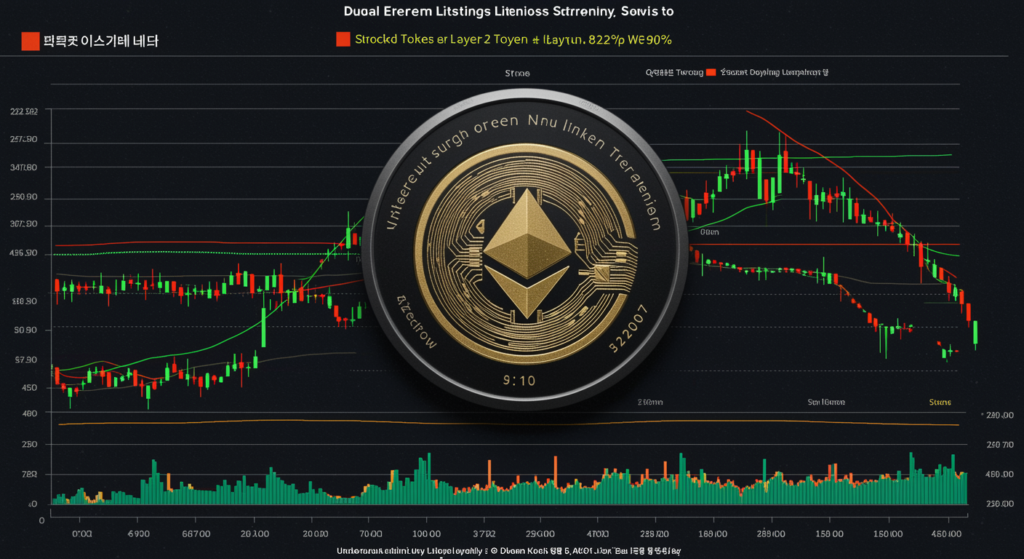
Privacy-focused Ethereum layer-2 token Aztec (AZTEC) posted a sharp rally after South Korean exchanges Upbit and Bithumb simultaneously launched KRW trading pairs, unleashing a wave of local buying in what had been a relatively illiquid market.
AZTEC climbed roughly 82% over 24 hours to trade near $0.035, driven largely by won-denominated demand following the dual listings.
Listings on major Korean exchanges often act as significant catalysts. Introducing a KRW pair shifts a token from being primarily traded against other cryptocurrencies to being directly accessible to South Korea’s sizable retail investor base.
South Korea routinely ranks among the world’s most active crypto markets on a per-capita basis. Upbit alone frequently rivals — and at times surpasses — Coinbase in daily spot trading volume during high-activity sessions.
A direct KRW pair removes the need to transact via stablecoins like USDT, plugs the asset into Korea’s highly engaged spot trading ecosystem, and places it front and center for local traders. For smaller-cap tokens such as AZTEC, that visibility can dramatically alter liquidity and price dynamics.
Historically, new listings on Upbit and Bithumb are treated as momentum events. Traders often rush in early, anticipating a liquidity surge and short-term premium before it compresses. Similar moves have been seen with other tokens, including VIRTUAL, which recorded double-digit gains on Korean listing announcements alone, regardless of broader project developments.
In thin order books, that influx of buying pressure can generate sharp, vertical price moves — precisely the pattern AZTEC displayed. As Korean prices spike, arbitrage traders typically step in, purchasing the token on global exchanges and selling into stronger local bids, helping lift prices across markets. During these episodes, the so-called “kimchi premium” — the gap between Korean and international prices — tends to widen before narrowing as arbitrage flows balance the spread.
Beyond the listing-driven momentum, Aztec promotes itself as an Ethereum-based layer 2 focused on privacy, using zero-knowledge proofs to enable encrypted transactions on a public blockchain. That technological narrative offers a longer-term angle beyond the immediate exchange catalyst.
By the Asian evening session, the premium had started to ease as arbitrage activity caught up and the initial burst of buying showed signs of cooling.
Rewrite the above article
Aztec (AZTEC) staged a sharp rally after South Korean crypto exchanges Upbit and Bithumb both launched KRW trading pairs for the privacy-focused Ethereum layer-2 token, unleashing a surge of local demand in an otherwise thin market.
The token climbed roughly 82% over 24 hours to trade near $0.035, driven primarily by won-denominated buying that followed the dual listings.
Listings on major Korean exchanges are often powerful catalysts. Adding a KRW pair shifts a token from crypto-to-crypto trading into direct access for South Korea’s large and highly active retail investor base.
South Korea consistently ranks among the top crypto-trading nations on a per-capita basis, and Upbit frequently rivals or even exceeds Coinbase in daily spot volume during peak sessions.
A direct KRW market removes the need for traders to route through stablecoins like USDT, embeds the asset into Korea’s vibrant spot trading culture, and puts it squarely in front of domestic investors. For smaller-cap tokens such as AZTEC, that kind of exposure can significantly reshape liquidity and price action.
Traders often treat new Upbit and Bithumb listings as short-term momentum plays, piling in ahead of deeper liquidity and before any initial premium fades. Similar reactions have been observed in the past, with tokens like VIRTUAL posting double-digit gains purely on Korean listing announcements, regardless of broader project developments.
In markets with shallow order books, this rush of demand can produce steep, vertical price spikes — the pattern AZTEC exhibited. As prices gap higher on Korean exchanges, arbitrage traders typically respond by buying on global platforms and selling into stronger local bids, helping lift international prices as well. During these episodes, the so-called “kimchi premium” — the spread between Korean and offshore markets — often widens sharply before narrowing as arbitrage flows close the gap.
Beyond the listing-driven surge, Aztec positions itself as a privacy-centric Ethereum layer 2 leveraging zero-knowledge proofs to enable encrypted transactions on a public blockchain, giving the project a narrative that extends beyond the immediate exchange catalyst.
By the Asian evening session, the premium had begun to narrow as arbitrage activity increased and the initial burst of buying showed early signs of fatigue.
About The Author




More Stories
Bitcoin Starts New Quarter Stuck in Familiar $82K-$85K Range
Citigroup Lifts 12-Month Bitcoin Target to $113K as ETF Inflows Return
Bitcoin’s Inflation-Fueled Jump to $85.5K Fades as Yields Stay High