

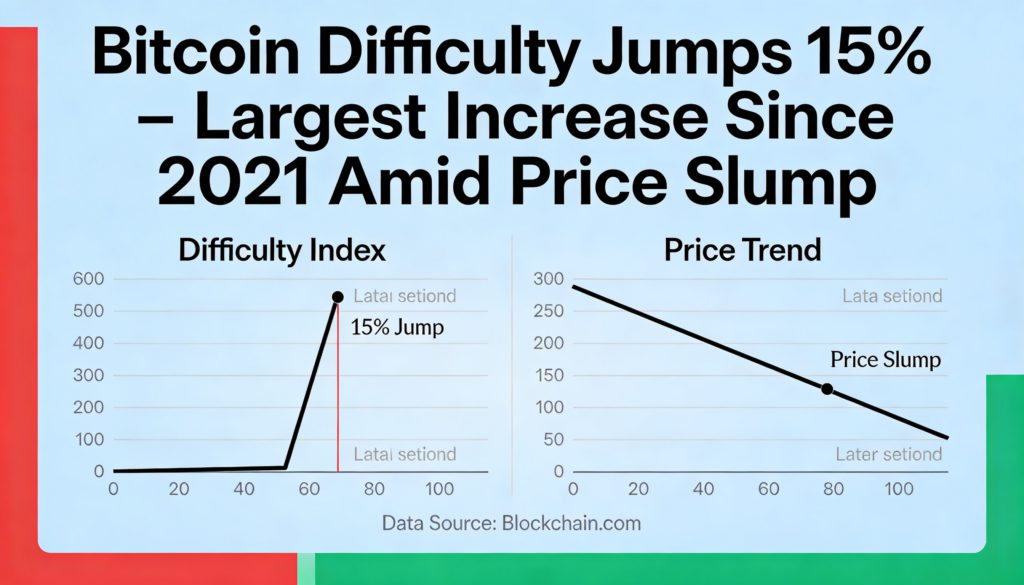
Bitcoin mining difficulty has surged to 144.4 trillion, rising 15% in its latest adjustment — the steepest percentage increase since 2021. The rebound comes as network hashrate climbs back to 1 zettahash per second (ZH/s), even though miner revenues remain under pressure at multi-year low hashprice levels.
Mining difficulty, which determines how challenging it is to produce a new block, adjusts every 2,016 blocks — roughly once every two weeks — to maintain the network’s average 10-minute block time. The sharp increase follows a prior 12% decline that occurred after hashrate weakened.
That earlier drop in computing power marked the most significant pullback since late 2021, when a severe winter storm in the United States forced several large mining operators to temporarily reduce output.
The network had previously reached record strength in October, when bitcoin’s price climbed to an all-time high near $126,500 and hashrate peaked at 1.1 ZH/s. As prices later slid to around $60,000 in February, hashrate fell to 826 exahash per second (EH/s). Since then, computing power has recovered to 1 ZH/s, alongside a price rebound toward $67,000.
Despite the improvement in network metrics, miner profitability remains strained. Hashprice — a measure of daily revenue earned per unit of hashrate — is hovering around $23.9 per petahash per second (PH/s), among the lowest levels seen in years.
Even so, large-scale miners with access to cheap and stable energy continue to operate aggressively. The United Arab Emirates, for example, is estimated to be sitting on roughly $344 million in unrealized profit from its mining activities.
Deep-pocketed operators capable of maintaining efficiency at lower margins are helping sustain elevated hashrate levels, reinforcing the network’s resilience despite softer bitcoin prices.
At the same time, industry dynamics are shifting. Part of the recent hashrate softness has been attributed to publicly listed mining firms reallocating energy and infrastructure toward artificial intelligence and high-performance computing (HPC) data centers.
Bitfarms (BITF) recently announced a rebrand that distances its identity from bitcoin as it ramps up its AI infrastructure focus. Meanwhile, activist investor Starboard has pressed Riot Platforms (RIOT) to accelerate its expansion into AI data center operations, highlighting a growing diversification trend across the mining sector.
About The Author





More Stories
U.S. Adds Just 29,000 Jobs in September as Unemployment Rate Hits 4.2%
Bitcoin Dominance Nears 60% as Crypto Traders Shift Into Risk-On Mode
Bitcoin Open Interest Surges $2.3B as Traders Increase Bullish Bets