

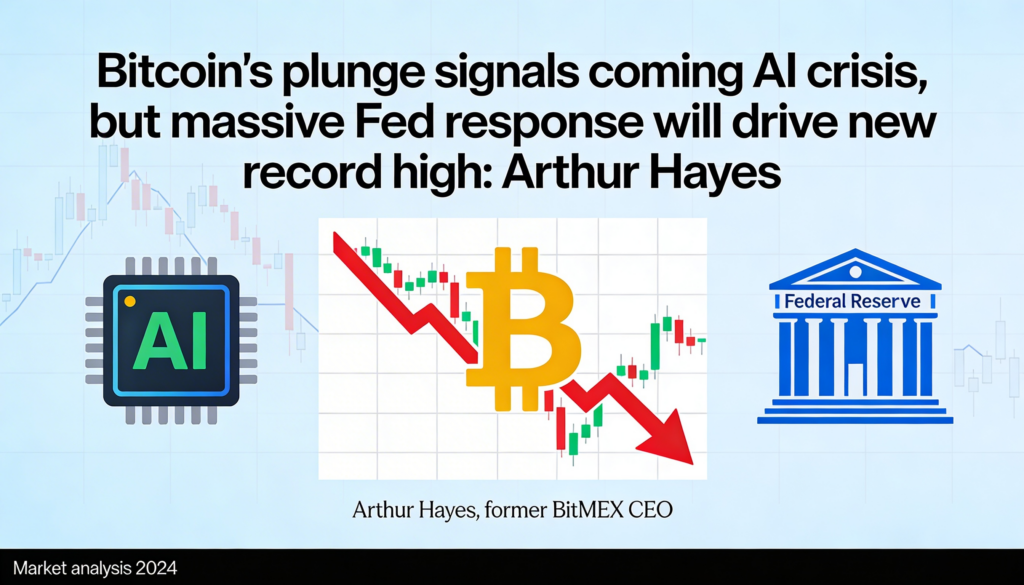
The accelerating adoption of artificial intelligence could displace millions of workers in a short span, setting off a wave of consumer credit stress and defaults, according to Arthur Hayes.
The BitMEX co-founder argues that bitcoin’s recent 52% slide from its October all-time high is not just a routine correction but an early warning of deeper financial strain ahead. BTC has fallen from $126,000 to around $67,000, even as the Nasdaq has traded relatively flat — a divergence Hayes views as significant.
In his latest essay, “This Is Fine,” Hayes describes bitcoin as the “global fiat liquidity fire alarm,” contending that it is the most sensitive freely traded asset to shifts in credit conditions. While equities have yet to fully reflect tightening financial stress, bitcoin’s sharp repricing suggests markets are bracing for a large-scale credit contraction.
Hayes models a scenario in which artificial intelligence eliminates 20% of America’s 72.1 million knowledge workers. In that case, roughly $557 billion in consumer credit and mortgage debt could default — about half the scale of the 2008 financial crisis. Such a shock, he argues, would hit regional banks especially hard and ultimately force the Federal Reserve into an unprecedented round of monetary expansion.
“Deflation is bad, but ultimately good for fiat credit-sensitive assets like bitcoin,” Hayes wrote. In his view, markets first price in the destruction phase. Then, once policymakers respond with aggressive liquidity measures, risk assets rebound sharply.
He also pointed to gold’s recent strength relative to bitcoin as another cautionary signal. A rally in gold alongside a weakening bitcoin, Hayes said, reflects mounting deflationary and risk-off pressures within the U.S.-led financial system.
Once the Fed steps in — similar to its emergency response during the regional banking turmoil of March 2023 — Hayes expects bitcoin to rebound decisively from its lows. Sustained money printing and renewed liquidity injections, he believes, would propel the cryptocurrency to fresh all-time highs.
However, Hayes cautioned that further downside is possible before any policy pivot materializes. Political gridlock could delay action, potentially pushing bitcoin below $60,000. For now, he advises investors to remain liquid, avoid excessive leverage and wait for a clear signal from the Federal Reserve before aggressively rotating back into risk assets.
About The Author





More Stories
Bitcoin Starts New Quarter Stuck in Familiar $82K-$85K Range
Citigroup Lifts 12-Month Bitcoin Target to $113K as ETF Inflows Return
Bitcoin’s Inflation-Fueled Jump to $85.5K Fades as Yields Stay High