

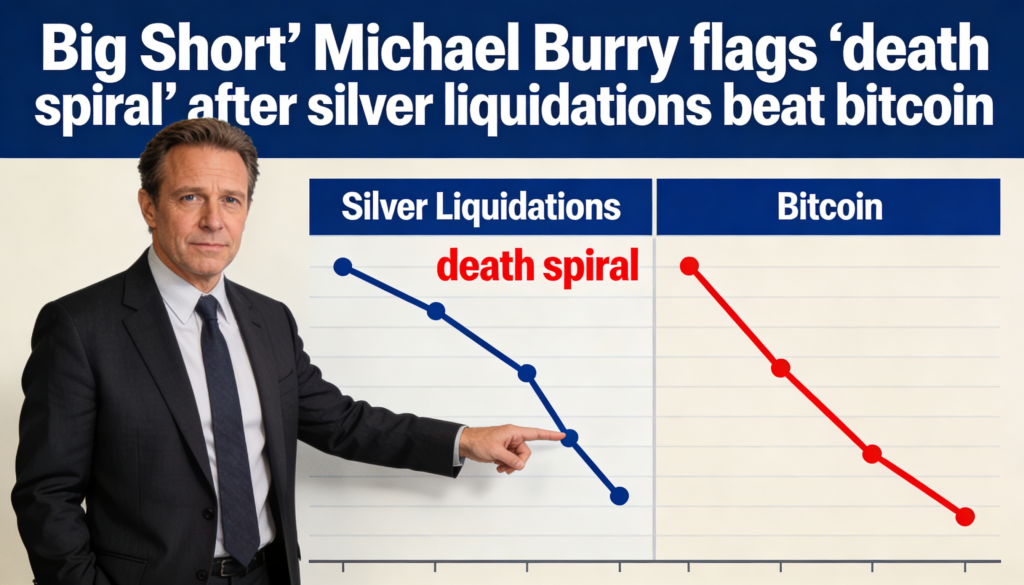
Tokenized silver futures triggered one of the largest liquidation waves across crypto markets this week, briefly overtaking bitcoin and ether as the main source of forced selling.
The crypto-native version of silver proved more volatile than bitcoin during the selloff, leaving heavily leveraged traders with steep losses. Hedge fund manager Michael Burry, known for “The Big Short,” described the episode as a self-reinforcing feedback loop in which falling prices triggered liquidations that pushed prices even lower.
In a note published this week, Burry labeled the move a “collateral death spiral,” arguing that excessive leverage across crypto trading venues amplified the decline. As crypto collateral values fell, traders were forced to dump tokenized metals positions to meet margin requirements, accelerating the unwind.
“Sky-high leverage on these crypto exchanges tied to rising metals prices meant that as the crypto collateral fell, the tokenized metals had to be sold,” Burry said. “This is a collateral death spiral.”
Burry noted that silver-related liquidations surpassed bitcoin liquidations on at least one crypto venue during the episode. “It was reported that tokenized silver futures liquidations actually exceeded Bitcoin liquidations on one crypto market called, ironically, Hyperliquid,” he added.
The move was driven less by bitcoin-specific weakness and more by positioning in metals markets, where a sharp pullback collided with crowded leverage and thin liquidity. At the height of the selloff, tokenized silver futures ranked among the largest wipeouts across crypto markets, overtaking the usual liquidation leaders, bitcoin and ether.
Tokenized metals products allow traders to take directional exposure to gold, silver, and copper using crypto-native platforms rather than traditional futures exchanges. These contracts trade around the clock and often require less upfront capital, making them appealing during periods of volatility. But that same structure can accelerate forced selling when trades become crowded.
As metals prices rolled over, leveraged long positions were forced to unwind. Liquidations surged as traders failed to meet margin calls or had positions automatically closed by platforms. On Hyperliquid, one of the most active venues for these instruments, silver-linked liquidations briefly exceeded those tied to bitcoin—an unusual moment in which a macro-linked contract became the dominant driver of market stress.
The episode also coincided with tighter risk conditions in traditional markets. CME Group raised margin requirements for gold and silver futures, increasing collateral demands and pressuring leveraged traders to either post additional capital or reduce exposure. While those changes apply directly to CME contracts, market participants say shifts in positioning and risk appetite can quickly spill into tokenized markets tracking the same underlying assets.
The broader takeaway is that crypto venues are increasingly serving as alternative rails for macro trades—not just crypto. In periods of stress, that evolution can flip the liquidation hierarchy in ways many traders don’t expect.
About The Author





More Stories
Bitcoin Falls Below $82K as AI Fears Resurface and DeFi Tokens Sink
Crypto Traders Value Reliance Jio IPO at $110 Billion
Asian Markets Slide as Bitcoin Pulls Back and China Enters Bear Territory