

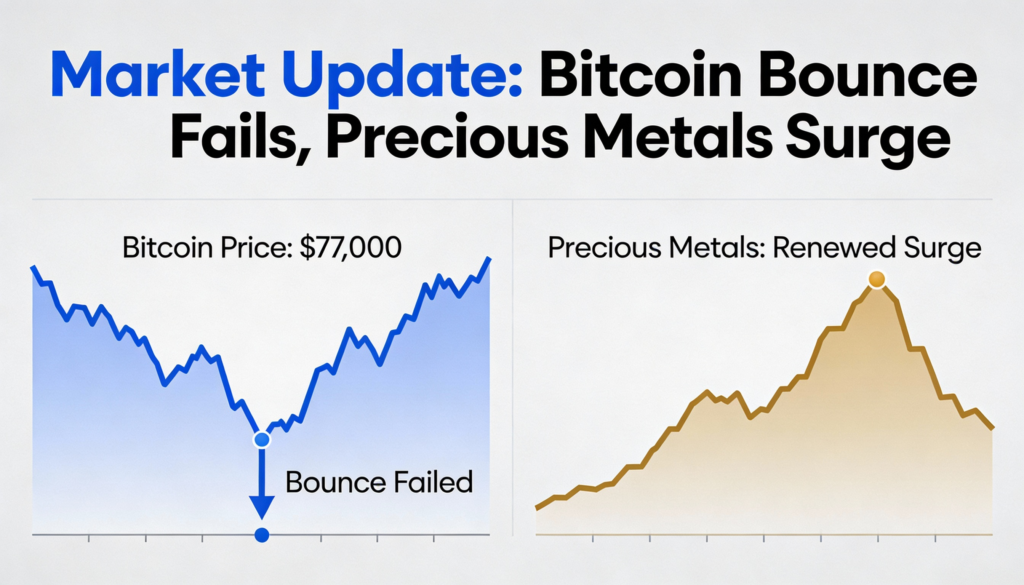
Bitcoin slipped back during U.S. trading hours on Tuesday after failing to hold a rebound from the weekend’s sharp selloff, while precious metals surged as investors rotated into traditional safe havens.
After climbing roughly 7% from panic-driven lows near $74,000 to trade above $79,000, bitcoin reversed course and was last changing hands around $77,100, down about 2% over the past 24 hours. Ether underperformed, falling 4.7% to roughly $2,260.
The renewed weakness in crypto coincided with a powerful rebound in precious metals. Silver jumped nearly 15% on the day, while gold extended gains toward the $5,000-per-ounce level following a 6.5% advance.
U.S. equities also came under pressure, led by declines in large-cap technology and artificial intelligence-related stocks. Nvidia, Oracle, Broadcom, Micron, and Microsoft were each down between 3% and 5%, dragging the Nasdaq lower by about 1%.
Crypto-linked equities largely tracked the broader risk-off move. Strategy, the largest publicly traded bitcoin holder, slid more than 2% to fresh lows, while Coinbase and Bullish posted similar declines. Galaxy Digital dropped over 12% following weaker-than-expected fourth-quarter results, and stablecoin issuer Circle fell another 3.5%.
Some bitcoin miners that have pivoted toward AI infrastructure bucked the trend. TeraWulf shares surged 12% after the company announced the acquisition of two U.S. industrial sites that could more than double its power capacity to 2.8 gigawatts. Cipher Mining rose 4% after unveiling plans to raise $2 billion in high-yield debt to fund its Black Pearl data center in Texas, a project expected to deliver 300 megawatts under a long-term agreement with Amazon Web Services.
Dead-cat bounce
Options market activity suggests traders are preparing for a short-lived rebound rather than a sustained recovery, according to Jake Ostrovskis, head of OTC at crypto trading firm Wintermute.
Ostrovskis said the lack of demand for upside exposure mirrors conditions seen in April 2025, when brief rallies failed to gain traction. Heavy buying of near-term downside protection has pushed short-dated implied volatility above longer-dated contracts, creating a backwardated options curve.
That structure typically reflects heightened near-term fear, he said, adding that he is watching for volatility to cool and the curve to normalize back into contango as a potential signal that a more durable bottom is forming.
About The Author





More Stories
Bitcoin Stays Above $81K as Markets Stabilize and Oil Prices Rise
Bitcoin Holds Near $81,700 as Altcoins Recover and PEPE Jumps 13%
Bitcoin May Be Breaking Away From Its Midterm Cycle Bottom Pattern