

Bitcoin Hashrate Falls During U.S. Winter Storm, Highlighting Mining Concentration Risks
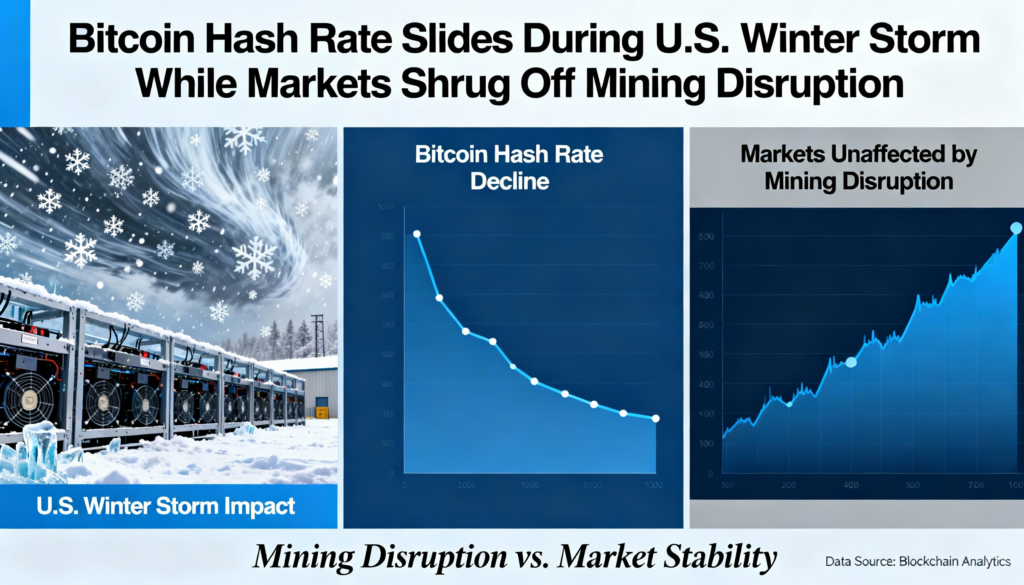
Bitcoin’s hashrate dropped roughly 10% on Sunday amid a U.S. winter storm, offering a real-world test of a risk long highlighted by researchers: concentrated mining can turn local infrastructure failures into network-wide stress. Despite the decline, markets showed little immediate reaction.
Hashrate measures the computing power supporting the Bitcoin blockchain. When it falls, transaction processing slows until difficulty adjusts. Although only about 10% of the network went offline, the episode underscores growing exposure from mining centralization.
Academic research illustrates the stakes. In the 2021 paper Bitcoin Blackout: Proof-of-Work and the Risks of Mining Centralization, Philipp Scharnowski and Jiahua Shi found that a regional mining outage in China caused longer block times, higher fees, and weaker market quality—showing how concentrated mining can magnify localized disruptions.
Concentration has increased over time. The top two mining pools often control more than 50% of hashrate, while the top six account for 80–90% of all blocks, leaving much of Bitcoin’s processing in the hands of a few operators.
For now, markets remain largely unfazed, but the storm highlights how mining centralization can transform physical outages into system-level stress without immediately affecting price.
About The Author





More Stories
Bitcoin Stays Above $81K as Markets Stabilize and Oil Prices Rise
Bitcoin Holds Near $81,700 as Altcoins Recover and PEPE Jumps 13%
Bitcoin May Be Breaking Away From Its Midterm Cycle Bottom Pattern