

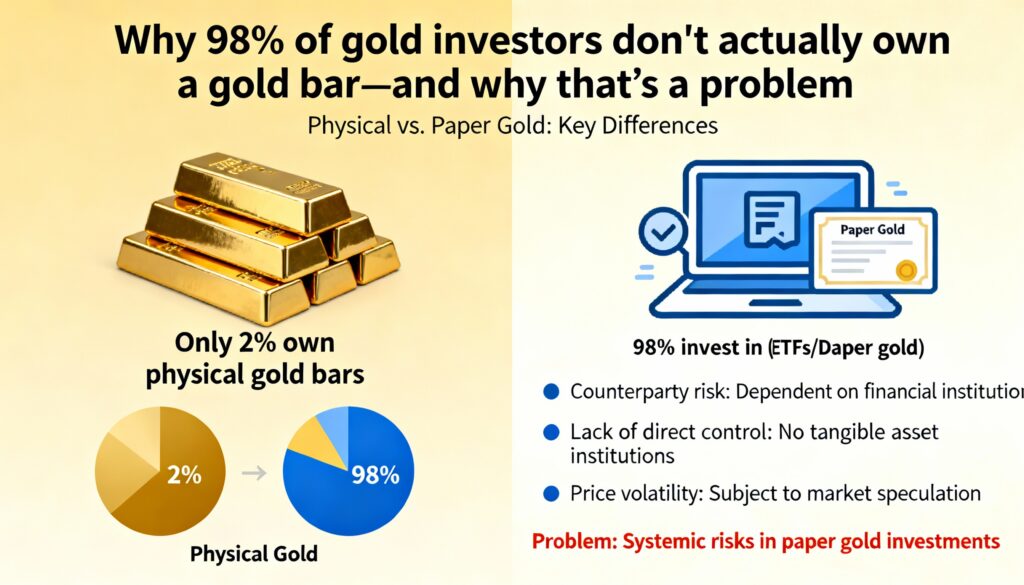
Aurelion has turned to tokenized gold as concerns grow over vulnerabilities in the paper gold market.
A surge in demand has pushed gold prices up more than 80% over the past year, making the metal one of the best-performing assets across global markets. But beneath the rally, a structural risk is building—one most investors are overlooking, according to Björn Schmidtke, CEO of Aurelion (AURE), a gold-treasury firm focused on blockchain-based assets.
The problem, Schmidtke argues, lies in how most investors gain exposure to gold.
For the vast majority, buying gold means purchasing shares of an exchange-traded fund or other forms of what he calls “paper gold.” These instruments offer price exposure without the need to store or transport physical bullion. But they also blur a crucial distinction between owning gold and holding a claim on it.
“When people buy paper gold, they believe they own a gold bar,” Schmidtke said in an interview with CoinDesk. “In reality, they own a piece of paper that says, ‘I owe you gold,’ and everyone agrees that paper has value.”
That abstraction works smoothly—until it doesn’t.
A system built on IOUs
According to Schmidtke, roughly 98% of global gold exposure is effectively unallocated, meaning investors collectively hold billions of dollars’ worth of claims without knowing which specific gold bars back them. The system has functioned for decades largely because few investors ever request physical delivery.
But Schmidtke warns that this equilibrium could break during a crisis.
In a scenario where fiat currencies rapidly lose value, investors could rush to claim the physical gold they believe they already own. At that point, questions emerge: Who owns which bar? Where is the proof? And how does delivery actually happen?
“You simply cannot move a few billion dollars’ worth of physical gold in a single day,” Schmidtke said. Without clear ownership records, the logistical challenges could escalate quickly, creating a bottleneck that strains the market’s ability to settle claims.
In such a “seismic event,” physical gold prices could spike while paper gold prices lag, leaving holders of derivatives unable to redeem their positions. Schmidtke points to past episodes in the silver market, where premiums on physical metal surged even as spot prices remained subdued.
“We’ve already seen this dynamic play out,” he said. “We believe it could happen in gold as well.”
Why onchain gold is different
Schmidtke believes tokenized gold offers a structural solution.
He compares the paper gold system to a hypothetical real estate project in which investors buy shares promising future delivery of housing units—but never sign a deed. When it comes time to hand over the properties, no one can easily determine which investor owns which unit, creating delays, disputes, and confusion.
Tokenized gold, he argues, fixes that problem by embedding ownership at the point of purchase.
With Tether Gold (XAUT), each token is linked to a specific, allocated gold bar stored in a Swiss vault. Ownership is recorded onchain, effectively creating a transferable title deed that can move globally in seconds, independent of the physical movement of the metal itself.
While delivering physical gold would still take time, Schmidtke says the critical difference is clarity. Ownership is provable, traceable, and searchable, reducing the risk of settlement failures during periods of stress.
“Decoupling ownership from physical delivery removes a major bottleneck,” he said. “You know exactly which gold bar is yours.”
Aurelion’s strategy shift
That philosophy now underpins Aurelion’s treasury strategy.
The firm has transitioned its holdings to XAUT, a blockchain-based gold token backed by allocated bullion held in Swiss vaults. Schmidtke argues that the token combines the efficiency of digital transactions with the assurance of physical settlement.
“How you own gold matters just as much as whether you own gold,” he said.
Schmidtke views XAUT as still early in its adoption curve, with significant room to scale as investors reassess counterparty and settlement risks in traditional gold markets.
Aurelion has no plans to reduce its holdings unless market prices trade at a “significant and sustained discount” to the value of its underlying gold. Instead, the firm is focused on long-term accumulation and capital growth.
“This isn’t a short-term arbitrage trade,” Schmidtke said. “It’s about building a durable gold equity that investors can participate in over time.”
The company plans to raise additional capital over the coming year to expand its gold treasury. According to CoinGecko data, Aurelion currently holds 33,318 XAUT tokens, valued at roughly $153 million.
About The Author




More Stories
SEC Set to Delay Tokenization ‘Innovation Exemption’ Again Amid Pushback
SEC Scraps Scheduled Reg Crypto Meeting, Leaves Proposal Timeline Unclear
Live: Bitcoin Falls Below $63K as Oil and Treasury Yields Rise