

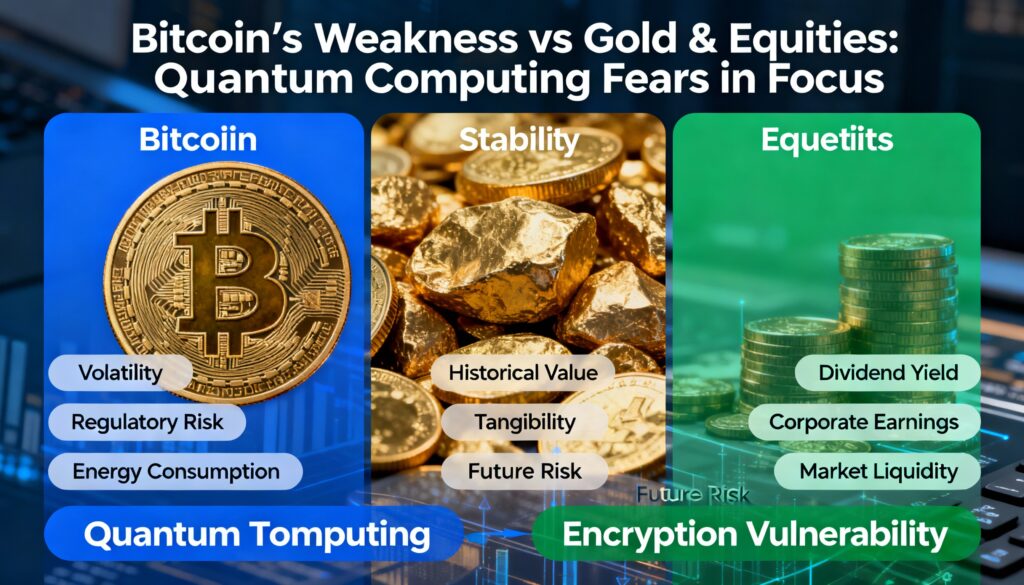
Quantum Computing Fears Resurface as Bitcoin Lags, But Analysts Point to Market Structure
Recent weakness in Bitcoin has reignited debate over quantum computing risks, though analysts and developers argue that conventional market forces are the main drivers.
On Thursday, gold rose 1.7% to a record $4,930 an ounce and silver jumped 3.7% to $96, while Bitcoin slid to just above $89,000, roughly 30% below its early-October peak. Since Trump’s November 2024 election win, Bitcoin is down 2.6%, compared with gains of 205% for silver, 83% for gold, 24% for the Nasdaq, and 17.6% for the S&P 500.
Castle Island Ventures partner Nic Carter sparked the latest round of chatter, attributing Bitcoin’s “mysterious” underperformance to quantum computing and calling it “the only story that matters this year.”
Other market watchers remain skeptical. @Checkmatey, an onchain analyst at Checkonchain, said blaming sideways price action on quantum fears is akin to attributing red candles to market manipulation. According to him, Bitcoin’s movement reflects supply, positioning, and HODLer sell pressure, not futuristic risks.
Prominent Bitcoin investor Vijay Boyapati echoed the view, noting that recent weakness stems from whales unlocking large supplies around key price milestones.
Quantum computing has long been discussed as a theoretical threat to Bitcoin’s cryptography. Advanced machines running Shor’s algorithm could, in principle, break elliptic curve encryption securing wallets. But most developers say such machines remain decades from practical use. Blockstream co-founder Adam Back described the threat as extremely remote, and Bitcoin Improvement Proposal 360 already outlines a gradual path to quantum-resistant addresses if needed.
Some traditional finance voices are paying attention. Jefferies strategist Christopher Wood recently removed Bitcoin from a model portfolio, citing quantum computing as a long-term risk.
As CoinDesk has reported, the key question is not whether Bitcoin could eventually adapt, but how long such an upgrade would take—measured in years, not market cycles—making it an unlikely explanation for short-term price moves.
About The Author




More Stories
Bitcoin Falls Below $82K as AI Fears Resurface and DeFi Tokens Sink
Crypto Traders Value Reliance Jio IPO at $110 Billion
Asian Markets Slide as Bitcoin Pulls Back and China Enters Bear Territory