

The market is now watching closely to see whether bitcoin can hold its key support levels into the new year, after December’s stalled rally raised concerns that the recent pullback may not be finished.
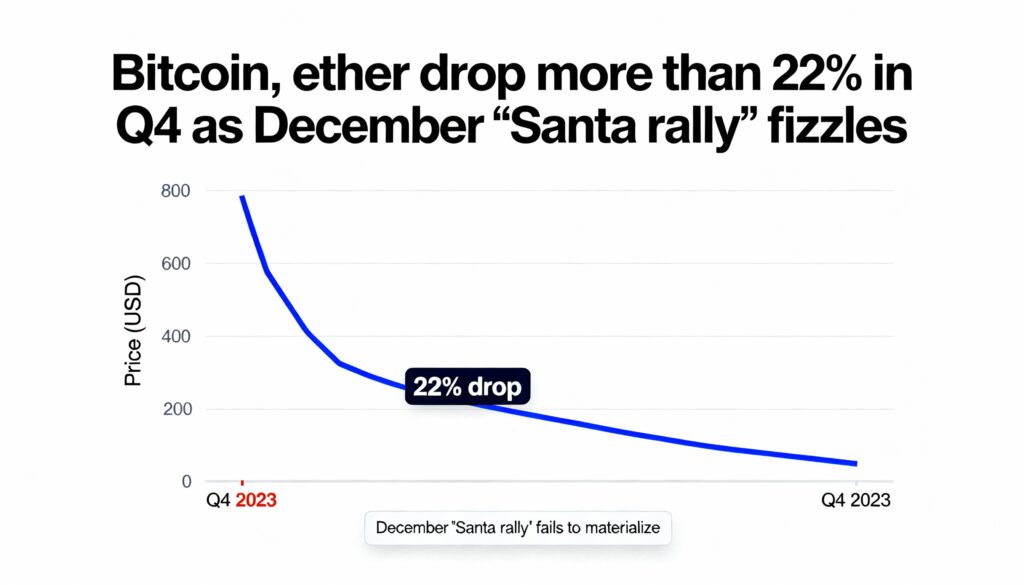
Bitcoin and ether wrapped up December without delivering the year-end surge traders often count on, closing out a quarter that highlighted how quickly crypto momentum can fade when liquidity dries up and risk appetite weakens. The much-discussed “Santa rally” never gained traction. Each attempt by bitcoin to reclaim important technical thresholds was met with selling, while ether and other large-cap tokens moved lower in tandem.
Bitcoin is on track to end December down roughly 22%, its worst monthly decline since December 2018. Ether, meanwhile, is set to finish the fourth quarter of 2025 down 28.07%, according to CoinGlass data.
The Santa rally refers to a seasonal pattern in which markets tend to rise in the final week of December and the first days of January, often supported by thin liquidity, year-end portfolio adjustments, and upbeat holiday sentiment. This year, however, December trading activity looked more like a broad positioning reset than the start of a renewed upswing.
That weak close is notable because crypto markets have historically relied on strong late-year flows to establish momentum for the early phase of a new cycle. With bitcoin’s fourth-quarter performance turning decisively negative, price action now reflects a risk-off tone rather than a renewed appetite for risk.
The contrast with precious metals has been especially pronounced. Gold has climbed to record highs amid expectations of rate cuts and elevated geopolitical tensions, while silver has rallied sharply and platinum has also posted new highs, as previously reported by CoinDesk. Ongoing central bank buying and rising ETF inflows have reinforced gold’s appeal as a hedge during periods of uncertainty.
Bitcoin, by comparison, has traded more like a high-beta asset. Even with macro conditions increasingly pointing toward easier policy, the cryptocurrency has struggled to sustain gains without broader participation from risk assets.
That dynamic has been a defining feature of late 2025, with rallies quickly sold, leverage pared back over the holidays, and U.S. trading hours often seeing the heaviest selling as funds reduce exposure. Volatile bond yields and an uneven dollar have kept investors focused on capital preservation — an environment that tends to favor gold before speculative assets.
The immediate question is whether bitcoin can hold its recent support zones as the new year begins. If those levels fail, the aborted Santa rally may come to be seen as an early warning that the market still needs a deeper reset before the next sustained advance can take shape.
About The Author





More Stories
Smaller Altcoins Rally as Bitcoin Holds Near $85,000
U.S.-China AI Rivalry Intensifies as Chinese Firms Raise Billions Ahead of IPOs
Bitcoin Is Down 32% From Its $126K Record High One Year Later