

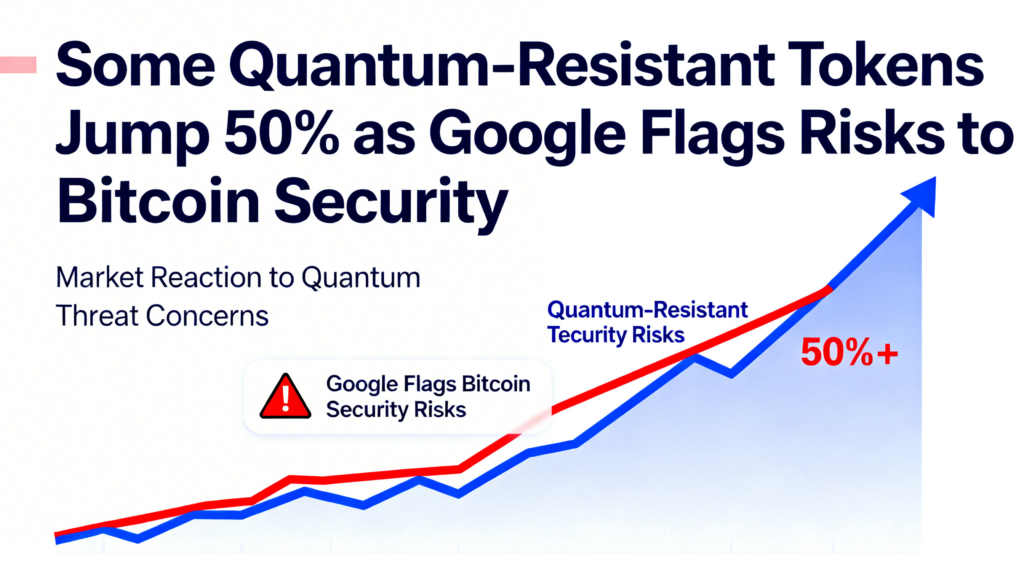
Interest in quantum-resistant cryptocurrencies has surged, with traders rotating into assets perceived as better positioned for long-term security. The move follows a fresh research update from Google’s quantum computing division, which has prompted markets to reassess the potential impact of future technological breakthroughs on existing blockchain systems.
Major cryptocurrencies such as bitcoin and ether have shown only limited movement over the past 24 hours. In contrast, a group of tokens associated with post-quantum cryptography has posted outsized gains, with several rising more than 50%. The divergence highlights how quickly investors are reacting to emerging, even if still theoretical, risks.
The catalyst stems from new findings by Google’s Quantum AI team, suggesting that breaking the elliptic-curve cryptography used by Bitcoin may require fewer than 500,000 qubits—significantly below prior estimates. This has led some analysts to flag the end of the decade, around 2029, as a potential timeline for when blockchain networks may need to upgrade their security infrastructure.
The research indicated that a sufficiently advanced quantum computer could potentially compromise Bitcoin’s defenses within minutes. Separate analysis has also pointed to vulnerabilities in Ethereum, outlining multiple attack pathways that could expose large amounts of value locked across DeFi and tokenized ecosystems.
While such quantum capabilities are not yet a reality, the market response suggests investors are increasingly pricing in long-term risks ahead of time.
Over the past day, demand has risen for projects emphasizing post-quantum resilience or advanced cryptographic frameworks. Tokens like Quantum Resistant Ledger (QRL) and Cellframe (CEL) have surged roughly 50%, while others such as Abelian (ABEL) have climbed around 25%. Additional gains have been seen in Qubic (QUBIC) and QANplatform (QANX), with privacy-focused Zcash (ZEC) also advancing.
Altogether, the market capitalization of this segment—comprising around 20 tokens—has risen to approximately $4.66 billion, reflecting growing investor focus on future-proof security narratives. Although Zcash is not fully quantum-resistant today, its use of zero-knowledge proofs and ongoing work on post-quantum cryptography keeps it aligned with the broader theme.
Even though the risks remain largely theoretical, their influence on market behavior has been building. Some analysts believe concerns about quantum threats have already weighed on Bitcoin’s relative performance. Capriole Investments founder Charles Edwards has argued that these concerns contributed to Bitcoin’s underperformance against traditional assets in the latter half of 2025, when it declined sharply from its highs.
Notably, that same period coincided with a significant rally in Zcash, which surged more than 1,200% to a peak near $744. The move illustrates how quickly capital can shift toward narratives centered on long-term technological resilience within the crypto market.
About The Author

More Stories
XRP remains near $1.34 amid shrinking supply, but upward momentum remains elusive.
The cryptocurrency is approaching levels considered a favorable entry point, unseen in three years.
Moody’s assigns a rating to the first-ever bitcoin-backed public bond offering.