

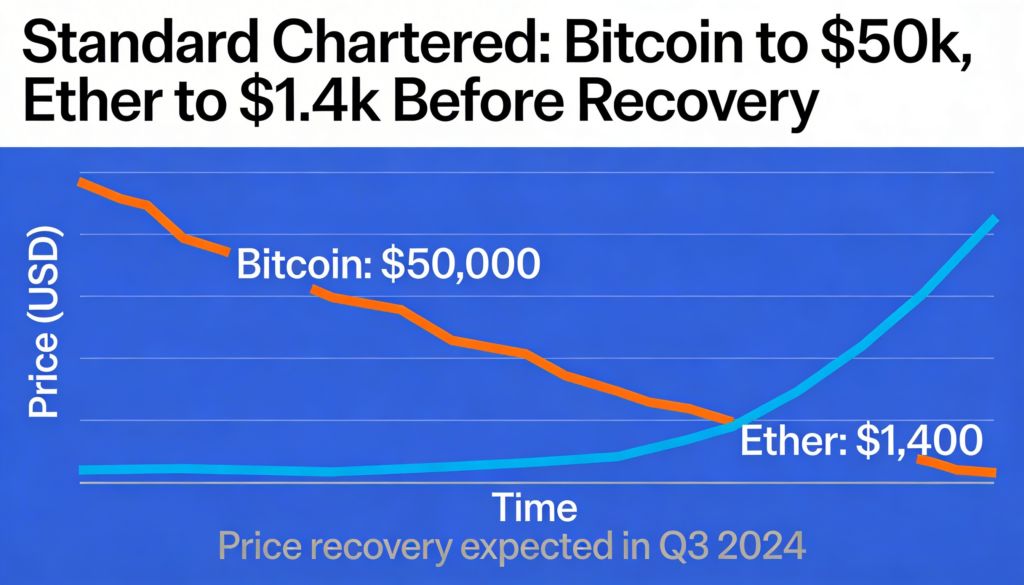
Standard Chartered has revised lower its near-term and 2026 cryptocurrency forecasts, warning that continued ETF outflows and macroeconomic headwinds could drive another leg down before a sustainable recovery takes hold.
The bank now expects bitcoin to decline toward $50,000 in the months ahead, with ether potentially sliding to around $1,400 before finding support. At the time of writing, bitcoin was trading near $67,900 and ether around $1,980.
Geoff Kendrick, Standard Chartered’s head of digital assets research, said the recent downturn may not be over. Many investors in crypto exchange-traded funds are currently underwater, he noted, making them more inclined to reduce exposure than to “buy the dip.”
Although Kendrick anticipates a rebound once a bottom is established, he lowered his end-2026 price targets across major tokens. The bank now forecasts bitcoin at $100,000 by year-end, down from its prior $150,000 estimate. Ether’s target was cut to $4,000 from $7,500. Projections for other large-cap assets were also reduced: solana to $135 from $250, BNB to $1,050 from $1,755, and AVAX to $18 from $100.
Digital assets have come under pressure in early 2026, with bitcoin down nearly 23% year-to-date and well below its late-2025 peak. The broader market has experienced heightened volatility and significant liquidations of leveraged positions, contributing to a sharp drop in total market capitalization.
Risk appetite has weakened as cryptocurrencies have moved more in tandem with struggling equity markets. Concerns about global growth and uncertainty over the path of interest rates have steered investors toward traditional safe-haven assets such as gold. In addition, stalled regulatory progress in the U.S. and liquidity constraints at certain institutions have further dampened sentiment, weighing on trading volumes and revenues across the sector.
Kendrick highlighted that bitcoin ETF holdings have declined by nearly 100,000 BTC from their October 2025 peak. With the average ETF entry price estimated at around $90,000, many investors are facing unrealized losses of roughly 25%, increasing the likelihood of further redemptions.
Macroeconomic dynamics remain a constraint. While U.S. economic data shows signs of cooling, markets do not expect interest-rate cuts before Kevin Warsh’s first Federal Open Market Committee meeting as Federal Reserve chair in mid-June, limiting near-term support for risk assets.
Even so, the bank emphasized that the current drawdown is less severe than previous crypto bear markets. At its lowest point in early February, bitcoin was down about 50% from its October 2025 all-time high, with approximately half of the circulating supply still in profit — a meaningful correction, but not as extreme as past cycle declines.
Notably, this downturn has not been accompanied by the collapse of major crypto platforms, unlike the failures of Terra/Luna and FTX in 2022. Kendrick said that resilience signals a maturing asset class.
Standard Chartered left its longer-term outlook unchanged, maintaining end-2030 price targets of $500,000 for bitcoin and $40,000 for ether, citing ongoing adoption trends and structural growth drivers.
About The Author

More Stories
Coinbase misses fourth-quarter forecasts with trading revenue slipping below $1 billion.
Bitcoin retreats toward last week’s floor as AI worries hit tech and metals markets tumble.
STRC returns to the $100 mark, positioning Strategy for further Bitcoin purchases.