

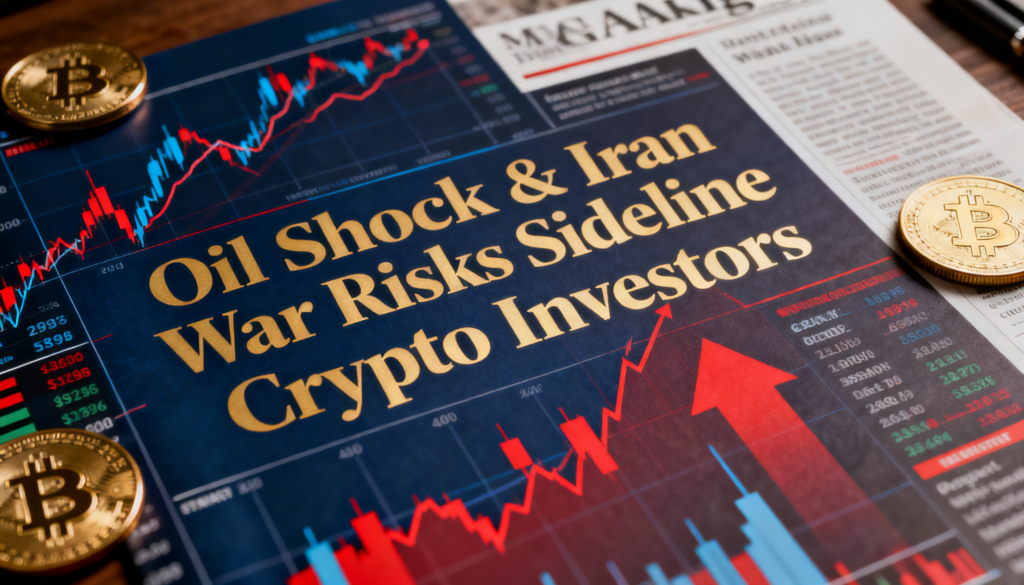
Crypto markets are holding in a tight range as escalating tensions in the Middle East weigh on investor sentiment, interrupting what had been a more constructive macro outlook, according to digital asset manager Grayscale.
In its latest report, the firm said the Iran conflict has become the primary force shaping markets, overshadowing earlier signs of strengthening global growth and a potential pivot toward interest rate cuts by central banks. That narrative has since shifted as surging oil prices reignited inflation concerns, pushing rate expectations higher and reducing appetite for risk assets.
Since the conflict intensified, crypto prices have been volatile but largely directionless, reacting to headline-driven moves in oil and broader risk sentiment. Bitcoin initially fell into the mid-$60,000 range during the first escalation, later rebounding toward the low-$70,000s before losing ground again as tensions persisted and financial conditions tightened.
More recently, a fresh wave of escalation has pushed bitcoin about 10% below its March highs, with ether and other digital assets also declining as investors pulled back. Even so, crypto has demonstrated relative resilience. Bitcoin has remained broadly unchanged since the conflict began and has at times outperformed equities, highlighting both its exposure to macro shocks and its underlying strength.
Grayscale expects many investors to remain cautious in the near term, waiting for greater clarity around geopolitical developments and energy markets. A de-escalation in tensions, coupled with a decline in oil prices, could quickly improve the macro environment and support a recovery in risk assets. Conversely, persistently high energy costs may continue to weigh on growth and delay a broader rebound.
Despite ongoing uncertainty, crypto valuations have remained relatively stable, suggesting that a more durable bottom may be taking shape. The firm also pointed to continued inflows into spot crypto investment products and rising activity in derivatives markets as signs that risk appetite is gradually stabilizing beneath the surface.
Looking ahead, Grayscale argues that easing macro uncertainty will be key to unlocking the next sustained move higher. However, it maintains that the long-term fundamentals of the asset class remain intact, particularly the continued expansion of stablecoins and tokenized assets.
The stablecoin market has seen significant growth, rising from roughly $20 billion in 2020 to over $300 billion by 2025, and currently stands near $315 billion. About $100 billion of that increase came in 2025 alone, reflecting renewed momentum after a brief slowdown and strong demand for dollar-pegged assets across trading, payments, and on-chain finance.
According to the report, periods of elevated uncertainty like the current environment have historically created attractive entry points for long-term investors positioning for the next phase of growth in digital assets.
About The Author




More Stories
U.S. job growth exceeds estimates with 178,000 added in March
Crypto markets stabilize amid fading volatility, but futures lean bearish
Naoris Protocol debuts quantum-resistant chain as Bitcoin, Ethereum face looming ‘Q-Day’ challenge