

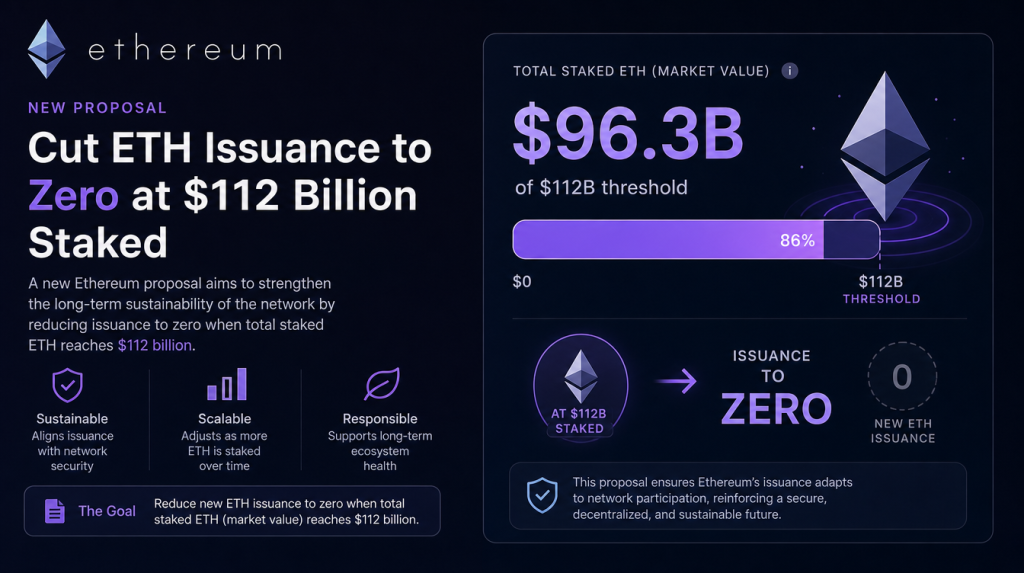
Ethereum researchers and developers have introduced a proposal that would gradually increase the amount of validator rewards burned as the network’s staking ratio rises.
The draft, known as EIP-8361, suggests increasing the burn rate of newly issued ETH until it reaches 100% once around 60.25 million ETH—roughly half of the total supply—is staked. At that point, Ethereum’s net issuance would fall to zero, potentially improving ETH’s scarcity by preventing further dilution for existing holders.
Ethereum relies on staking to secure the network. Users lock up ETH and operate validators that confirm transactions, receiving newly issued ETH as rewards. Under the proposal, those rewards would not be fully distributed. Instead, a growing portion would be permanently removed from circulation through burning.
At the end of every Ethereum epoch, which lasts about 6.4 minutes, a percentage of validator rewards would be destroyed rather than issued. That percentage would gradually increase in a linear manner until reaching the full burn rate as staking approaches the proposed threshold.
Validators would continue earning transaction fees and tips from block production, and their duties would remain unchanged. The only difference would be that newly created ETH rewards would increasingly be burned. The transition would be gradual, with the change expected to roll out over an 18-month adjustment period following roughly six months of preparation, giving the ecosystem about two years to adapt.
The proposal was signed by six Ethereum researchers, including Ethereum Foundation researcher Justin Drake. It was introduced shortly before the deadline for smaller changes to be considered for Hegotá, Ethereum’s upcoming network upgrade.
According to the authors, the issue is that Ethereum’s staking model continuously encourages more deposits. Even if all ETH were staked, the network would still offer a yield of around 1.5%, creating an incentive for additional staking.
Proposal co-author Jérôme de Tychey estimates that more than 70 million ETH could be staked by January 2028 if the current system remains unchanged. Beyond a certain point, the proposal argues, additional staking could reduce network security rather than improve it, as more ETH becomes concentrated with exchanges and staking providers while smaller independent validators struggle to compete.
Currently, about 41 million ETH—roughly 34% of total supply—is staked. Another 2.5 million ETH is waiting in the activation queue, with delays extending beyond six weeks, while withdrawals remain limited by Ethereum’s exit queue system.
Ethereum controls the rate at which validators can enter and leave the network to prevent sudden changes that could threaten stability. At present, around 57,600 ETH can become active validators each day.
The proposal has sparked debate across the Ethereum ecosystem.
Aave Labs CEO Stani Kulechov argued that reducing staking rewards toward zero could disrupt ETH borrowing strategies. Many ETH loans on Aave are used to purchase additional staked ETH, a strategy that depends on staking returns exceeding borrowing costs.
Liquid staking protocol ether.fi founder Mike Silagadze criticized both the proposal’s rollout and its potential impact. He argued that introducing a major economic change with limited notice could have significant consequences for decentralized finance.
Silagadze warned that lowering staking rewards could hurt independent validators while favoring large centralized staking providers with lower operating costs. He also suggested that several major DeFi protocols could experience capital outflows if the change moves forward.
On the price impact, Silagadze argued that reduced staking incentives could discourage new ETH deposits and potentially push large amounts of previously staked ETH back into circulation.
The larger question is whether EIP-8361 will be included in the Hegotá upgrade, which is expected in the second half of 2026 and focuses on improving Ethereum’s structure, censorship resistance, and state efficiency.
The proposal represents a major shift in Ethereum’s monetary policy by potentially eliminating staking-based ETH issuance once half of the supply is locked. However, it arrives only days before the Aug. 6 deadline for Hegotá changes, with limited implementation work completed and no broad agreement among validators and stakers.
Given the timing and uncertainty around consensus, the proposal may be more likely to be delayed until a future upgrade rather than included in Hegotá. The authors note that each month of delay could allow the staking ratio to increase by roughly another 1.5 percentage points.
About The Author





More Stories
Bond Volatility Surges as Bitcoin and Wall Street Remain Calm
Altcoins Surge as Bitcoin Holds Near $84,000
Bitcoin ETF Flows Turn Positive in 2026 After Erasing $5.8B Deficit