


Crypto industry experts are pushing back after billionaire hedge fund manager Ray Dalio renewed his criticism of Bitcoin, arguing that the digital asset lacks key characteristics that make Gold a reliable store of value.
Speaking on the All‑In Podcast, the founder of Bridgewater Associates said bitcoin should not be compared to gold. Dalio argued that the cryptocurrency lacks central bank support, provides limited privacy, and could face long-term risks from advances in Quantum Computing. He also highlighted bitcoin’s public ledger, suggesting that transactions can potentially be tracked or restricted.
Dalio has long voiced concerns about bitcoin. Last year, he said he held roughly a 1% allocation to the asset but warned that its transparency and potential vulnerabilities could limit its ability to function as a global reserve asset.
Industry participants say those critiques largely reflect longstanding debates within the crypto space and note that such risks are already reflected in bitcoin’s valuation relative to gold.
Risks as part of the opportunity
Some analysts argue that the very risks Dalio points to help explain bitcoin’s potential upside.
Matt Hougan, chief investment officer at Bitwise Asset Management, said Dalio’s concerns are not entirely unfounded. Quantum computing risks exist, and central banks have not yet embraced bitcoin in the way they hold gold reserves.
However, Hougan noted that those factors help explain why bitcoin’s market capitalization — roughly $1.4 trillion — remains far smaller than gold’s estimated $35 trillion.
“These criticisms are effectively the opportunity,” Hougan said, arguing that investors are betting the landscape will evolve as technology improves and institutional adoption grows.
“If those concerns didn’t exist,” he added, “bitcoin might already be trading near $1 million per coin.”
Familiar criticisms resurface
Alex Thorn of Galaxy Digital said Dalio’s comments echo arguments that circulated widely in bitcoin’s earlier years.
According to Thorn, concerns about quantum computing are already being examined by developers working on improvements to cryptographic security. He also argued that while comparisons between bitcoin and gold are common, they overlook how the two assets function differently.
Gold may serve well as a physical store of value held in vaults or central bank reserves, Thorn said, but bitcoin offers digital utility that traditional metals cannot replicate — including its ability to move value globally without intermediaries.
A shift in monetary systems
Matthew Sigel of VanEck said the debate reflects a broader shift in the global monetary landscape.
In his view, gold and bitcoin represent hard assets tied to different financial eras. Gold helped solve trust issues in an analog financial system built on custodians and reported reserves, while bitcoin addresses trust through open-source code and verifiable blockchain transactions.
Sigel added that some institutions are already experimenting with digital asset exposure, pointing to initiatives by the Czech National Bank. He also noted that privacy improvements are emerging through better wallet practices and second-layer networks.
Regarding quantum computing concerns, Sigel argued that the issue is not unique to bitcoin.
“Quantum risk is a challenge for the entire cryptographic infrastructure that underpins the global financial system,” he said.
Investor behavior may also be shifting. According to Sigel, surveys increasingly show younger investors favoring bitcoin over traditional assets, suggesting the possibility of a gradual change in the world’s “monetary center.”
About The Author



More Stories
Bitcoin ETFs have attracted more than $1 billion in fresh capital, yet the asset’s price is barely reacting, analysts say.
Bitcoin stabilizes as ether, solana decline amid Middle East turmoil hitting Asian markets.
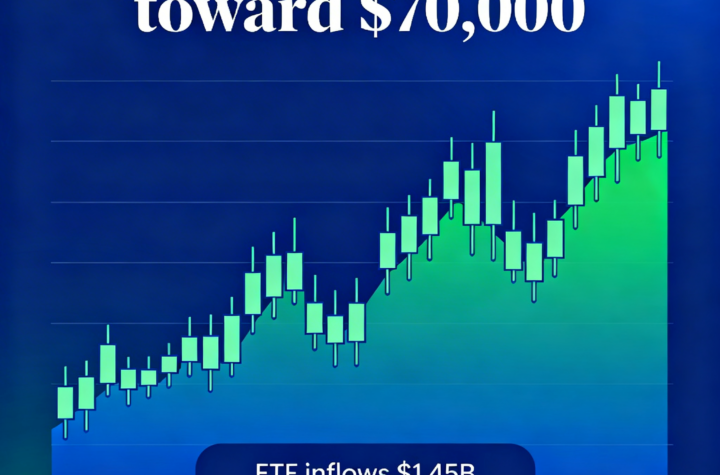
Bitcoin rebounds near $70,000 with $1.45B flowing into ETFs in the past five sessions.