

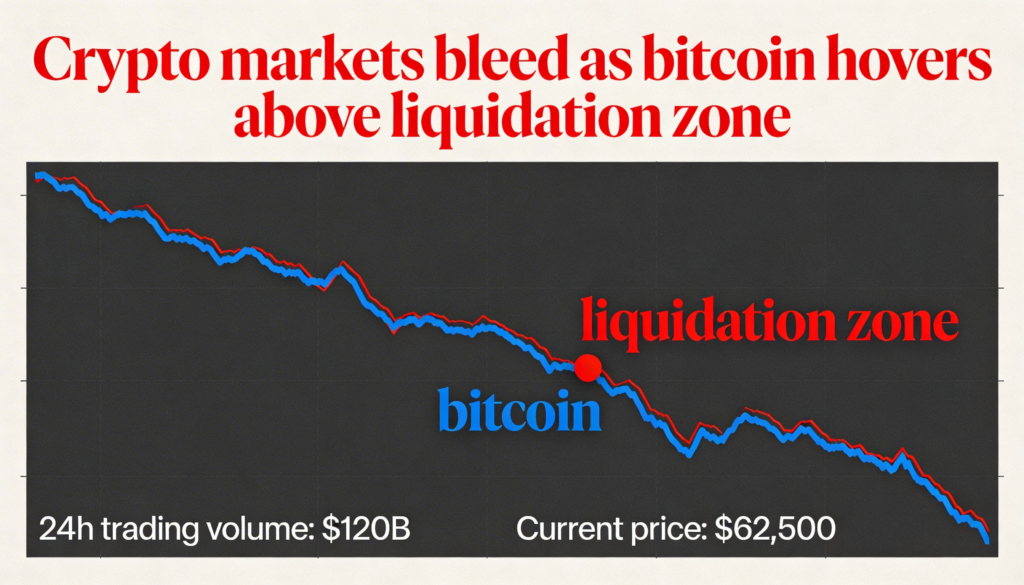
Bitcoin slipped toward $63,000 on Tuesday, extending its losing streak to four days as a firmer U.S. dollar and weaker equities weighed on risk assets globally. Traders warn that a decisive break below $60,000 could spark another wave of liquidations and potentially drag prices toward $52,500, a key support level dating back to 2021.
BTC touched roughly $63,100, its lowest point since the Feb. 6 pullback to around $60,200, according to CoinDesk data. The decline unfolded alongside a 0.5% rise in the dollar index (DXY) since the start of Asian trading on Monday, while U.S. stocks continued to retreat.
Bitcoin has fallen 2.1% since midnight UTC and is down 4.7% over the past 24 hours. Market participants caution that a sustained drop through $60,000 would likely accelerate forced selling across leveraged positions.
Broad-Based Altcoin Weakness
The selling pressure extended beyond bitcoin. Bitcoin Cash tumbled 11.5% in 24 hours, while Sui, Jupiter and World Liberty Financial each posted losses exceeding 2%, reflecting widespread risk aversion across digital assets.
Analysts characterized the current trend as a gradual “slow bleed,” a pattern often observed during extended downturns. At the same time, technical indicators suggest markets may be nearing exhaustion. The relative strength index (RSI) across major tokens has dipped into oversold territory, signaling the potential for a relief bounce if buyers step in near current levels.
Derivatives Point to Defensive Positioning
Futures and options markets reveal a cautious tone:
- Total notional open interest in crypto futures declined more than 4% to $92.5 billion, the lowest since April 2025, indicating ongoing deleveraging.
- Approximately $360 million in leveraged positions were liquidated over the past day, with bullish bets accounting for the overwhelming majority of forced closures on exchanges including BitMEX and Bitfinex.
- Despite the drop in aggregate open interest, global bitcoin futures open interest rose to 690,890 BTC, its highest since Feb. 6, suggesting some traders are adding short exposure.
- Funding rates for perpetual futures tied to major tokens remain negative, highlighting a bearish bias. Contracts linked to TRON show funding rates as low as -35%, pointing to crowded short positioning.
- Thirty-day implied volatility for bitcoin and ether has climbed to two-week highs, signaling heightened uncertainty.
- On Deribit, put options for bitcoin and ether are trading at a volatility premium of more than 10 points over calls through late-March expiry, reflecting strong demand for downside protection. Block trades featured put spreads and straddles, strategies that either hedge against further losses or position for increased volatility.
Limited Bright Spots in Token Markets
Aside from isolated outperformers, bullish catalysts remain scarce. AI-focused token Pippin has bucked the broader trend, climbing 7.7% over the past 24 hours and doubling since the start of the year.
In decentralized finance, total value locked (TVL) has declined less sharply than token prices, implying that investors are rotating into stablecoins rather than fully exiting protocols. Nevertheless, DeFi-related tokens continue to underperform. CoinDesk’s DeFi Select Index (DFX) has fallen 34.8% year-to-date, making it the weakest-performing major crypto benchmark in 2026 so far.
With macroeconomic headwinds building and leverage being unwound, attention remains squarely on the $60,000 support level. Whether it holds may determine if bitcoin stabilizes — or faces a deeper correction in the sessions ahead.
About The Author



More Stories
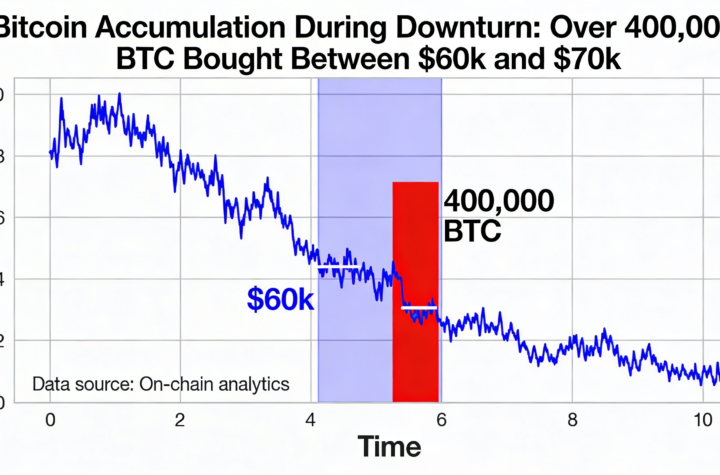
Over 400K Bitcoin purchased as prices hovered between $60K and $70K in the recent sell-off
Bitcoin Trading Momentum Signals Price Discovery Migration to Chicago
Polymarket Sees $3M in Bets Over the Next Crypto Company ZachXBT Might Reveal