

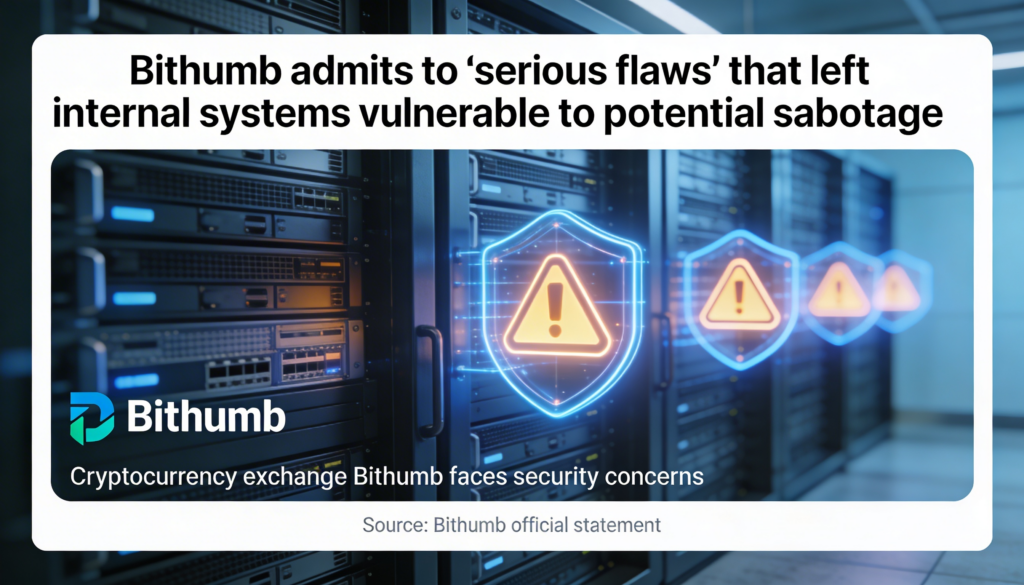
South Korean crypto exchange Bithumb has admitted to serious internal control failures that resulted in the accidental transfer of bitcoin worth more than $40 billion to customers, an error that briefly roiled markets and drew regulatory scrutiny.
Speaking before a parliamentary committee, CEO Lee Jae-won acknowledged that weaknesses in the exchange’s internal systems left it exposed to potential sabotage and allowed the erroneous transaction to proceed unchecked. Most of the funds have since been recovered.
The mistake occurred when Bithumb credited users with 620,000 bitcoins instead of 620,000 won (about $428), according to Reuters. The massive misallocation — roughly 15 times the platform’s reported bitcoin holdings of 42,000 BTC — triggered a sharp 17% drop in bitcoin’s price on the exchange before trading was halted.
Lee attributed the incident to a 24-hour delay in transaction processing and slow updates to the exchange’s internal balance records, which created a mismatch between assets available and assets transferred.
“We are acutely aware of the deficiency in internal system control,” Lee told lawmakers, conceding that safeguards meant to ensure transfers matched actual holdings had failed. He also acknowledged that the assets were not ring-fenced in a separate account prior to the transfer, removing an additional layer of protection.
Bithumb has recovered the overwhelming majority of the mistakenly distributed bitcoin. However, 1,786 BTC remain outstanding after being sold within minutes before the platform froze customer accounts, Reuters reported. Those customers are legally required to return the proceeds.
The episode has prompted closer oversight from regulators. South Korea’s Financial Supervisory Service (FSS) announced plans to investigate “high-risk” trading practices that could undermine market stability, including large-scale price manipulation by major holders, trading activity linked to suspended deposits and withdrawals, and coordinated pump schemes fueled by misinformation on social media.
The regulator said it intends to deploy enhanced monitoring systems capable of detecting suspicious trading patterns in real time, down to the second and minute, along with artificial intelligence tools to analyze text data and flag potential market abuse.
Lawmakers expressed concern over both corporate governance shortcomings and gaps in regulatory supervision within South Korea’s digital asset sector. The country is one of the world’s most active crypto markets by trading volume, with an estimated 10 million investors. Major exchanges such as Upbit and Bithumb generate revenues in the trillions of won, highlighting the growing economic footprint of virtual assets in the country.
About The Author


More Stories
Robinhood falls short of Q4 revenue expectations as crypto downturn weighs on quarterly results.
Crypto’s latest downturn reflects turbulence in traditional financial markets rather than an industry-specific crisis.
SkyTelecom.io Launches High-Performance Global SIP Calling and SMS Platform with Crypto Payment Support