

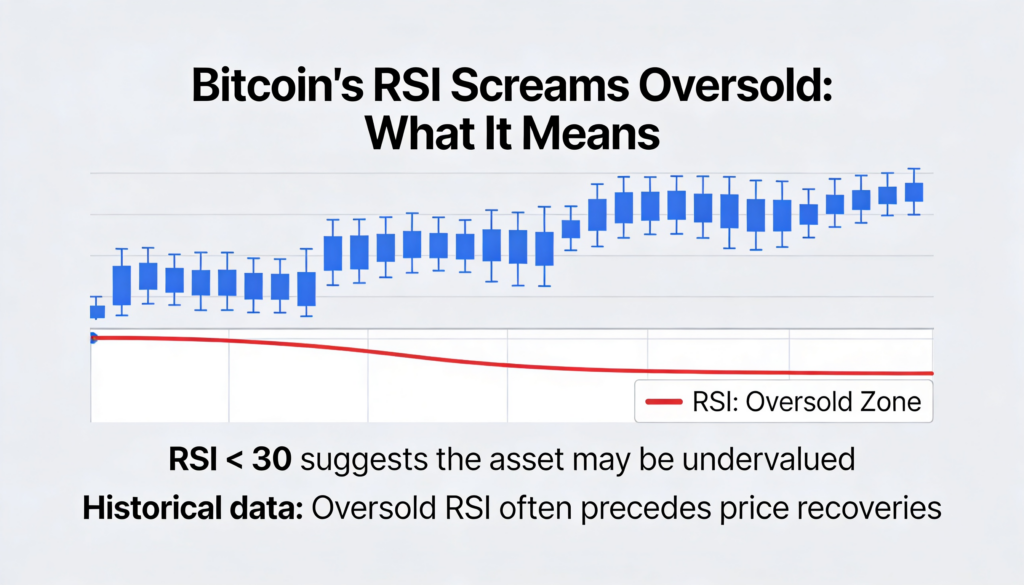
Bitcoin’s relative strength index (RSI) has slipped below the 30 mark, a level widely viewed as signaling oversold conditions, as the cryptocurrency trades near a key support zone between $73,000 and $75,000.
The RSI is one of the most commonly used tools in technical analysis, designed to gauge trend strength and identify momentum extremes. Developed in 1978 by mechanical engineer and technical analyst J. Welles Wilder Jr., the indicator was introduced in his book New Concepts in Technical Trading Systems and has since become a staple across trading desks.
Calculated over a standard 14-day period, the RSI compares recent price gains with losses to produce a reading that oscillates between zero and 100. When the indicator falls below 30, it suggests that selling pressure has dominated too aggressively over the recent period, reflecting strong bearish momentum.
Traders typically interpret such conditions as “oversold,” meaning prices may have fallen too far, too fast relative to recent norms. Historically, markets often stage short-term rebounds after the RSI dips below 30, as selling pressure eases and buyers step in.
That dynamic can become self-reinforcing. Because many discretionary traders and algorithmic strategies monitor the same signal, oversold readings can trigger coordinated buying, turning the expectation of a bounce into a self-fulfilling outcome.
The setup is often more compelling when oversold signals coincide with well-defined support levels—areas where buyers have previously emerged to halt declines. Bitcoin is currently trading near the $73,000 to $75,000 range, a zone that has repeatedly acted as a battleground between buyers and sellers. A sell-off in April 2025 stalled in this area, while the early-2024 bull run also lost momentum at similar levels, reinforcing its technical significance.
Taken together, the combination of an oversold RSI and nearby support raises the odds of a relief bounce. However, such a move is far from guaranteed and should not be mistaken for confirmation of a new bull market.
The RSI, like any technical indicator, can generate false signals. Context is critical: during broader downtrends, oversold readings have historically produced only modest or short-lived rebounds. In 2022, for example, similar signals led to brief bounces that ultimately failed. More recently, an oversold reading in November preceded weeks of consolidation before giving way to a deeper sell-off last month.
About The Author



More Stories
Bitcoin holds near $68,300 while gold tumbles for a ninth session and Asian stocks fall
XRP slides 3% on break under $1.44 with BTC softness capping recovery
BTC mining turns unprofitable with $19,000 loss per coin despite 7.8% difficulty drop