

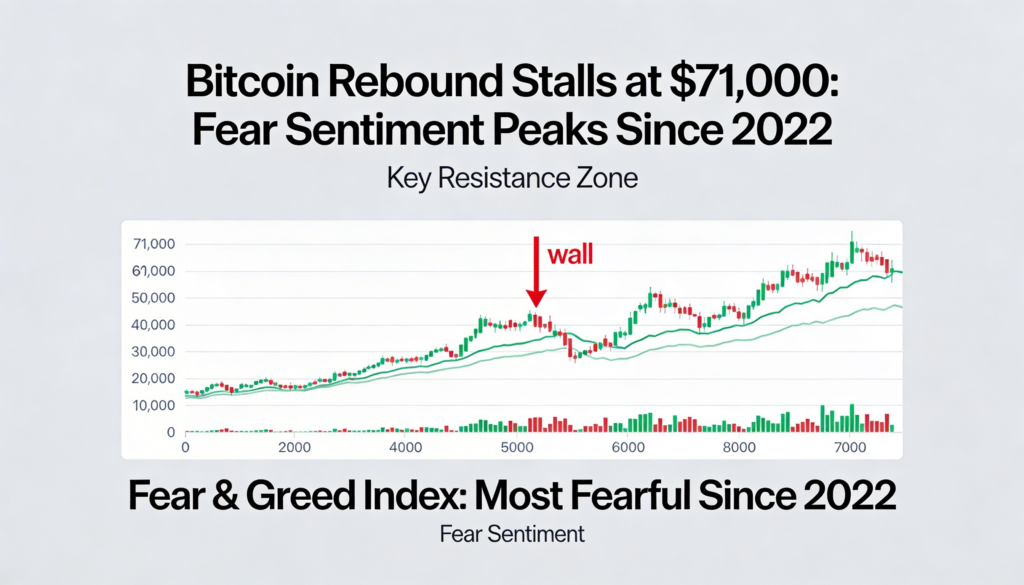
Trading data suggests the latest bounce in bitcoin is unfolding against a broader risk-off backdrop, with activity cooling and retail participation continuing to fade.
Bitcoin (BTC) rebounded sharply after last week’s capitulation-style drop into the low-$60,000 range, briefly reclaiming ground toward $70,000 over the weekend. But that recovery has already begun to stall, raising doubts about the durability of the move.
The pause has prompted some traders to characterize the rally as a typical bear-market bounce — a swift relief move that attracts dip buyers before running into heavy overhead supply from investors seeking to exit at more favorable levels.
“There is still significant supply from those looking to sell into strength,” said Alex Kuptsikevich, chief market analyst at FxPro. He warned that under such conditions, a renewed test of the 200-week moving average could be imminent.
Kuptsikevich added that the loss of momentum over the weekend, alongside selling pressure near the $2.4 trillion total crypto market capitalization mark, reinforces his cautious stance. “It may turn out that this was simply a rebound within a broader downtrend that has yet to fully play out,” he said.
Sentiment indicators echo that fragility. The Crypto Fear and Greed Index plunged to 6 over the weekend — matching levels seen during the FTX-driven turmoil of 2022 — before edging up to 14 by late Monday. Even so, those readings remain deeply in “extreme fear” territory.
According to Kuptsikevich, such depressed sentiment levels are not yet conducive to sustained buying, suggesting the weakness reflects more than just short-term anxiety.
Liquidity trends are compounding the uncertainty. With order books thinner than in previous months, relatively modest selling pressure can trigger exaggerated price swings. Those moves can, in turn, spark additional stop-losses and liquidations, creating a reflexive cycle that amplifies volatility and makes intraday price action appear chaotic.
That dynamic — rather than any single catalyst — helps explain how bitcoin can swing thousands of dollars within hours while still failing to clear key resistance levels.
A note from market data firm Kaiko described the environment as a broader risk-off unwind. Aggregate volumes across major centralized exchanges have fallen roughly 30% since late 2025, with monthly spot trading declining from around $1 trillion to approximately $700 billion.
While last week featured several sharp spikes in activity, Kaiko said the broader pattern has been one of steady participation erosion. Retail traders in particular appear to be gradually stepping back, rather than exiting in a single wave of panic.
In such thin conditions, prices can drift lower on relatively light selling, without the heavy, high-volume flush that typically marks a decisive capitulation and longer-term bottom.
Kaiko also placed the correction within the context of bitcoin’s historical four-year halving cycle. After peaking near $126,000 in late 2025 or early 2026, bitcoin has retraced sharply, with the move back into the $60,000–$70,000 range representing a drawdown of more than 50% from the highs.
Historically, cycle bottoms have taken time to form and often include multiple failed recovery attempts before a durable uptrend resumes.
For now, the $60,000 level remains pivotal. Continued defense of that zone could pave the way for a period of volatile consolidation. A decisive break lower, however, would risk reactivating the same thin-liquidity feedback loops that intensified last week’s selloff — particularly if broader macro conditions remain tilted toward risk aversion.
About The Author



More Stories
SkyTelecom.io Launches High-Performance Global SIP Calling and SMS Platform with Crypto Payment Support
Robinhood falls short of Q4 revenue expectations as crypto downturn weighs on quarterly results.
Bitcoin trades in a narrow band below $70,000 as markets await Wednesday’s U.S. jobs data.