

Bitcoin’s four-year cycle refers to the recurring price pattern historically tied to halving events, where periods of rapid gains are followed by major corrections, typically spanning roughly four years from peak to peak.
Some observers argue the cycle may not hold into 2026. U.S.-listed bitcoin ETFs have absorbed $57 billion in inflows, Strategy (MSTR) has effectively become a perpetual buyer, and early holders distributed bitcoin at unprecedented levels above $100,000. Moreover, 2025 ended as a down year, contrary to expectations for a parabolic peak under the traditional cycle.
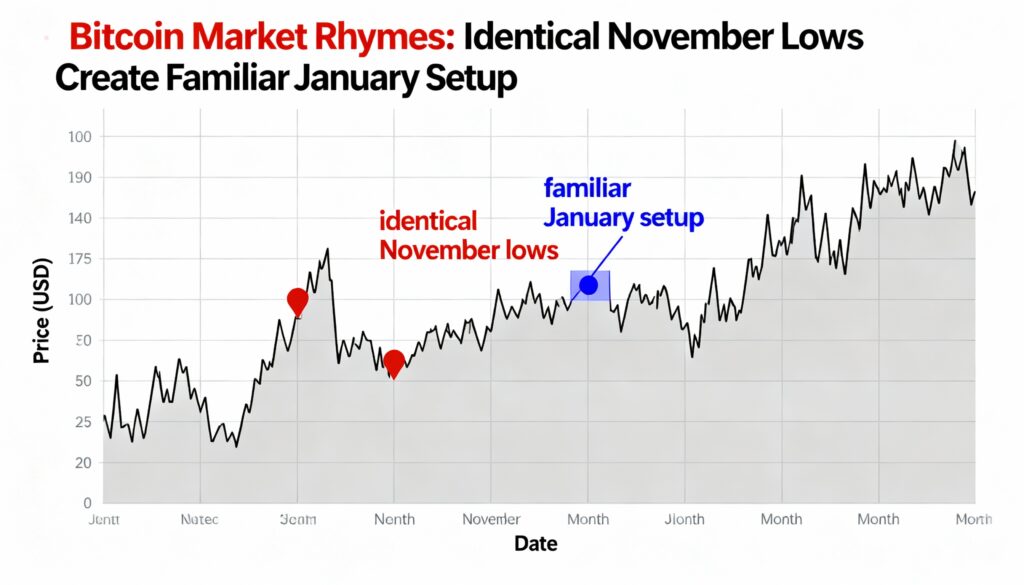
Yet the cycle’s framework remains intact. Bitcoin peaked about 18 months after the April 2024 halving, which halved the block subsidy for miners. By October 2025, it reached $126,000, rebounding strongly from the cycle low of $15,500 following the FTX collapse in November 2022. Timing adds intrigue: the local bottom on Nov. 21, 2025, at $80,524 mirrored the prior cycle low on Nov. 21, 2022, at $15,460.
January has historically marked key inflection points. January 2023 saw a local top near $25,000 before a drop below $20,000; January 2024 coincided with the launch of U.S. spot bitcoin ETFs and a local low just under $40,000; and January 2025 aligned with President Donald Trump’s inauguration and a local high near $110,000.
Attention now turns to January 2026, with a U.S. crypto market structure bill scheduled for a Jan. 15 markup hearing. Traders will be watching to see if the month signals a top or a bottom in the current bitcoin cycle.
About The Author




More Stories
Monday’s 5% rally in Bitcoin was driven by short squeezes, not new buying interest, an analyst notes.
Bitcoin jumps above $68,000 amid subdued equity reaction to Iran tensions.
Bitcoin tops equity markets as risk aversion deepens on day three of Iran conflict.