

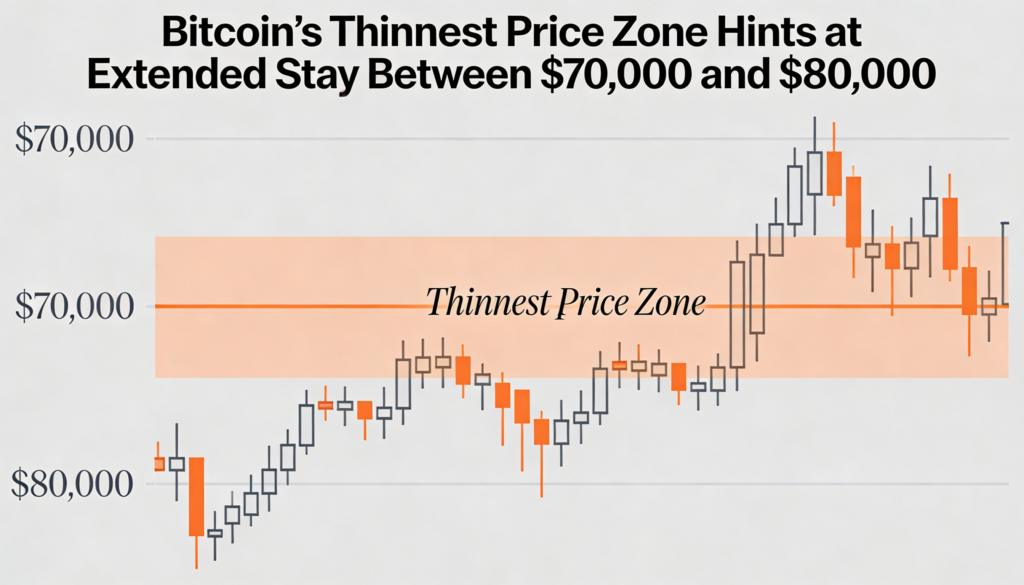
Since the weekend’s dip, Bitcoin (BTC $68,419.02) has remained confined between $70,000 and $79,999 for five consecutive days—a notably long period for a range where the cryptocurrency has historically spent little time.
Bitcoin has logged roughly 35 days within this $10,000 bracket, making it one of the least developed price zones. Historically, the asset has tended to move quickly through this range rather than establishing sustained support or resistance.
Longer periods spent within a range allow positions to accumulate, which can later translate into stronger support. In this context, Bitcoin is more likely to consolidate in this zone, or potentially retest the lower boundary before forming a more durable base.
During last April’s tariff-driven volatility, Bitcoin stayed below $80,000 for only a few weeks before bouncing back. Similarly, when it hit a then all-time high near $73,000 in March 2024, it lingered briefly before falling.
Perhaps the most striking example of rapid movement through this zone occurred in November 2024, following Donald Trump’s presidential election victory, when Bitcoin surged from roughly $68,000 to $100,000 in weeks—leaving minimal opportunity for consolidation between $70,000 and $80,000.
Corporate buying in this range has also been limited. Strategy (MSTR), the largest corporate holder of Bitcoin, has made just one purchase in this bracket: on Nov. 11, 2024, it acquired 27,200 BTC for roughly $2 billion at an average price of $74,463.
Overall, the data highlights a structural thinness between $70,000 and $80,000, underscoring why this price zone remains relatively underdeveloped and prone to swift moves.
About The Author



More Stories
Bitcoin holds near $68,300 while gold tumbles for a ninth session and Asian stocks fall
XRP slides 3% on break under $1.44 with BTC softness capping recovery
BTC mining turns unprofitable with $19,000 loss per coin despite 7.8% difficulty drop