

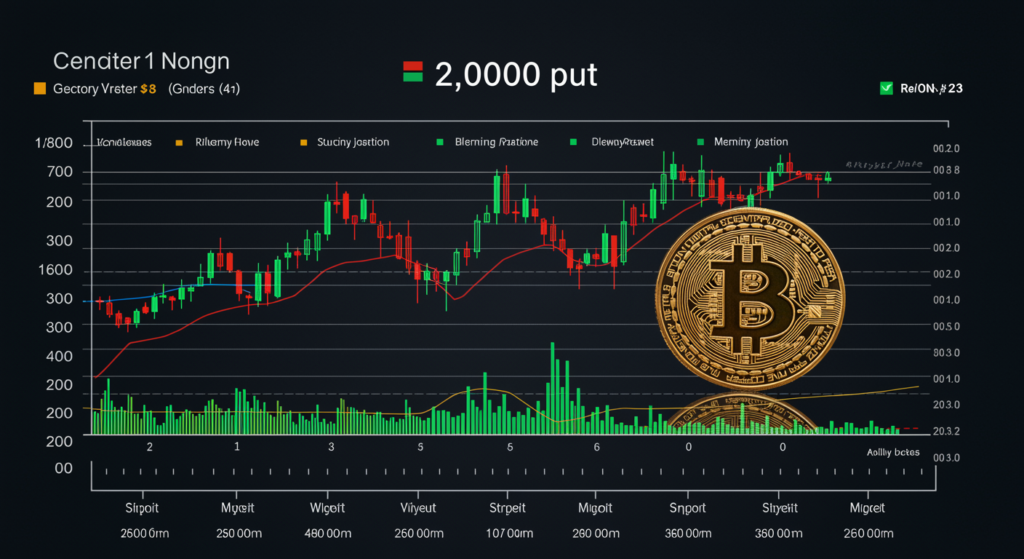
Positioning in bitcoin options is flashing notable tail-risk hedging ahead of Deribit’s quarterly expiry, with nearly $600 million in notional value concentrated in $20,000 put options.
The strike now ranks as the third most popular, highlighting how traders are accounting for extreme downside scenarios amid ongoing geopolitical tensions in the Middle East. That said, derivatives flows suggest the activity is less about outright bearish bets and more about volatility-driven strategies.
Put options give traders the right to sell bitcoin at a fixed price. With BTC trading below $70,000, the $20,000 strike is deeply out of the money, requiring a roughly 70% drop to become relevant.
Approximately $596 million in exposure sits at that level, behind only the $75,000 strike with $687 million and the $125,000 strike with $740 million. The distribution reflects a wide range of market views, from sharp downside protection to aggressive upside positioning.
Despite the size of the position, the buildup in $20,000 puts is unlikely to signal expectations of a crash. Much of the activity is believed to come from traders selling these far out-of-the-money options to collect premium, a strategy that benefits from the low probability of such a steep decline.
As a result, the positioning points more toward income generation and volatility trading than a clear directional outlook.
In total, about $13.5 billion in bitcoin options are set to expire on Deribit. Even as broader market sentiment remains fragile, the options market continues to lean slightly bullish, with a put-call ratio of 0.63, indicating a higher concentration of call options.
Open interest currently stands at 195,719 BTC, comprising 120,236 BTC in calls and 75,482 BTC in puts.
Meanwhile, the max pain level is estimated at $75,000 — a level that could draw price action into expiry as market makers adjust hedges, often pulling prices toward where the largest number of contracts expire worthless.
About The Author




More Stories
Bitcoin drops under $70,000 as rising oil prices and a Fed pause pressure risk assets.
Bitcoin drops under $71,000 while stocks end the day near session lows as expectations for a 2026 Fed rate cut dim further.
Bitcoin unexpectedly beats gold as a hawkish Fed and surging oil prices spark a risk-off mood.