

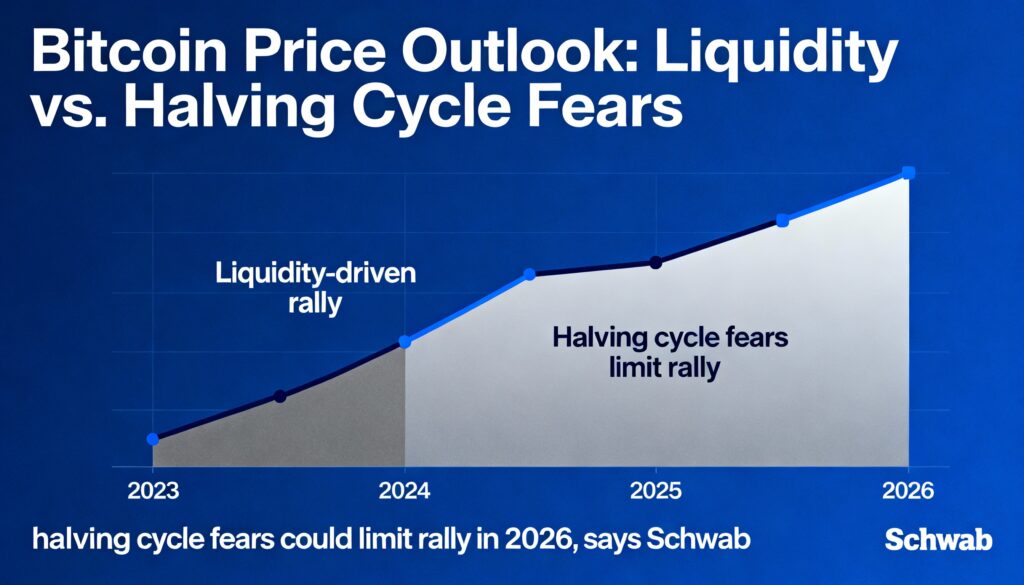
Schwab: Liquidity Supports Bitcoin, but Halving Cycle and Adoption Risks Cloud 2026
Bitcoin (BTC $91,452.15) enters 2026 influenced by a mix of macro and market-specific factors, according to Jim Ferraioli, director of crypto research and strategy at the Schwab Center for Financial Research.
Ferraioli identifies three long-term drivers—global M2 money supply, Bitcoin’s disinflationary supply growth, and adoption—and seven short-term factors, including market risk sentiment, interest rates, U.S. dollar strength, seasonality, central bank liquidity, large wallet concentration, and financial contagions.
Several short-term factors currently favor Bitcoin. Credit spreads remain tight, and much of the speculative derivative activity fueling late-2025 volatility has unwound. “A risk-on environment in equities should be supportive of crypto—the ultimate risk asset,” Ferraioli said.
Monetary policy adds support: with quantitative tightening ended and balance sheets expanding, rates and the dollar are expected to decline, boosting liquidity.
Challenges remain. Adoption could slow after last year’s volatility, though regulatory clarity, such as the Clarity Act, may accelerate institutional involvement. The halving cycle also poses a potential headwind; historically, the third year has been weak. While Bitcoin has averaged gains of around 70% from its annual lows since 2017, 2026 returns may fall short.
Ferraioli also notes a shift in correlations: Bitcoin remains tied to megacap AI stocks, but its link to broader equities is weakening, suggesting it may move more independently from traditional markets.
About The Author





More Stories
Bitcoin Falls Below $82K as AI Fears Resurface and DeFi Tokens Sink
Crypto Traders Value Reliance Jio IPO at $110 Billion
Asian Markets Slide as Bitcoin Pulls Back and China Enters Bear Territory