

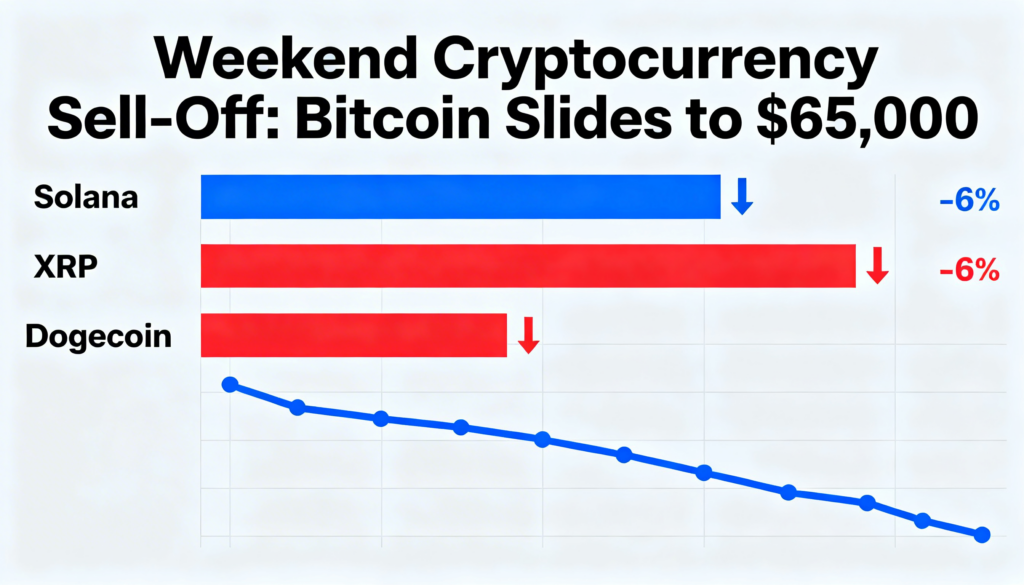
Bitcoin’s latest attempt to retake the $70,000 level quickly unraveled, with the rally fading as inflation concerns and equity weakness weighed on risk assets heading into the weekend.
Bitcoin dropped to $65,735 during early Asian trading on Saturday, down 3% over the past 24 hours and nearly 3% on the week. The midweek surge that briefly brought prices within striking distance of $70,000 has now given back more than half its gains as sentiment deteriorated through the final U.S. sessions of the week.
Altcoins experienced sharper losses. Solana fell 6.7%, Ethereum declined 6.2%, Dogecoin shed 5.1%, and XRP slipped 4%. The downturn pushed most major tokens into negative territory for the week, wiping out the brief stretch of altcoin outperformance. BNB was comparatively resilient, losing around 2.5%.
The move mirrored declines in traditional markets. On Friday, the S&P 500 closed 0.4% lower, the Nasdaq-100 fell 0.3%, and the Dow Jones Industrial Average dropped 1.1%. Shares of Nvidia declined another 4.2% as investors continued adjusting positions after its earnings report.
A stronger-than-expected 0.5% rise in producer prices added to the pressure, reinforcing concerns that the Federal Reserve may keep interest rates elevated for longer than markets had hoped. Meanwhile, significant layoffs at Block, Inc. heightened fears that artificial intelligence adoption may be displacing jobs more rapidly across the economy.
Crypto once again amplified the broader market move. A modest pullback in equities translated into a larger percentage decline in digital assets, with leverage built up during Wednesday’s rally being unwound during the sell-off.
Ironically, institutional demand appeared strong earlier in the week. U.S. spot bitcoin ETFs attracted $1.1 billion over three days, putting them on pace for their strongest weekly inflows in months. However, those inflows were not enough to counter mounting macroeconomic headwinds.
“Over-analyzing short-term price action can be misleading,” said Dom Harz, co-founder of bitcoin finance firm BOB. “Volatility is inherent to bitcoin. What stands out this cycle is the profile of capital entering the space.”
On-chain data added another note of caution. According to CryptoQuant, reserves of Tether on exchanges have declined from $60 billion to $51.1 billion over the past two months. The firm warned that a drop below $50 billion could heighten the risk of a more pronounced sell-off.
Elsewhere, shares of Strategy ranked among the most shorted large-cap U.S. stocks, reflecting growing skepticism about the sustainability of its debt-financed bitcoin accumulation strategy.
Within the Ethereum ecosystem, selling pressure has emerged as well. Some large holders have trimmed positions at a loss, and digital asset firm ETHZilla announced it would end its ether accumulation strategy and pivot toward tokenized real-world assets.
Bitcoin now sits back in the middle of the $60,000–$70,000 range that has contained price action since the early-February correction. The latest failed breakout reinforced resistance near the top of that band, leaving traders to watch whether support near $60,000 will hold as March approaches.
About The Author


More Stories
Bitcoin could be primed for a short squeeze with funding rates hitting a three-month bottom.
Geopolitical escalation, with Iran targeting U.S. bases around the Middle East, could push Bitcoin lower.
Bitcoin dips toward $63,000 amid sharp risk-off sentiment following U.S. and Israel strikes on Iran.