

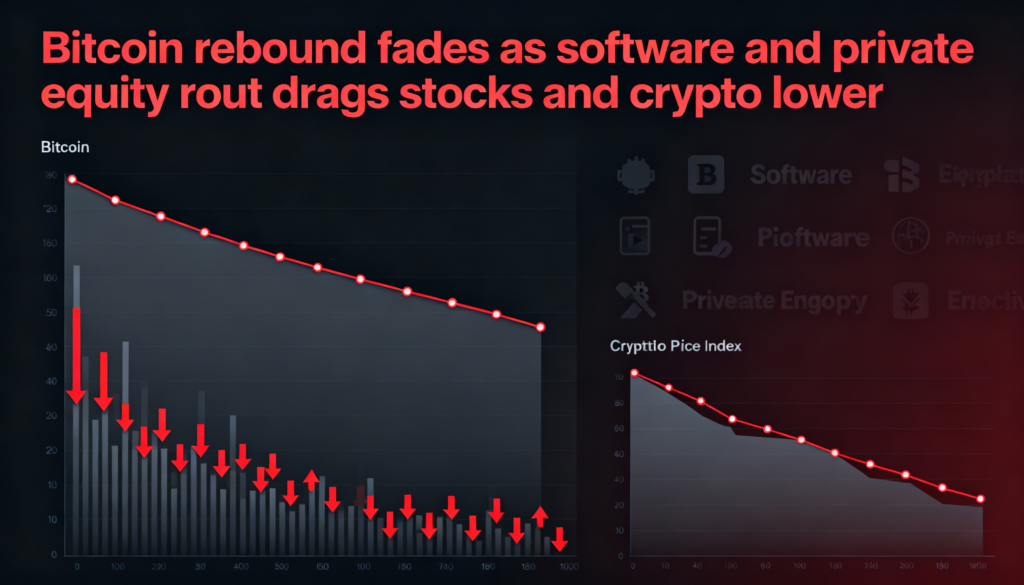
Crypto markets remained under strain Monday as digital assets continued to shadow steep losses in the software sector, where a key exchange-traded fund slid to a fresh 52-week low.
Bitcoin attempted a small rebound following a sharp overnight drop, but the recovery quickly faded during U.S. morning hours as risk sentiment deteriorated. By midday on the East Coast, bitcoin was trading near $65,400, still deeply lower over the previous 24 hours after heavy selling pressure.
The decline coincided with weakness across U.S. equities. The S&P 500 and the Nasdaq-100 both fell more than 1%, led by renewed selling in software companies and private equity firms.
The iShares Expanded Tech-Software ETF dropped another 5% to a new one-year low and is now down roughly 35% since October. Investors have grown wary that generative AI technologies could undermine traditional software revenue models. Regardless of whether that thesis ultimately plays out, traders have increasingly lumped crypto into the same bucket, with bitcoin’s price movements closely mirroring IGV in recent weeks.
At the same time, concerns are building that the rapid expansion of AI-related investment may be creating financial excesses that could culminate in a broader credit event, drawing comparisons to the 2008 global financial crisis. Those fears have weighed heavily on private equity shares, many of which have significant exposure to the software sector.
Blue Owl Capital — which recently sold assets to meet investor liquidity demands — slipped another 3.5% on Monday and is now down roughly 32% year to date. Other major alternative asset managers, including Blackstone, Ares Management, and Apollo Global Management, extended recent losses with declines ranging from 6% to 8%.
Crypto frequently trades as a high-beta proxy for technology stocks and broader liquidity conditions, and Monday’s price action reinforced that pattern. Although bitcoin has managed to remain above its early February lows, it continues to consolidate within a wide $60,000 to $70,000 range as overall risk appetite remains fragile.
Further clouding the outlook is uncertainty over global trade policy after the Supreme Court of the United States restricted President Donald Trump’s prior use of sweeping tariffs, according to Joel Kruger, market strategist at LMAX Group.
The development contributed to a broader risk-off tone, with investors retreating from speculative assets. In that environment, bitcoin has behaved less like a safe-haven asset and more like a leveraged play on overall market risk.
About The Author



More Stories
Trump-backed stablecoin falters amid WLFI’s warning of an organized attack.
Strategy celebrated a century of bitcoin purchase announcements after picking up 592 coins last week in a $39.8 million deal.
Bitcoin ETFs shed $3.8B in record five-week withdrawal streak