

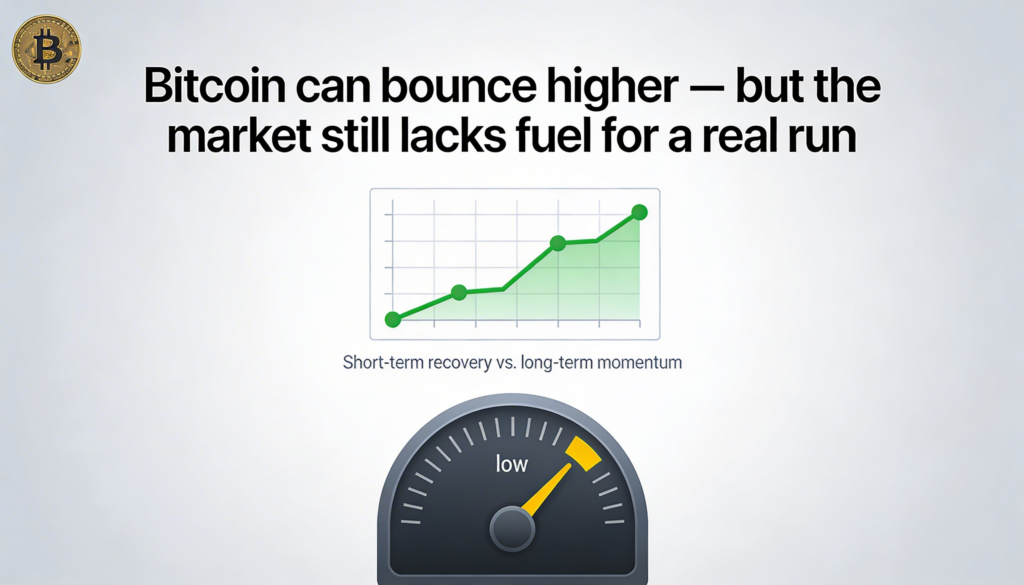
Bitcoin continues to flash brief bursts of strength, only to see those gains fade against a backdrop of dollar firmness, cautious Federal Reserve messaging and steady overhead supply.
The setup allows for rebounds — but not yet for a sustained breakout.
Cooling headline inflation has modestly improved the macro tone, reinforcing expectations for as many as three rate cuts this year. That shift has revived the familiar narrative that looser monetary policy can buoy risk assets and gradually ease the liquidity squeeze that has weighed on crypto markets for months.
Still, traders are wary of extrapolating too far. The Federal Reserve does not appear poised for an aggressive easing cycle. Instead, policymakers are signaling a gradual recalibration, suggesting liquidity may return slowly rather than in a wave. In that environment, bitcoin can mount tactical rallies but often struggles to convert them into durable advances.
Analysts at Bitfinex describe the current structure as one defined by waves of volatility rather than decisive breakouts. Upside squeezes can develop when positioning becomes overly defensive, but a sustained trend higher likely requires clearer confirmation of ongoing disinflation and consistent spot demand.
Recent price action illustrates the pattern. Bitcoin climbed to roughly $68,500 overnight before reversing during U.S. hours and slipping below $66,000, a move that coincided with a firmer dollar and hawkish Fed minutes. Such intraday reversals underscore how fragile rallies remain, with traders quick to sell when macro signals turn even marginally less supportive.
Alex Kuptsikevich, chief market analyst at FxPro, noted that bitcoin’s price behavior increasingly mirrors dollar strength. If investors grow convinced the dollar’s advance is more than temporary, volatility could spike sharply.
He also pointed out that volatility in crypto has been comparatively muted, even as equity indices remain active. Investors have consistently bought dips in major stock benchmarks, leaning on key moving averages — the 50-day for the Dow Jones and Russell 2000, and the 200-day for the Nasdaq 100. By contrast, bitcoin remains well below its own 50- and 200-day averages, highlighting relative technical weakness.
Sentiment adds another layer of caution. A widely followed crypto fear gauge has registered single-digit readings on nine of the past fourteen days — levels typically associated with late-cycle stress. Meanwhile, data from Glassnode show stablecoin outflows from major exchanges, signaling tighter liquidity, and signs of strain among long-term holders reminiscent of late-2022 bear market conditions.
For now, bitcoin sits between gradually improving macro optics and persistent supply. Short-term upside remains feasible, particularly when positioning skews too bearish. But a more durable advance likely hinges on clearer disinflation trends, a softer dollar and sustained spot buying. Until those elements align, the path higher may remain uneven.
About The Author


More Stories
Bitcoin rebounds from U.S. session losses after Donald Trump claims the U.S. trade deficit has narrowed by 78%
Bitcoin drops to $66,000 as U.S. equities retreat after Fed minutes flag potential rate hike.
Slipping under $70,000 could open the door to further downside for bitcoin.