

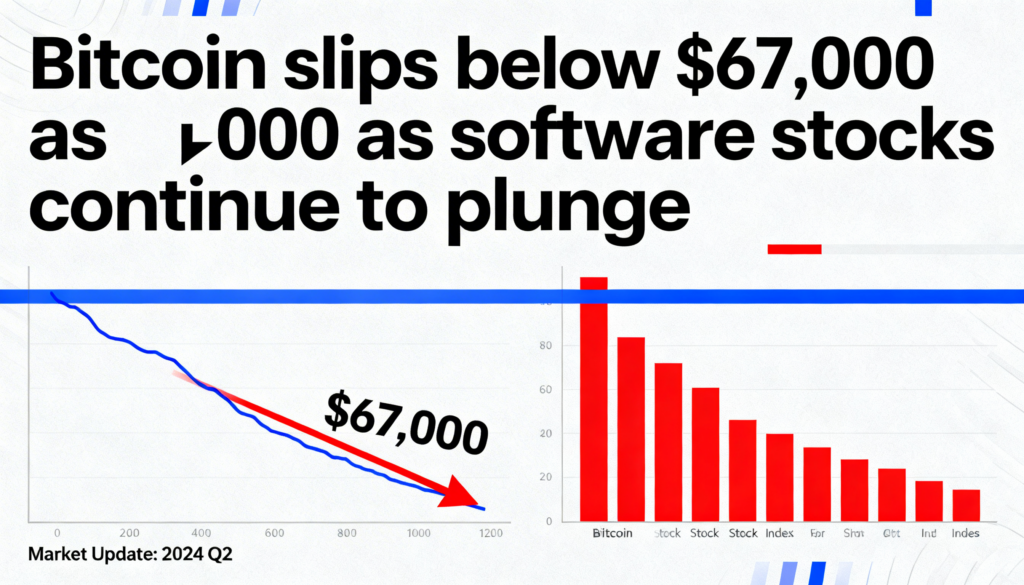
Bitcoin fell below $67,000 on Tuesday as weakness in U.S. software stocks deepened, reinforcing the sector’s growing influence on crypto price action.
The largest digital asset slipped out of its narrow $68,000–$70,000 weekend range, trading around $67,173 at the time of writing. The move lower came alongside a soft open for U.S. equities, with losses concentrated in technology — particularly software names.
The iShares Expanded Tech-Software Sector ETF (IGV), a closely watched gauge of software stocks, declined another 3% on the session and now sits roughly 30% below its October peak. The sector has faced mounting pressure amid concerns that advances in artificial intelligence could disrupt traditional software business models.
In recent months, bitcoin has increasingly traded like a high-beta tech proxy. As markets frame crypto as “just software,” perceived threats to the software industry — including AI-driven disruption — have weighed on sentiment toward digital assets as well.
The broader Nasdaq Composite slipped 0.8%, while the S&P 500 fell 0.6%.
Precious metals also extended their pullback after a powerful rally earlier this year. Gold dropped 3% to around $4,860 per ounce, and silver sank another 6%, leaving it roughly 40% below its late-January high.
Crypto-linked equities gave back part of Friday’s rebound. Strategy (MSTR), the largest corporate holder of bitcoin, declined about 5%, while Circle (CRCL), issuer of the USDC stablecoin, posted a similar loss. Bitcoin miners and data center operators — including Riot Platforms (RIOT), MARA Holdings (MARA), CleanSpark (CLSK), Cipher Mining (CIFR) and TeraWulf (WULF) — fell between 4% and 5%.
Crypto searches for direction
According to Paul Howard, senior director at Wincent, crypto markets remain closely tied to macro sentiment.
“Macro news has been closely correlated with crypto’s risk profile over the last 12 months, and expectations are that macro data remain soft, implying a continued risk-off mindset,” Howard said.
He added that an upcoming ruling from the Supreme Court of the United States on tariffs later this week could prove a more significant near-term catalyst than routine economic releases.
For now, Howard expects consolidation as bitcoin and the broader digital asset market struggle to establish a compelling narrative capable of drawing capital away from AI-focused equities and commodities.
“Crypto has some work to do to reestablish itself as an attractive asset class,” he said, noting that relatively low prices alone have not been enough to lure investors back.
About The Author


More Stories
Shares of trading platform eToro surged 14% after the company reported a record fourth-quarter profit, even as crypto revenue declined
Michael Saylor’s Strategy acquired $168 million worth of bitcoin last week.
Crypto declines alongside falling tech stocks and gold, as bitcoin’s correlation with the Nasdaq flips positive