

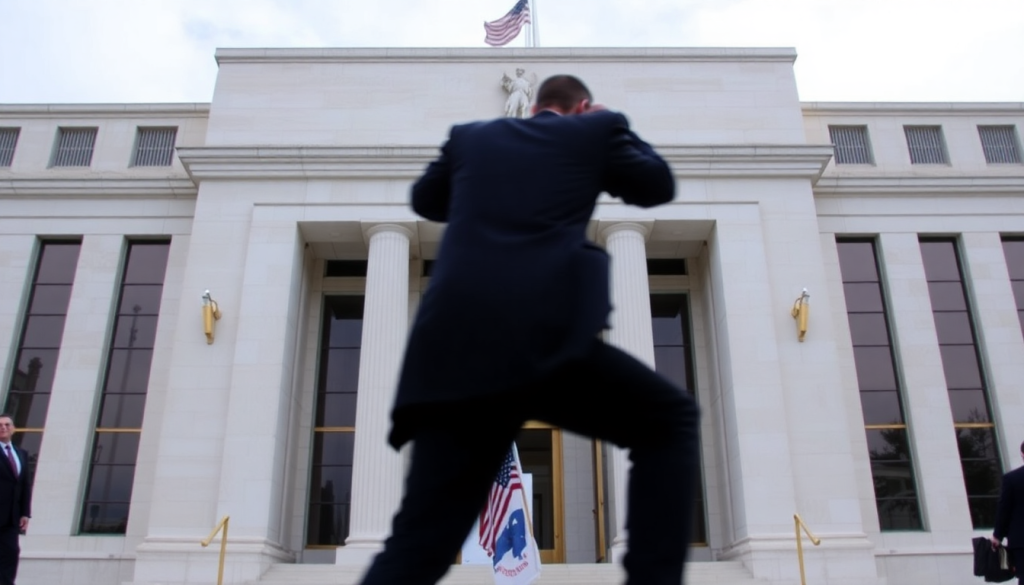
Experts believe the Federal Reserve may be relying on outdated economic indicators as it considers further interest-rate increases. Recent declines in gasoline, crude oil and other commodity prices suggest that inflationary pressures are already beginning to cool.
The situation highlights a familiar problem with central bank policy: officials risk falling behind the curve by focusing too heavily on backward-looking indicators such as the Consumer Price Index (CPI) and Producer Price Index (PPI). Both measures reflect prices paid by consumers and businesses in the previous month rather than current market conditions.
Meanwhile, real-time indicators, including refining margins, gasoline futures and retail fuel prices, are increasingly pointing toward weaker inflation.
“Inflation is a lagging indicator. It tells you what you paid last month. The crack spread is a leading indicator. It tells you what you’ll pay next month. One says inflation is too high. The other says it’s already falling. The Fed is listening to the first one. It’s about to hike into falling prices at the pump,” said Thierry Borgeat, co-founder and chief investment officer of Zurich-based asset manager Arvy, which is regulated by Swiss financial watchdog FINMA.
Concerns about additional rate increases, which could put further pressure on Bitcoin, have gained support from the minutes of the Fed’s October meeting and recent statements by policymakers.
Minutes published Wednesday revealed that almost all participants believed additional increases in the federal funds rate could be necessary in the coming months. They based this view on their inflation and labor market outlooks, arguing that further action could help bring inflation back to the Fed’s 2% target.
Two officials also suggested that a December increase exceeding 25 basis points could be warranted if incoming inflation figures were unfavorable. One basis point equals 0.01 percentage point, making 25 basis points the equivalent of the Fed’s standard quarter-point adjustment.
Earlier Wednesday, Fed Governor Christopher Waller told CNBC that he supported a 50-basis-point increase in December, twice the usual rate adjustment. Governor Michael Barr also indicated that higher interest rates might be appropriate, while San Francisco Fed President Mary Daly advocated a more cautious approach.
Rising interest rates increase borrowing costs and generally create unfavorable conditions for risk-sensitive assets, including Bitcoin.
However, policymakers appear to be responding mainly to October’s CPI and PPI figures, which indicated that inflation was spreading across a wider range of consumer goods and services. Critics argue that these reports do not capture the latest decline in energy and commodity prices.
Energy costs have been a significant contributor to inflation since the Iran war began in early March.
Crack spreads and gasoline prices signal cooling inflation
The refining crack spread offers a different perspective on the inflation outlook. It measures the profit refiners earn by processing crude oil into products such as gasoline and diesel, representing the difference between crude oil costs and the selling prices of refined fuels.
One widely followed measure is the 3-2-1 crack spread. It assumes that a refinery converts three barrels of crude oil into two barrels of gasoline and one barrel of diesel.
A declining spread generally indicates that gasoline and diesel prices are weakening faster than crude oil prices, often signaling that retail fuel costs could move lower.
According to figures shared by James E. Thorne, chief market strategist at wealth management firm Wellington Altus, the 3-2-1 crack spread has dropped 36% over six weeks. It fell from $65.56 per barrel to $41.90 as of Wednesday.
Thorne believes the decline indicates that inflationary pressure is easing further along the fuel supply chain.
He explained that elevated refining profits encouraged refiners to increase production, eventually leaving fuel markets oversupplied. As a result, gasoline and diesel prices are declining faster than crude oil.
He also pointed to wholesale RBOB gasoline futures, which have fallen approximately 20%, alongside retail gasoline prices of around $3.78 per gallon as evidence of the trend.
RBOB futures represent wholesale gasoline prices traded by refiners and market participants on the NYMEX. They declined 11.1% and 6.1% during the previous two completed weeks, representing a combined drop of roughly 16.5%.
The contract has fallen another 4.4% so far this week, bringing its three-week decline close to 20%. CoinDesk’s analysis of TradingView data suggests this is the steepest such decline since March 2020.
Consumers are also beginning to see lower prices at gas stations. According to AAA, the national average price of regular gasoline stood at $3.75 per gallon on Thursday. That represents a 12.8% decline over the past month and a 4.9% drop over the previous week, although prices remain approximately 22% higher than a year ago.
Thorne argued that the decline in refining margins could translate into additional relief for inflation because retail gasoline prices typically adjust more slowly than wholesale markets.
He estimated that every 10-cent reduction in gasoline prices could lower headline CPI by approximately nine basis points. November could therefore produce a negative headline inflation reading, while March would remove the inflationary impact of the war-related energy surge from year-over-year comparisons.
Thorne described the situation as a supply glut rather than weakening demand, arguing that falling fuel costs are already helping accomplish what the Fed is trying to achieve through monetary policy. He warned that raising rates by another percentage point while refining margins are collapsing could be counterproductive.
Commodity funds extend their losses
The weakness is not limited to gasoline and crude oil. Several other commodity markets have also recorded significant declines.
Ryan Detrick, chief market strategist at Carson Investment Research, examined the performance of commodity-focused exchange-traded funds through Wednesday’s market close. These funds hold futures contracts, meaning their returns may differ from movements in underlying spot prices.
Since the beginning of November, the gasoline ETF (UGA) has dropped 20.9%, while the United States crude oil fund (USO) has declined 19.4%. The Brent crude ETF (BNO) has also lost 18.7%.
Broader commodity funds have fallen approximately 12%, with copper’s ETF (CPER) down 12.5%. Agricultural commodities have also weakened, as wheat (WEAT) declined 4.6% and corn (CORN) slipped 2.7%. Gold (GLD) has lost 4.1% over the same period.
Natural gas has moved in the opposite direction, gaining 16.9% this month.
These declines have prompted some market participants to question the Fed’s increasingly hawkish messaging.
James Lavish, co-managing partner of Bitcoin Opportunity Fund, suggested that policymakers could be using aggressive statements about potential rate increases to create enough market pressure to eventually justify pausing further tightening.
He questioned why several Fed officials were discussing a possible 50-basis-point December increase despite mounting evidence that energy-related inflation pressures were easing.
Meanwhile, interest-rate futures currently reflect expectations of quarter-point rate increases in December and January, followed by another potential increase by April.
About The Author




More Stories
OKX Brings Anthropic IPO Pricing to Crypto Markets, Challenging Wall Street
Trump Media Plans $884M Debt Repayment Without Liquidating Bitcoin Holdings
Bitcoin Stays Above $63,750 as Fed Rate-Hike Fears Pressure Markets