

Here’s a clear paraphrased version of your text:
The Senate majority leader is prioritizing floor time for unrelated legislation, leaving the crypto industry waiting for its turn to advance its key policy proposal.
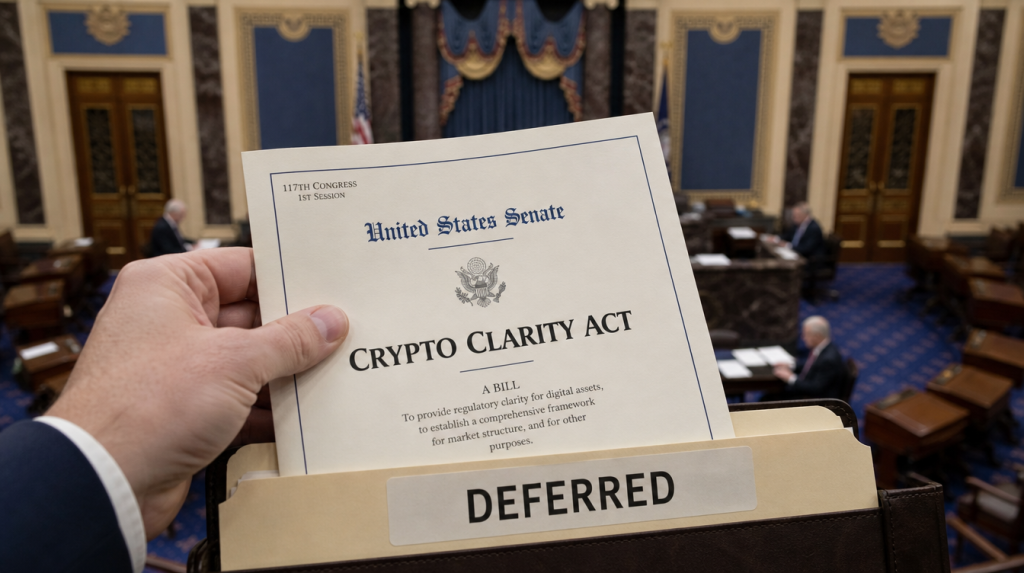
For now, the U.S. Senate has set aside the Digital Asset Market Clarity Act as it focuses on other matters, including Russian sanctions and federal nominations. This shift further delays progress on the crypto sector’s primary legislative effort and limits its chances within an already packed Senate schedule.
Majority Leader John Thune began pushing forward a slate of nominations on Monday and is expected to turn to a Russia sanctions bill by Tuesday evening, initiating the cloture process. Because Senate rules involve multiple procedural steps and waiting periods—and typically allow only one contested bill at a time—it’s unlikely the Clarity Act will move forward until these issues are resolved, which could take several days.
The Russia sanctions bill targets the country’s leadership and includes tariffs on its trading partners. It has also been dedicated to the late Senator Lindsey Graham, a key supporter. His funeral, taking place this week in Washington and South Carolina, is expected to occupy much of the Senate’s attention on Tuesday and Wednesday.
In practical terms, the Clarity Act is unlikely to reach a vote before next week, just days ahead of the Senate’s summer recess beginning August 8. Even then, the bill is not fully ready, as lawmakers continue negotiating a controversial provision that would restrict senior government officials—including former President Donald Trump—from supporting crypto ventures.
Although Thune has expressed interest in addressing the Clarity Act before the recess, he has indicated that progress depends on whether there are enough votes to move it forward.
At this stage in the legislative calendar, floor time is extremely limited, and key disagreements—particularly around government ethics—remain unresolved. These ongoing disputes could reduce the likelihood of the bill becoming law in 2026, potentially leaving the crypto industry uncertain about the timeline for U.S. regulation.
If the Clarity Act fails to pass, the industry may instead rely on other efforts for regulatory clarity, such as the implementation of the GENIUS Act or ongoing rulemaking by the Securities and Exchange Commission (SEC) and the Commodity Futures Trading Commission (CFTC).
For now, the best-case scenario in the Senate may be to push the bill into the cloture process just before lawmakers leave for recess.
Although a similar version of the bill has already advanced in the House of Representatives, the Senate has historically been the bigger obstacle. Earlier delays stemmed from disagreements between the crypto industry and banks over stablecoin yields, eventually leading to a compromise limiting reward structures. More recently, the focus has shifted to restrictions on government officials’ involvement in crypto.
Last week, there appeared to be progress on the ethics provision when Trump signaled willingness to accept limits on his crypto activities. While the White House framed this as a significant step, Democrats argued the restrictions were insufficient. Despite this, negotiations are ongoing.
Lawmakers will return in September for a short session, but time will be tight. After the November elections, Congress enters its “lame duck” period, which can either produce last-minute legislation or stall due to political gridlock.
Even if the Senate approves the Clarity Act, it must return to the House for final passage, where internal disagreements have recently slowed legislative progress. If both chambers pass the bill, it would then go to the president for signature.
However, President Trump has recently declined to sign unrelated bipartisan legislation, insisting that Congress first address voter-identification requirements ahead of the midterm elections. While he has urged completion of the Clarity Act, it remains uncertain whether he would sign it. If the president takes no action within 10 days, the bill would automatically become law.
About The Author





More Stories
Bond Volatility Surges as Bitcoin and Wall Street Remain Calm
Altcoins Surge as Bitcoin Holds Near $84,000
Bitcoin ETF Flows Turn Positive in 2026 After Erasing $5.8B Deficit