

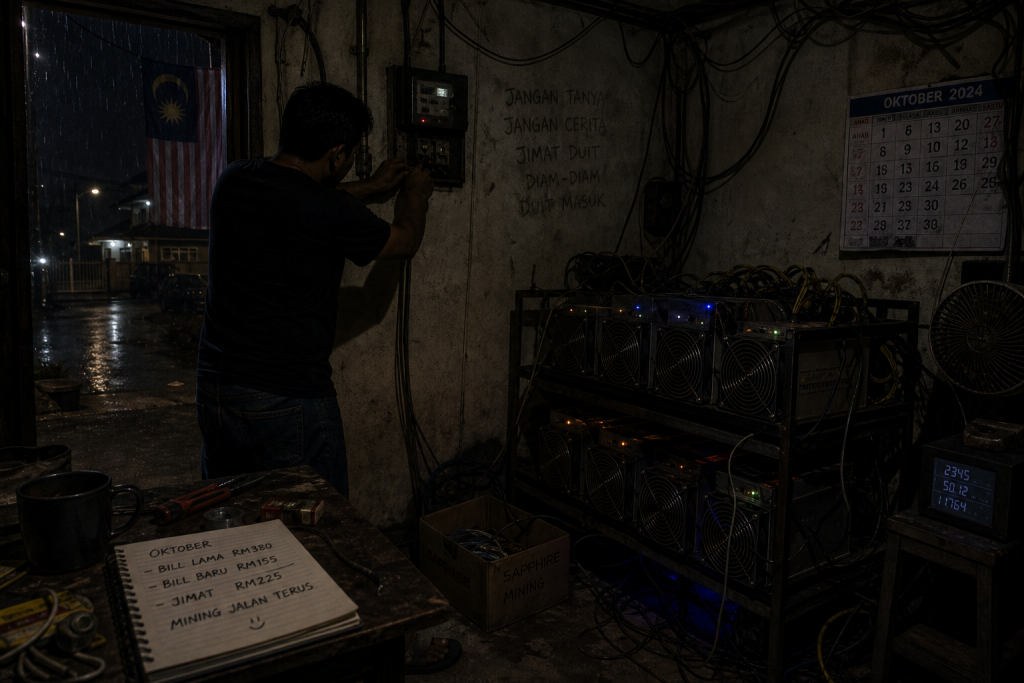
In today’s Bitcoin news, Malaysian authorities dismantled a crypto mining syndicate after conducting four coordinated raids on July 22 and 23. The operation, led by Tenaga Nasional Berhad (TNB), targeted four rented locations.
During the crackdown, police arrested three Malaysian men and confiscated 71 cryptocurrency mining machines. The group is believed to have generated monthly profits ranging between RM80,000 and RM100,000 (approximately $25,000).
The operation, known as Ops Letrik, highlights the ongoing profitability of illegal mining activities in Johor. By stealing electricity, the syndicate significantly reduced operational costs, turning an otherwise marginal business into a highly lucrative one—while TNB bore the financial losses.
This development comes as Bitcoin (BTC) declined by 0.4% over the past 24 hours, falling to $65,300 after dropping below the $66,000 mark. At present, the $65,000 level is acting as key support.
How the Johor Syndicate Operated
The raids were carried out by the Johor Contingent Police Headquarters’ Criminal Investigation Department (D4) in partnership with TNB’s Southern Region SEAL team.
Authorities targeted three residential properties and one commercial shophouse located in Iskandar Puteri, Johor Bahru Utara, and Kulai. Each site was rented for between RM5,000 and RM6,000 per month, with investigations into the rental agreements still ongoing.
The syndicate used a direct tapping method, bypassing official TNB meters through illegal wiring to access electricity without payment. This allowed their mining operations to run continuously without incurring energy costs.
In just about a month before the raids, the stolen electricity resulted in losses of RM67,502.30 for TNB. Meanwhile, the syndicate earned multiple times that amount in Bitcoin revenue, highlighting the high profit margins enabled by power theft.
Items seized during the operation included 71 mining rigs, two desktop computers, two laptops, five routers, two monitors, two keyboards, a mobile phone, and two vehicles.
Johor police chief Datuk Ab Rahaman Arsad stated that one suspect acted as the manager overseeing all locations, while the other two served as technicians responsible for installing and maintaining the equipment.
Initial findings suggest the syndicate generated between RM80,000 and RM100,000 monthly, while the individuals involved were reportedly paid around RM5,000 each.
The suspects, aged between 26 and 46, have been remanded until July 26. Authorities are continuing efforts to identify and apprehend additional individuals connected to the network.
Legal Risks and Enforcement in Johor
The case is being investigated under Section 427 of the Penal Code, which covers criminal mischief and carries penalties of one to five years’ imprisonment, fines, or both. It also falls under Section 37(1) of the Electricity Supply Act 1990, which addresses tampering with electrical installations and carries fines of up to RM100,000, imprisonment of up to five years, or both.
While the legal penalties are significant, they may not fully deter such activities given the scale of potential profits. As a result, Malaysian authorities have intensified enforcement efforts rather than relying solely on legal consequences.
From January 2025 to June 2026, Johor police conducted raids on 16 locations linked to illegal mining, seizing 158 machines and recording nearly RM1 million in losses for TNB.
The July 22–23 operation alone resulted in losses of RM67,502.30 and the seizure of 71 machines, reflecting a pattern consistent with earlier cases.
Malaysia’s Ongoing Electricity Theft Issue
More broadly, the Johor case is part of a nationwide effort to combat illegal crypto mining. Unlike smaller-scale incidents seen elsewhere, Malaysia faces a widespread and organized problem involving significant abuse of the national power grid.
The economics behind these operations are straightforward. Legal Bitcoin mining requires paying high electricity costs, which can quickly erode profits—especially as mining difficulty increases.
By illegally tapping electricity, operators eliminate their primary expense, making even marginal operations highly profitable regardless of market conditions. This explains why such activities persist despite repeated enforcement actions.
In contrast, legitimate Bitcoin businesses operate transparently, managing both costs and market risks. Illegal syndicates, however, shift their biggest expense—electricity—onto public infrastructure.
Authorities in Johor confirmed they are still tracking additional suspects, indicating the syndicate may be part of a larger network beyond the three individuals currently in custody.
About The Author





More Stories
Bond Volatility Surges as Bitcoin and Wall Street Remain Calm
Altcoins Surge as Bitcoin Holds Near $84,000
Bitcoin ETF Flows Turn Positive in 2026 After Erasing $5.8B Deficit