

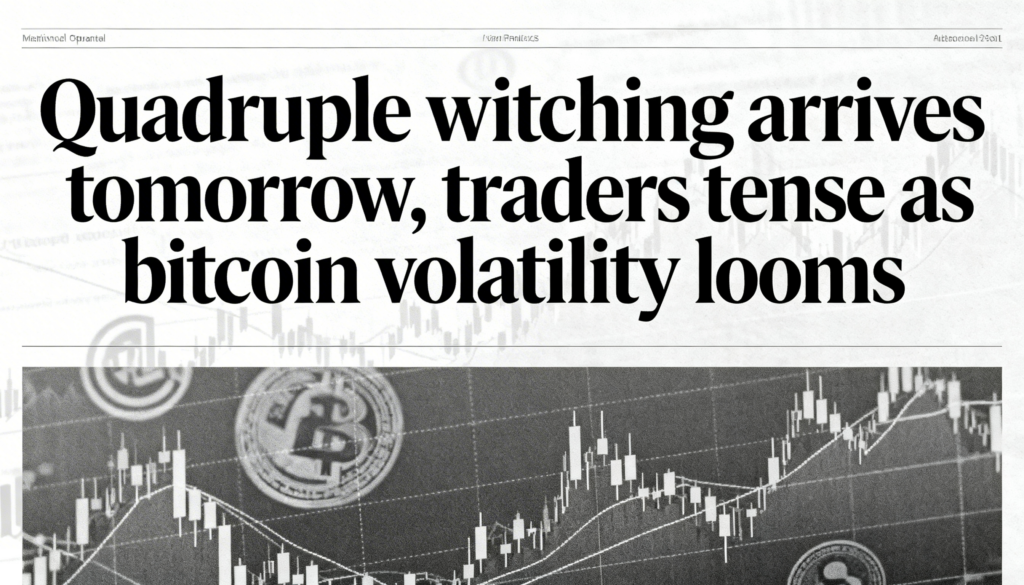
Global markets are approaching Friday’s quadruple witching event, a major quarterly derivatives expiry that could shape bitcoin’s near-term price action.
Held on the third Friday of March, June, September and December, the event marks the simultaneous expiration of stock index futures, stock index options, single-stock options and single-stock futures. The alignment typically leads to a surge in trading activity as positions are closed or rolled, often amplifying volatility in equities.
Although final figures for March 2026 are not yet available, previous data underscores the scale. In March 2025, roughly $4.7 trillion in contracts expired, with the session recording the highest S&P 500 trading volume of the year, according to TradeStation.
Large expiries often force institutional investors to rebalance portfolios, unwind hedges and adjust exposure within a short window. This activity tends to intensify into the closing hours, when liquidity peaks and price swings can accelerate.
This quarter’s event comes amid an already fragile macro backdrop. Tensions in the Middle East have pushed oil prices toward $120 per barrel, while gold has slipped below $4,600 and bitcoin has fallen under $69,000. At the same time, the VIX volatility index has climbed above 35, its highest level in a year, reflecting elevated market stress.
While quadruple witching originates in traditional markets, its impact can extend into crypto. Bitcoin’s increasing correlation with equities means sharp moves in risk assets can spill over into digital markets.
According to Volmex Finance CEO Cole Kennelly, the event could trigger a rise in cross-asset volatility, with the Bitcoin Volmex Implied Volatility (BVIV) Index already trending higher ahead of the expiry.
Historical patterns suggest bitcoin tends to show limited movement on the day itself, with more meaningful price action emerging afterward.
Following last year’s March expiry, bitcoin remained relatively stable initially before weakening in the weeks that followed. A similar trend was observed in June, where a modest decline on the day was followed by further downside shortly after.
In September, bitcoin again posted only a small move during the event, but experienced a sharper drop in the following week. December’s expiry saw prices rise on the day, though the broader trend remained negative.
Overall, the data points to a recurring pattern: muted price action during quadruple witching, followed by weakness in the days to weeks after.
Even if Friday’s event proves uneventful, crypto markets face another key trigger soon after. On March 27, roughly $13.5 billion in bitcoin options are set to expire on Deribit, with current positioning suggesting a preference for volatility trades over directional bets.
About The Author





More Stories
Bitcoin Starts New Quarter Stuck in Familiar $82K-$85K Range
Citigroup Lifts 12-Month Bitcoin Target to $113K as ETF Inflows Return
Bitcoin’s Inflation-Fueled Jump to $85.5K Fades as Yields Stay High