

A new study from the Cambridge Centre for Alternative Finance finds that the infrastructure supporting Bitcoin is far more robust than previously believed, with growing adoption of Tor helping strengthen the network’s resilience.
Bitcoin has operated continuously since its launch in 2009, but until recently there had been little comprehensive analysis of how vulnerable the system might be to real-world infrastructure disruptions.
To address that question, Cambridge researchers conducted a long-term study examining 11 years of peer-to-peer network data alongside 68 confirmed submarine cable failures worldwide.
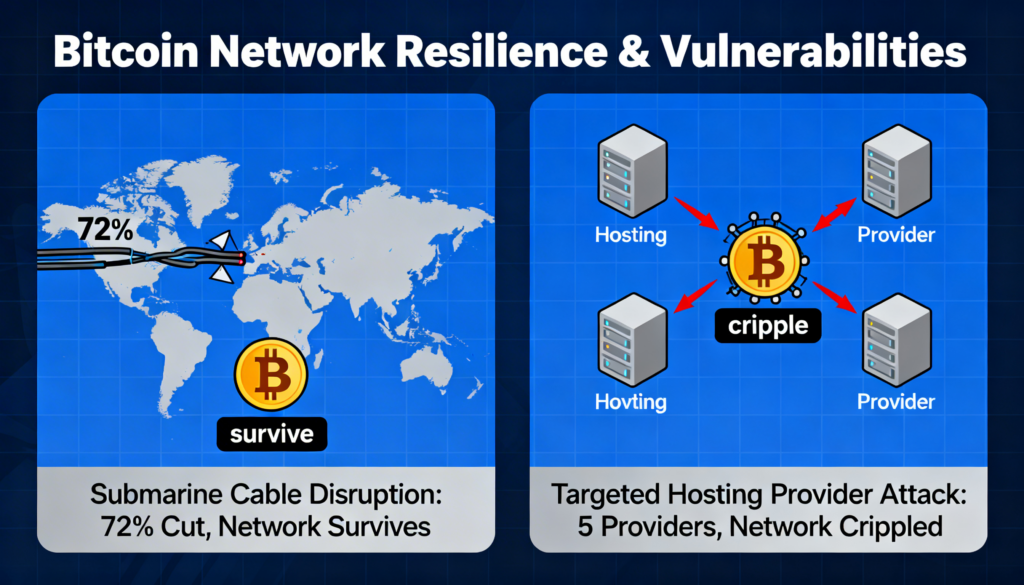
Their analysis shows that between 72% and 92% of global inter-country submarine cables would need to fail simultaneously before Bitcoin begins experiencing meaningful levels of node disconnection.
At a time when infrastructure risks are gaining attention — particularly amid disruptions affecting key maritime routes such as the Strait of Hormuz — the findings offer one of the first empirical measures of how difficult it would be to disrupt the Bitcoin network.
Random disruptions have little effect
The research suggests Bitcoin’s infrastructure tends to degrade gradually rather than collapse during disruptions.
Using 1,000 Monte Carlo simulations across multiple scenarios, the study found that random cable outages generally have minimal impact on the network. More than 87% of the 68 real-world cable failures examined affected fewer than 5% of nodes.
The most significant incident occurred in March 2024, when seabed disturbances near Côte d’Ivoire damaged seven to eight submarine cables simultaneously. Although about 43% of nodes in the affected region were temporarily disrupted, only five to seven Bitcoin nodes worldwide were affected — roughly 0.03% of the network.
Researchers also found almost no correlation between cable failures and Bitcoin’s market price, with a statistical correlation of about -0.02, suggesting such infrastructure incidents are largely invisible amid normal price fluctuations.
Targeted attacks could pose a bigger risk
The study highlights a stark contrast between random disruptions and deliberate attacks.
While random cable failures would require the loss of most of the world’s submarine cables to cause significant disruption, a targeted attack on cables with the highest “betweenness centrality” — key links connecting continents — could reduce the failure threshold to roughly 20%.
The analysis also points to potential concentration risks within hosting infrastructure. Disrupting the five largest hosting providers supporting Bitcoin nodes — Hetzner, OVH, Comcast, Amazon Web Services and Google Cloud — could generate similar disruption by removing just 5% of global routing capacity.
This distinction reflects two different threat models. Natural disruptions such as cable breaks pose limited systemic risk, while coordinated actions targeting infrastructure providers or key cable routes could represent a more credible challenge.
Bitcoin’s resilience has evolved
The researchers also examined how Bitcoin’s resilience has changed over time.
Between 2014 and 2017 the network was at its most resilient, when nodes were widely distributed geographically and the critical failure threshold reached around 0.90–0.92.
Resilience weakened during 2018–2021 as the network expanded rapidly but became more geographically concentrated, particularly during the peak of mining activity in East Asia. The threshold fell to roughly 0.72 in 2021.
Following the crypto mining crackdown in China that same year, miners and nodes redistributed globally. The network’s resilience recovered to around 0.88 in 2022 before stabilizing near 0.78 by 2025.
Tor adoption strengthens the network
One of the study’s more unexpected findings involves the growing role of Tor.
By 2025, approximately 64% of Bitcoin nodes were operating through Tor, which hides their geographic location.
Some analysts previously speculated that obscured node locations might conceal geographic concentration and therefore increase vulnerability. However, the study’s four-layer network model found the opposite.
Tor relay infrastructure is heavily concentrated in highly connected European countries such as Germany, France and Netherlands — regions with extensive submarine cable networks and cross-border connectivity.
Because these countries are difficult to isolate from global networks, disrupting Tor relay infrastructure through cable cuts would be significantly more challenging. The study found that Tor increased Bitcoin’s resilience threshold by 0.02 to 0.10 compared with a network relying solely on standard internet connections.
Researchers describe this process as “adaptive self-organization.”
Tor adoption accelerated following censorship events such as the 2019 Iranian Internet shutdown, the 2021 Myanmar coup and China’s mining ban.
Without centralized coordination, the Bitcoin ecosystem gradually shifted toward more censorship-resistant infrastructure — changes that also made the network physically harder to disrupt.
With geopolitical tensions and infrastructure vulnerabilities increasing around key global transit routes like the Strait of Hormuz, questions about the impact of submarine cable damage on digital networks have become more relevant.
However, the study suggests that Bitcoin would likely continue operating through most such disruptions unless attackers deliberately targeted the specific cables and hosting providers that act as critical global chokepoints.
About The Author





More Stories
Bitcoin Starts New Quarter Stuck in Familiar $82K-$85K Range
Citigroup Lifts 12-Month Bitcoin Target to $113K as ETF Inflows Return
Bitcoin’s Inflation-Fueled Jump to $85.5K Fades as Yields Stay High