

Investor caution is intensifying ahead of Tuesday’s market open as Middle East tensions continue to rattle global markets, driving a clear shift toward risk-off assets.
Now in its fourth day, the conflict is fueling volatility during pre-market trading, with investors moving into the U.S. dollar and closely watching energy markets.
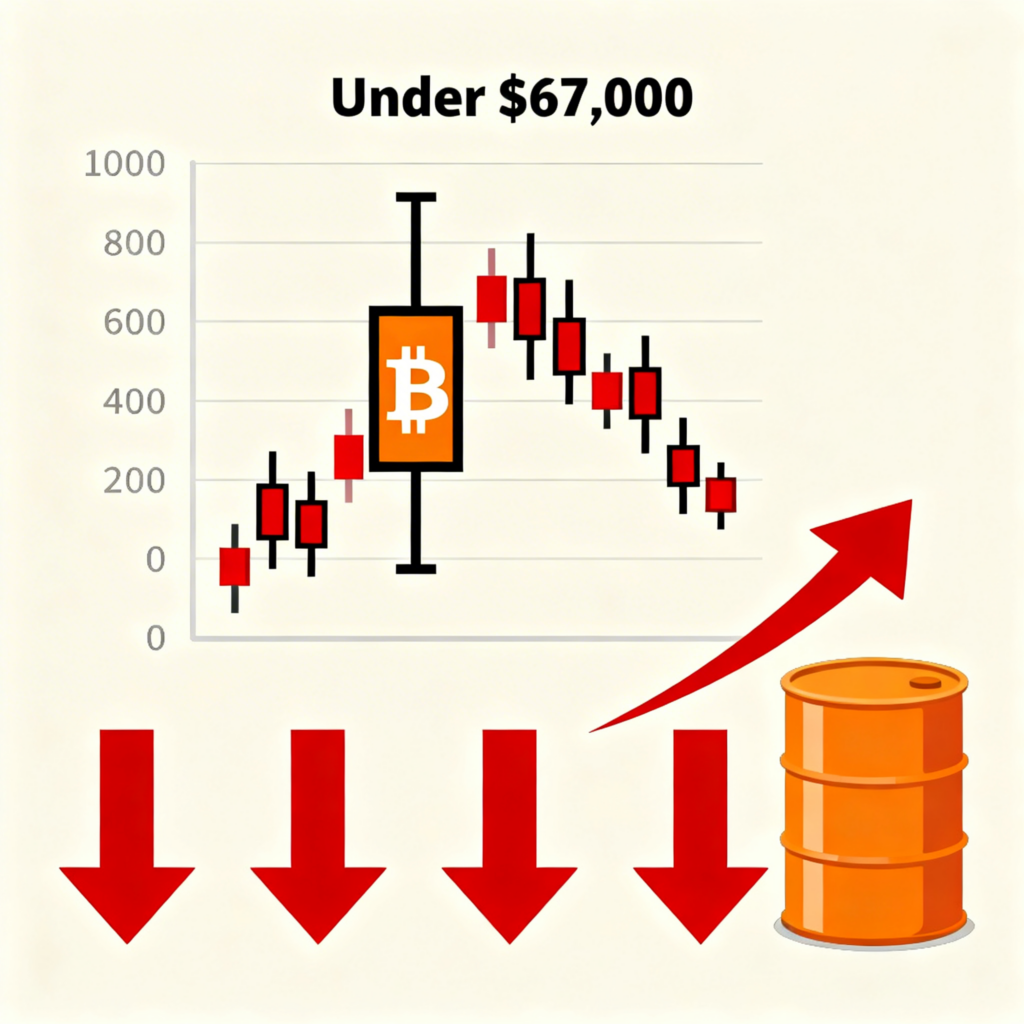
Bitcoin has dropped roughly 3% over the past 24 hours, slipping below $67,000 after briefly touching $70,000 on Monday. Equities are also under pressure: the Invesco QQQ ETF finished Monday slightly higher but is down about 2% in pre-market trading.
Precious metals are retreating as well. Gold remains above $5,300 per ounce, while silver has fallen about 4% to near $85 per ounce.
Energy markets are climbing, with WTI crude oil trading above $74 per barrel—up 5% over the past 24 hours and approaching Sunday’s futures highs just above $75.
The U.S. dollar is strengthening, with the DXY index surpassing 99, marking its highest level since Jan. 20, as investors seek safety amid market uncertainty.
Treasury yields are trending higher across the curve. The 10-year U.S. Treasury yield is holding above 4% and edging toward 4.1%, reflecting persistent rate pressures.
Crypto-related equities are tracking bitcoin’s decline. Strategy (MSTR), the largest publicly traded corporate holder of bitcoin, is down about 2%. Coinbase (COIN) has dropped 5%, Galaxy Digital is off 3%, and AI-focused miners IREN (IREN) and Cipher Digital (CIFR) are each down roughly 4% in early trading.
About The Author





More Stories
Bitcoin Starts New Quarter Stuck in Familiar $82K-$85K Range
Citigroup Lifts 12-Month Bitcoin Target to $113K as ETF Inflows Return
Bitcoin’s Inflation-Fueled Jump to $85.5K Fades as Yields Stay High