

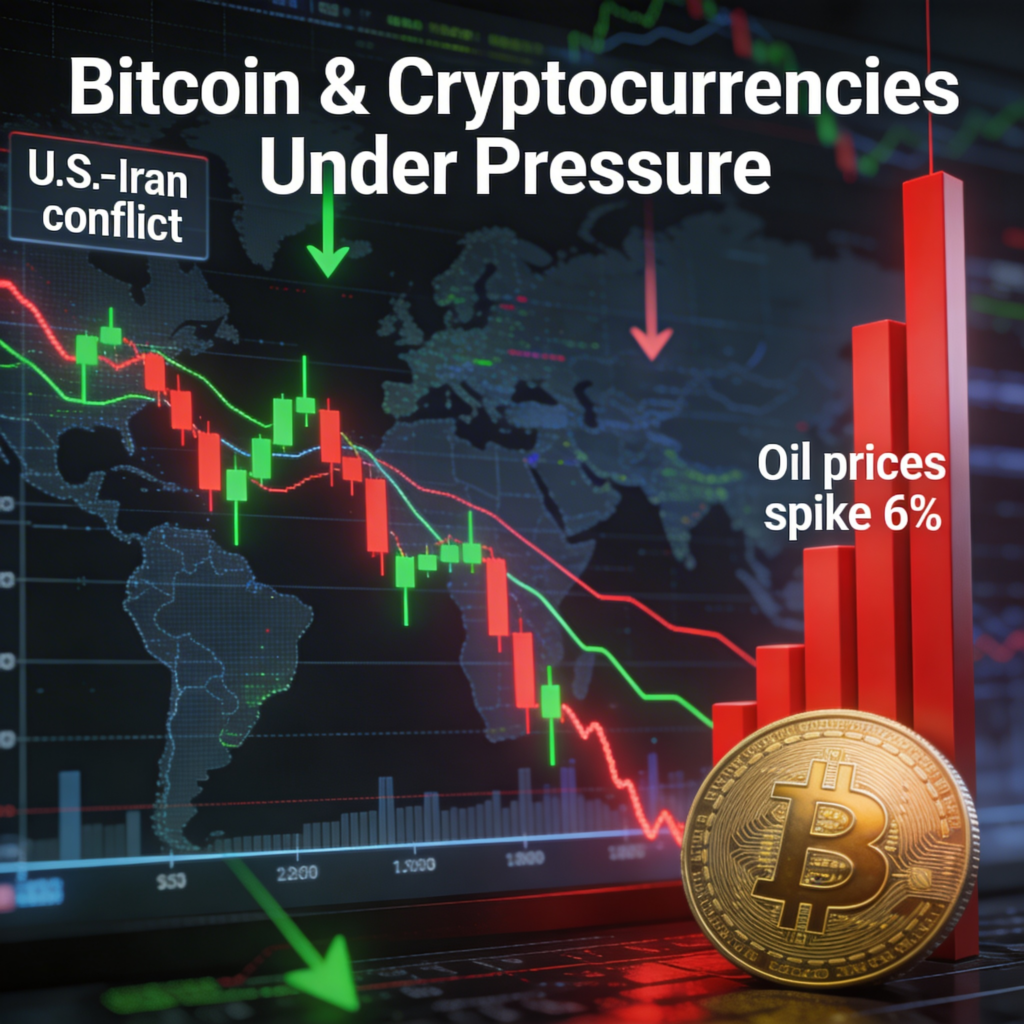
Bitcoin slipped back toward $66,700 on Monday as global markets reopened and began digesting the weekend’s escalation between Washington and Tehran. Oil prices surged while equities across Asia declined, reinforcing a broad risk-off mood.
The leading cryptocurrency traded at $66,702 in early hours, down 1.1% over the past 24 hours. Digital assets had been reacting independently since Saturday, but the return of traditional markets introduced fresh volatility. A short-lived jump to $68,000 on Sunday — following statements from Iran’s Supreme Leader, Ali Khamenei — has largely reversed, with Bitcoin settling back into the mid-$66,000 range seen before the military action.
Major altcoins also weakened. Ether fell 2.5% to $1,967, solana declined 4.1% to $84, and XRP dropped 3.6% to $1.36. On a seven-day basis, solana has led losses among large-cap tokens, down 8.1%.
Energy markets delivered the sharpest reaction. Brent crude initially spiked as much as 13% before easing to around $77.50, still up 6.4% — its steepest rise since Russia’s 2022 invasion of Ukraine. According to Bloomberg, the Strait of Hormuz — a critical route that handles roughly 20% of global oil shipments — is effectively closed. Asian stocks fell 1.4%, U.S. equity futures dropped 0.7%, and gold climbed to $5,350 per ounce.
The surge in oil prices could prove pivotal for crypto. Higher energy costs tend to fuel inflation expectations, which in turn may delay potential interest rate cuts from the Federal Reserve. Tighter liquidity conditions historically weigh on risk-sensitive assets such as cryptocurrencies.
Meanwhile, diplomatic signals remain inconsistent. The Wall Street Journal reported that Iran may be exploring renewed nuclear talks with the United States. However, Iran’s national security chief, Ali Larijani, publicly rejected the prospect of negotiations. U.S. President Donald Trump said military operations would continue until objectives are achieved, though The Atlantic reported he is open to discussions with Iran’s new leadership.
Despite heightened volatility, some market participants see limited downside for digital assets. Jeff Mei, chief operating officer at BTSE, argued that Iran’s long-standing isolation from global financial systems reduces the risk of broader financial contagion. While rising oil prices are a concern, he noted that increased production from OPEC and the U.S. could help stabilize supply.
Ultimately, the market’s direction may hinge on whether the Strait of Hormuz reopens and how prolonged the military campaign becomes. Until clearer signals emerge, cryptocurrencies are likely to trade in line with broader macro risk sentiment in an increasingly uncertain environment.
About The Author




More Stories
Bitcoin Starts New Quarter Stuck in Familiar $82K-$85K Range
Citigroup Lifts 12-Month Bitcoin Target to $113K as ETF Inflows Return
Bitcoin’s Inflation-Fueled Jump to $85.5K Fades as Yields Stay High