

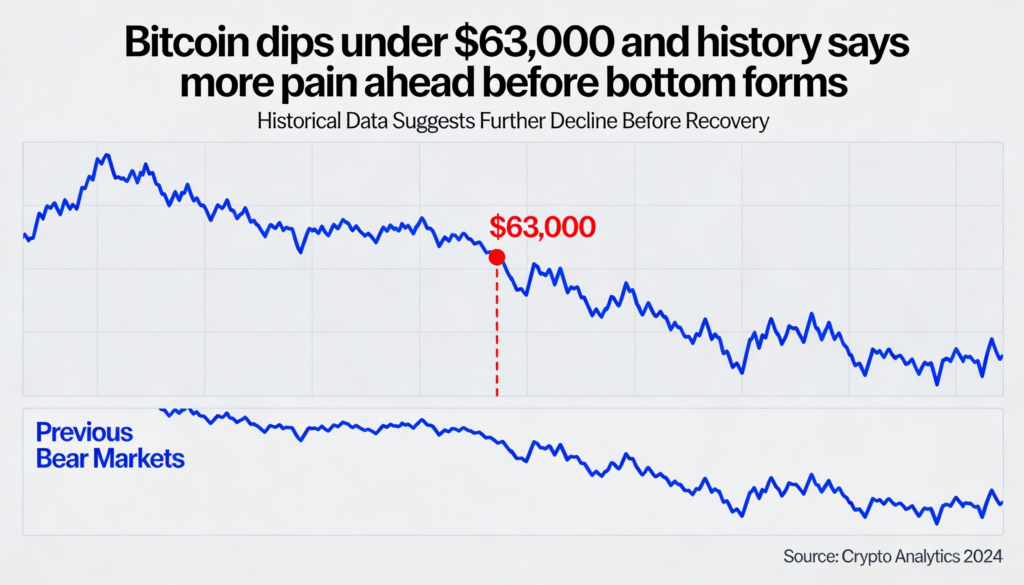
Bitcoin deepened its pullback during Asian trading hours, sliding below $63,000 as renewed tariff tensions and persistent AI-related volatility dampened investor sentiment.
The cryptocurrency is now down nearly 7% on the week, hovering around levels last seen on Feb. 6, when prices briefly approached $60,000, according to CoinDesk data. The latest move comes as markets digest fresh policy signals from President Donald Trump and broader geopolitical uncertainty.
Matt Howells-Barby, vice president at Kraken and host of Trading Spaces, said bitcoin’s drop mirrors the risk-off tone seen in equities. He attributed much of the pressure to renewed tariff uncertainty reminiscent of April 2025 and warned that escalating geopolitical strains could weigh further on BTC in the near term.
He identified $60,000 as a key technical support. A decisive break below that level, he said, could expose bitcoin to a deeper correction into the mid-to-low $50,000 range.
U.S. stocks also retreated after Trump announced plans to impose temporary 15% tariffs on imports, an increase from the 10% rate previously outlined, following a ruling by the Supreme Court of the United States that struck down his earlier tariff framework. Meanwhile, investors continued to reduce exposure to companies perceived as vulnerable to AI-driven disruption.
Moving Averages Signal the Downturn May Not Be Over
Long-term technical indicators suggest bitcoin may not yet have reached a cyclical bottom. In prior bear markets — including those in 2018 and 2022 — BTC did not establish a durable low until its 50-week moving average crossed below its 100-week moving average, a formation known as a “bear cross.”
That crossover has yet to occur in the current cycle, with the 50-week average still trending above the 100-week.
If historical trends are any guide, bitcoin could face further downside, potentially revisiting the $50,000 region or lower before a final capitulation phase unfolds. Analysts speaking at industry gatherings in Hong Kong have similarly suggested that additional weakness cannot be ruled out.
Although a bear cross may appear to confirm deteriorating momentum, moving averages are lagging indicators. Historically, the crossover has marked the latter stages of prolonged downturns rather than predicted them in advance.
Still, technical signals offer probabilities — not certainties — and past patterns do not guarantee future outcomes.
About The Author





More Stories
Bitcoin Starts New Quarter Stuck in Familiar $82K-$85K Range
Citigroup Lifts 12-Month Bitcoin Target to $113K as ETF Inflows Return
Bitcoin’s Inflation-Fueled Jump to $85.5K Fades as Yields Stay High